

Living on the Road Q&A
I am super excited to announce that I will be co-hosting season three of the Occupation Wild Podcast with Courtney Condy. The season has already kicked off with a question and answer session around photography, van life, how to make money while living on the road, and so much more! Below is the link to the first episode.
I am super excited to announce that I will be co-hosting season three of the Occupation Wild Podcast with Courtney Condy. The season has already kicked off with a question and answer session around photography, van life, how to make money while living on the road, and so much more! Below is the link to the first episode.
Podcast Link:
https://podcasts.apple.com/us/podcast/episode-81-season-3-q-a/id1470422711?i=1000566320935
more below…

Living on the road increases your opportunity and access to nature, like backpacking in the Eastern Sierra. Photograph by Dalton Johnson
Questions Courtney and I attempted to answer:
What was your guys biggest inspirations for living life this way? Living non traditional lives?
How did you pick a new cohost? Was this a job that you were hiring for?
How do you pick which location to work? There are so many and it seems overwhelming on the site
How do you get hired as a photographer?
What are your favorite outdoor docs or books?
Do you think majoring in photography helps? Or does college not matter?
Getting started when you are over 40!
You should put yoga jobs on here!!
Why don’t you work with brands? Is there a reason?
How to go about retirement/ savings, etc money and insurance with this lifestyle
How hard is it to get a working visa for the US (i’m from Australia)
For Dalton: Do you pick locations? Do brands tell you where to go or do you decide?
Do you recommend traveling sola or traveling with a friend or significant other?
I just realized you don’t live in the mountains? Why is that? I feel like that’s unusual for the outdoor industry
What is the shortest amount of time companies have? My other job doesn’t give me much time off
How do you start as a creative? How do you find confidence to put yourself out there
I’ve been following OW from the start! How have you been able to grow it so fast?
What camera do you use?
Fav part about traveling or adventuring?
Tips about starting your own business?
What would you do if you just graduated from college?
What do brands look for when hiring photographers?
Why don’t all the jobs come with housing?
Living this type of life with kids?
All of these questions came from you all, so thank you very much for submitting your questions. If you have any more questions, or want to learn more, please shoot me a direct message on Instagram.
Reach out, give us a follow, and go live your life!

Baja Mexico Bucket List Ideas with Travel Trips
Looking for travel ideas in Baja, Mexico? Well, you are in the correct place. I have traveled through Baja, Mexico over 30 times in search of adventures. Throughout the experiences, there have been many take aways, but the most important is to be open. Traveling in Baja is much slower than the US, the people are friendlier, and the landscape is uninhabited in comparison. While you do not need to know Spanish, if you know the basics, you’ll be happier. Below you will find a bucket list of adventure travel ideas for your travels to Baja, Mexico.
Looking for travel ideas in Baja, Mexico? Well, you are in the correct place. I have traveled through Baja, Mexico over 30 times in search of adventures. Throughout the experiences, there have been many take aways, but the most important is to be open. Traveling in Baja is much slower than the US, the people are friendlier, and the landscape is uninhabited in comparison. While you do not need to know Spanish, if you know the basics, you’ll be happier. Below you will find a bucket list of adventure travel ideas for your travels to Baja, Mexico.
If you are building out a bucket list for Baja, Mexico, look no further. Here are the best adventures of Baja Mexico:
Surf in Baja Sur
Snorkel, or SCUBA dive, in the Sea of Cortez
Fish with the locals of San Juanico
Hike to the abandoned Sugar Port in todos santos
Spearfish in Canejo
Eat Pan Dulce from the oldest bakery in Baja
Release turtles in Todos Santos
Paraglide in La Ventana
Soak in Hot Springs on the Beach
Surf in baja sur
Okay, surfing everywhere might be an exaggeration as the Sierra de la Lagunas don’t have much water, but if you are along the coast, you should be able to find a place to surf… eventually. While traveling throughout along dirt roads you’ll find there are still secret surf spots all throughout Baja. But, there are also a ton on Surfline so, if if it is your first visit, start with Surfline. As you become more familiar with the language and places, you’ll find some epic surf, maybe even find your own breaks!
Want to discover more surfing in Baja? I wrote a full article on the best surf spots of Northern and Southern Baja, click here to check out the article.
Snorkeling in Baja, Mexico while road tripping along the Sea of Cortez. Photograph by Dalton Johnson
Snorkel, or SCUBA dive, in the Sea of Cortez
When you are road tripping along the Baja Peninsula, some essential gear is a snorkel mask and fins. Why? Well, Jacques Cousteau, the famous French Naval Officer and early SCUBA pioneer called the Sea of Cortez, “the next great barrier reef”, because of the diversity in life swimming in the Sea of Cortez. If he put a stamp of approval on this body of water, it must be good. If that isn’t good enough for you, go check out Blue Planet’s episode on the Oceans, they feature a good amount of the Sea of Cortez.
Fishing with locals in San Junaico, Baja Sur while on a road trip through the Baja Peninsula. Photograph by Dalton Johnson
Fish with the locals of San Juanico
One of my favorite opportunities while traveling in Baja has been to fish with the locals. While this sleepy surf/fishing village is known for endless barrels at thirds peak, the locals live on fishing. If you stay in San Juanico, sleeping in your van, you will find out that the surfers are also fisherman. At some point, chat them up or head down to the marina. As you learn names and faces in the surf line-up, you’ll recognize most of them loading their boats in the morning. If you are lucky, you can ask one of them to take you out. If that opportunity arrises, do it!
Wondering how you get to San Juanico?
San Juanico can feel like a tricky town to get to for a vacation because it is 3 hours from the closest airport, but visiting San Juanico is worth it. Below are some of your options for getting to San Juanico:
Click here for driving directions to San Juanico in Baja Mexico
Fly into La Paz airport, drive or take a shuttle from there
Fly into San Jose del Cabo, drive or take a shuttle from there
Want to learn more about what is at San Junaico? I wrote a full article about this amazing fishing town and what it offers, check it out here.
Hiking to the abandoned Sugar Port while road tripping in Baja, Mexico. Photograph by Dalton Johnson
Hike to the abandoned Sugar Port in todos santos
If you are looking for a good leg stretcher while traveling in Baja, Mexico with views of the Pacific Ocean, hiking to the abandoned Sugar Port is a must! This hike takes you to a “secluded” beach, which is growing in popularity. If you arrive around low tide, you can lay on the beach without any worries. However, if the tide is rising, make sure to NOT leave your things on the beach, as the tide might consume them.
Old Port of Todos Santos Hike Overview:
Distance: 4.6 miles round trip
Elevation Gain: 900 feet
Are dogs allowed? Yes, dogs are allowed and welcomed on the Old Port hike
Where is the Abandoned Surgar Port hike in Baja?
If you are looking for a good hike along the beach while you are in Baja Sur make your way to Todos Santos and hike to the abandoned sugar port. Parking for this 5 mile hike is near the Hotel San Cristobal at Punto Lobos.
How long does it take to hike to the old port in Todos Santos Take?
If you are looking to hike out and back, without stopping for a swim, the hike will take you 60-90 minutes. However many hikers will bring a towel and swim in the ocean at the secluded bay. You can also jump off the old dock into the water when the tide is high enough.
Can you swim at the old port of Todos Santos?
When you hike into the Old Sugar Port of Todos Santos, you will find the secluded bay to be welcoming. There is a sand beach that you can walk directly into the water and start to swim. Please note, high tide can sweep away your belongings on the beach, so keep an eye on your stuff. If you decide to explore the old port, you will find there are places you can jump into the water! This makes for a really fun break from your hike.
Spearfishing in Canejo, Baja Sur to catch dinner. Photograph by Dalton Johnson
Spearfish in Canejo
If you have spearfishing gear while traveling in Baja Mexico, you should suit up and hit the waters. While I say Canejo is the spot to go, you can honestly catch your dinner in most spots along the coastline. Fish are ample and as long as you are not in a preserve, you can catch as much as you would like. Have a fish fry, make ceviche, make some sushi, heck… do it all! It’ll taste better in a taco, I promise.
El Canejo has crystal clear, blue water with a flourishing fish community, perfect for spearfishing. The fish diversity ranges drastically, but you will be able to find a fish of your choice if you look long enough. The ocean around El Canejo is exposed to the Pacific Ocean so there can be a strong swell on occasion, making it difficult to reach the deeper water where the fish congregate. There are some local octopus and lobster fisherman, so please do not take from their income.
Other places to spearfish in Baja:
La Ventana
The Cabo Area
The greater La Paz area
San Juanico
Interested in spearfishing in Baja? I wrote up a full article on where to spearfish, the fish you can catch, and so much more here in this article!
Note: Do NOT take any lobsters, this is the local money maker. Also, Gringos are not legally allowed to take lobster!
Releasing turtles in Todos Santos, Mexico. Photograph by Dalton Johnson
Release turtles in Todos Santos
Park your van on the beach and halt your road trip through Baja for a couple of days at Tortugueros Las Playitas just outside of Todos Santos. While this beach might not be the friendliest to swim in or play in, the beach itself is home to the a turtle sanctuary. What feels like daily occurrences throughout the winter, turtles are released at sunset. If you are sleeping at this beach, or just here for an outing, I suggest taking a picnic. You can eat your food, laugh with friends, and hang out while you wait for the turtles to be released. Once the sun sets, the night will get cold, so go crawl back into your van.
Where can you release turtles in Todos Santos?
Just north of the town of Todos Santos you will find a long stretch of beaches that are unpopulated. It is here that Tortugueros Las Playitas has its conservation center with turtle releases.
Directions to Tortugueros Las Playitas
HOW MUCH DOES IT COST to release turtles in todos santos?
There is no cost to release turtles in Todos Santos, however there is an option to donate to the turtle rescue to keep the turtle conservation going.
Learn more about the conservation efforts of turtles in Todos Santos by clicking here.
Ordering Pan Dulce for the road from Baja’s oldest bakery, El Boleo, in Santa Rosalia, Baja Sur. Photograph by Dalton Johnson
Eat Pan Dulce from the oldest bakery in Baja
Okay, I know this isn’t an adventure for-say, but it is a cultural adventure. Walk around the industrial city of Santa Rosalía and make sure to stop at El Boleo. El Boleo is the oldest bakery in Baja, founded in 1901 with the boom of mining. This bakery was founded by the French and still maintains 2 of the 4 original stoves. Kinda Crazy right?! In an ideal world, you would grab some goodies and then head to Conception Bay for a few days to paddle board on the calm water. If you are lucky enough, there will be a red tide and you’ll get to see bioluminescence.
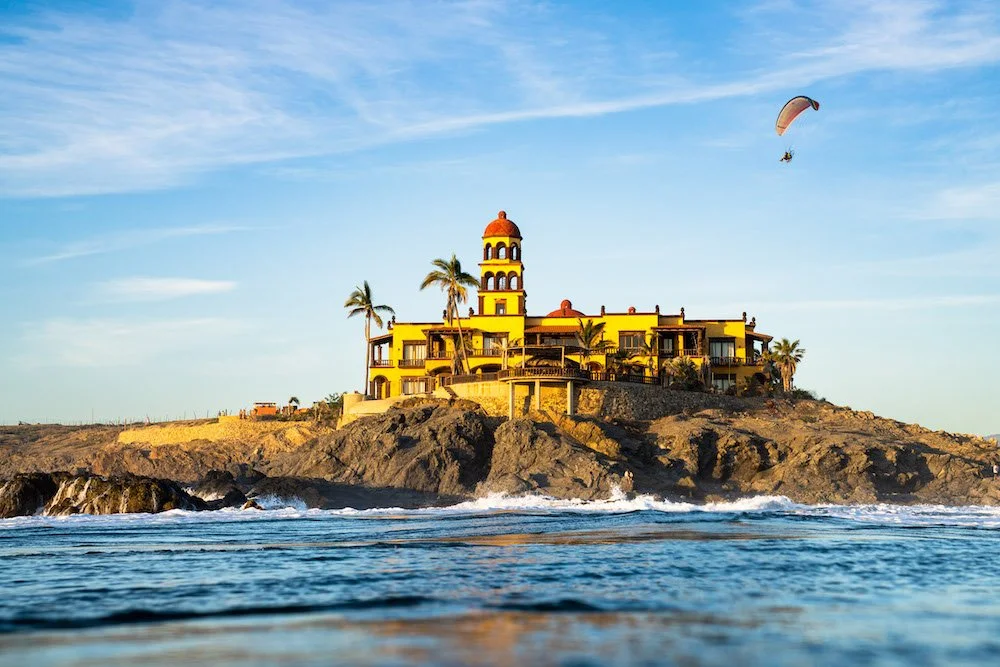
Paragliding in La Ventana, Baja Sur while traveling in a van. Photograph by Dalton Johnson
Paraglide in La Ventana
If you are into kiteboarding, La Ventana is on your radar. However, what you didn’t know is that with the right wind direction, you can go soaring along the cliffs of La Ventana. Yup, that is correct, you can paraglide in La Ventana. Now, the opportunities are few and far between, but if you hang out long enough, you will have the right conditions for a few hours! So, maybe put this on your ideas list, pack your wing, and just hope that along your Baja Mexico travels you will be able to fly.
Side note, there are several spots throughout Baja to fly. If you are into it, I suggest packing your wings!
What else can you do in La Ventana?
La Ventana is a hot spot for action sports in Baja Sur with several guide services that can teach you just about anything. Here are some of the incredible activities you can do in Todos Santos:
Kiteboard
Foilboard
Surf
SCUBA dive
Snorkel
Hike
Trail Run
Beach Camp
Off-road into the mountains
Sea Kayak
The best star gazing while road tripping Baja was in Catavina. Photograph by Dalton Johnson
Sleep under the stars in Cataviña
While driving through the Baja peninsula, you’ll come across a gap, without gas stations, of about 200 miles. Now, this place isn’t great to break down, run out of water or gas, etc. BUT, Cataviña is a wonderful place to take photographs of the stars, watch the Baja 1000, and escape the world. There is NO cell service and the light pollution is minimal. Additionally, there is a bunch of wildlife that lives among the variety of cactus in this remote part of Baja. If you can, I suggest stopping for a night, or two, to take in a landscape as pristine (once you are away from the graffitied rocks and trash from the highway) as Cataviña.
Where is Catavina?
Catavina is a small town in the middle of Baja Norte most known for being a gap, of roughly 200 miles, without fuel. This wild and rugged landscape is the perfect spot to stop for a few days and recharge without cell service. The closest towns are El Rosario to the north and El Rosalito to the south.
What is there to do in Catavina?
At first site, Catavina seems like a desolate place with nothing to do, but that is not the case. When you visit Catavina you will find:
Tons of wildlife to photograph
Bouldering
Epic Landscapes
Dirtbike/OHV trails to explore
An oasis that is tucked into a valley
A clear night sky (perfect for taking star photographs | click here to learn how to snap milky way photographs)
Is camping free in Catavina?
Camping in Catavina is free and wild. When I say wild I mean pull off the highway and find yourself a spot to set up wild. For the most part, there is nothing in Catavina and you can camp where ever you would like. With this privilege comes responsibility however. In recent years, Catavina has increased in popularity and campers have started to leave trash behind, let’s not allow this.
If you stop to camp in Catavina, let us leave the place better than we found it and pick up some of the trash that is beginning to accrue. This will help preserve this wild place for others and the wildlife who inhabit the Dr. Suess like landscape.
Soaking in the beach hot springs of La Ventana, Baja Sur. Photograph by Dalton Johnson
Soak in Hot Springs on the Beach
Yup, you read that correctly. There are hot springs on the beach north of La Ventana. If you time the tide correctly, you’ll get to soak in warm water as the waves gentle move in and out of the pools. This beach is called Hot Springs Beach. If you arrive and there are not hot springs, you might have to wait for low tide to expose the pools. If you are there and the pools are covered, pull out your shovel and start digging!
Common questions about Traveling Baja, Mexico:
Where is Baja, Mexico?
Baja is a peninsula just below California.
Do I need to know Spanish to go to Baja?
No. However, if you know the language, the experience will be better!
Driving dirt roads in Baja Mexico. Photograph by Dalton Johnson
Is driving in Baja Mexico safe?
I have spent six months driving around the Baja Peninsula and the roads are safe. Just level set your expectations for a two lane highway without a center divider that has pot holes and a limited shoulder.
Do I need a passport to travel to Baja Mexico?
Yes, Passports are required to enter unless you are a Mexican citizen.
Are the police are corrupt in Baja?
Police are on your side, but bring a few photocopies of your license just in case you find a bad apple. Often, if you are pulled over, you broke a law that you didn’t know existed.
Looking at the days catch from fishing with locals in Todos Santos. Photograph by Dalton Johnson
how much should I expect to spend per day in baja mexico?
If you plan to eat out and drink daily, I would budget $20-40 per person. Common prices for a hotel room are $100-200 per night. The prices in Mexico are increasing, so the sooner you go the better!
How are the road conditions when driving?
Once off the Highways, expect dirt roads
Is baja mexico safe to travel?
For your safety, if you do not go looking for trouble, your typically won’t find it… much like the gangs in the United States.
Discover more of Baja Mexico


Local Tips for Visiting Travertine Hot Spring
Sucking it up, I put my big boy pants on— mainly to avoid being left behind by Kristin—and head to the hot spring. It was my first time here, I didn’t know what to expect and I was blown away. The landscape was cloaked in a orange glow as the light danced down the mountains and across the fields in the distance. Staring out from the warmths of the hot spring, I was proud that we persevered.
First person Experience
Watching las light disappear behind the Sawtooth mountains, Kristin and I snuggled. Tired from a long day of shooting (we were shooting a catalog release for Coghlan’s), we didn’t want to drive back to Tahoe. So, we found a camping spot along a quaint creek, ate some dinner, and made an ambitious plan to dip in Travertine Hot Spring for a sunrise soak, while enjoying the warmth of a fire.
Beep Beep Beep Beep
The morning alarm went off, it was time to get up. “Okay, it’s time! Let’s go!” I said.
“UUHHH! Do we have to? It is cold!” Kristin responds.
“You said this was a dream of yours, let’s get it!”
“Okay… will you make coffee?”
“Sadly, we don’t have time.”
“UHHHH”
Kristin enjoys the sunrise view while soaking in Travertine hot spring near Bridgeport, CA. Photograph by Dalton Johnson
Even though we both didn’t want to, we crawled out from under the covers and got ready. The van felt very cold! We tried to start the heater, but the propane was out. Starting the van and running the heater, I took down the window coverings.
EVERYTHING WAS FROZEN. The windshield and windows were coated, on the inside, with frost! Sometimes, living vanlife can be difficult. Times like these, you are just camping in a metal tent with a bed. However, the lifestyle has done well for me since 2016, so I am not complaining.
As the windshield melted, we got dressed and mentally prepared for the dip.
Driving a short ways, we were warmed up, but once we parked a little bit of internal regret overtook me. It was going to be cold. The van’s thermostat read 18f outside. While I might be a warm blooded California kid, I think 18f is cold for anyone! Especially knowing you are going to be in a swim suit.
Sucking it up, I put my big boy pants on— mainly to avoid being left behind by Kristin—and head to the hot spring. It was my first time here, I didn’t know what to expect and I was blown away. The landscape was cloaked in a orange glow as the light danced down the mountains and across the fields in the distance. Staring out from the warmths of the hot spring, I was proud that we persevered.
Driving directions to Travertine Hot Springs: Travertine Hot Springs, Bridgeport, CA 93517
Free camping near Travertine Hot Spring in Bridgeport, CA. Photograph by Dalton Johnson
Pro Tips when Visiting Travertine:
Free Camping Near Travertine Hot Spring
The land surrounding the thermal springs is Forest Service Land, so you can legally camp for free in any of the pullouts along the back roads. It is primitive camping, with no facilities of any kind, so be prepared to be self-contained. Arrive late afternoon, set up camp, and walk a half-mile for a sunset soak.
Rise Early and Have Travertine to yourself
Rise before daybreak to enjoy the empty pool of your choice before anyone has even turned over in bed. It’ll be all yours for those precious few hours.
Cold Soak and rinse off in clean rivers close by
Make time for a cold soak in any of the nearby rivers (you’ll have to drive) to avoid any issues with bacteria infections. While these are very rare, they are easily avoided with a rinse!
FAQ about travertine hot springs
CAN YOU SWIM IN TRAVERTINE HOT SPRINGS?
Travertine hot springs are a wonderful grouping a naturally occurring hot springs in the Eastern Sierra perfect for soaking and swimming. Some of the pools have been dug out to be made larger, but overall the pools are waist deep and 5-10 feet in diameter. Since there are several pools you can typically find a pool to yourself to swim, or soak, in.
CAN YOU SOAK NAKED IN TRAVERTINE HOT SPRINGS?
When you visit the Travertine Hot Springs in Bridgeport you can soak naked. There will be a mix of clothed and nude soakers, so please be respectful of the company you are in. There is an unspoken ethic, if you are arriving to a pool with clothed people, and you want to soak naked, to ask before stripping naked. This is out of respect. However, if you arrive to a hot spring and have it to yourself, you make the rules!
HOW MANY HOT SPRINGS ARE THERE AT TRAVERTINE HOT SPRINGS?
Travertine Hot Springs has several, 11 pools, that you can soak in. The main pool is immediately in the parking lot, but there are paths which will take you to a grouping of four pools a short walk away. Additionally, there are more pools if you take the path starting behind the bathroom, I like these pools best. In total, I know of 11 pools that are enjoyable to soak in at Travertine Hot Springs.
In the distance while soaking at Travertine you will see the Sawtooth sub-range of the Eastern Sierra mountains. Photograph by Dalton Johnson
If you are up for an adventure, I have heard that there are more pools hidden in the landscape, so if you are up for a challenge, go find one!
ARE TRAVERTINE HOT SPRINGS OPEN DURING THE WINTER?
The Travertine Hot Springs in Bridgeport do not close and remain open for every season. These year round pools are an excelent way to relieve soar muscles after a long day in the mountains. Visiting Travertine Hot Springs during the winter is a great time because you will rarely find other soakers, meaning you will have pool of your choice.
Note: If there is bacteria outbreak, the pools will be closed. This does not happen often.
IS THERE A BATHROOM AT TRAVERTINE HOT SPRINGS?
There is a bathroom at the main parking lot of Travertine Hot Spring. This bathroom is a pit toilet and often has toilet paper. However, I suggest bringing your own toilet paper just in case. There is no way to wash your hands, so bring some hand sanitizer.
Discover More of the Eastern Sierra


How To Pack For Backpacking
The time has come to pack your backpack, hit the trail, and sleep in the dirt. Backpacking is an adventure combining hiking with backcountry camping, so be ready for a deep thigh burn and dirt under your fingernails. Living out of a backpack combined with the lack of conveniences makes backpacking an enjoyable type two activity. In the moment, as you labor up a steep grade, you might question your decision to go on this trip, but as you roast a marshmallow for s’mores and stare out at the Milky Way you’ll cherish those steep grades like a badge of honor. If this is your first backpacking trip, or your 10,000th trip, I promise there will be a nugget of goodness in this article.
Kristin and Abi testing out their sock-hop skills after arriving early to their campsite. Photograph by Dalton Johnson
The time has come to pack your backpack, hit the trail, and sleep in the dirt. Backpacking is an adventure combining hiking with backcountry camping, so be ready for a deep thigh burn and dirt under your fingernails. Living out of a backpack combined with the lack of conveniences makes backpacking an enjoyable type two activity. In the moment, as you labor up a steep grade, you might question your decision to go on this trip, but as you roast a marshmallow for s’mores and stare out at the Milky Way you’ll cherish those steep grades like a badge of honor. If this is your first backpacking trip, or your 10,000th trip, I promise there will be a nugget of goodness in this article.
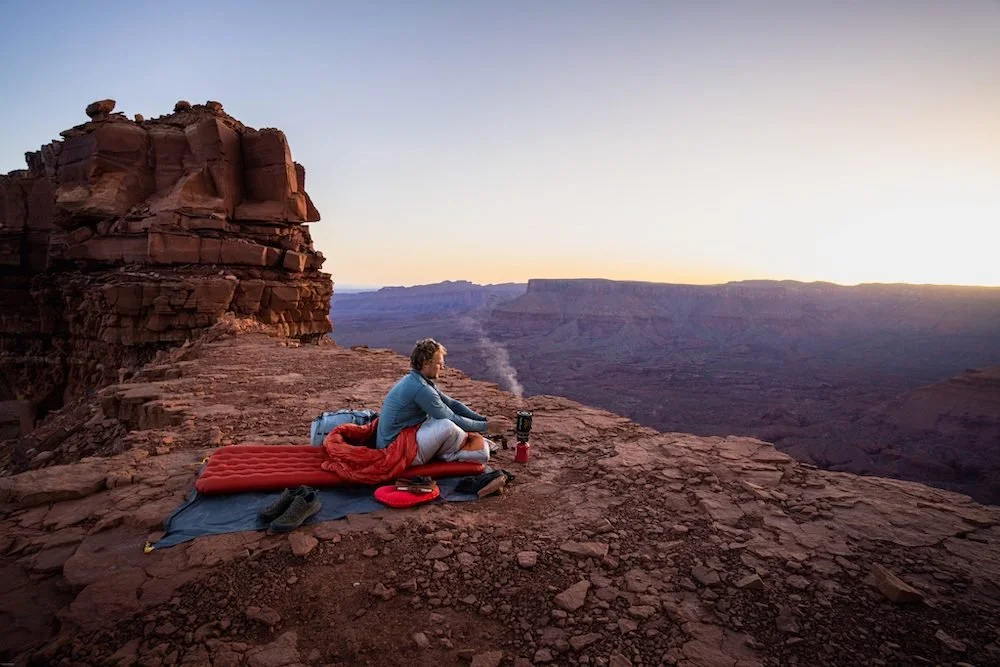
Dalton warms his hands after a solo night cowboy camping in the Utah desert, coffee soon awaits. Photograph by Dalton Johnson
Pick your style: Overnight vs Multiday
Once you know where and when you are going on your backpacking trip, the next step is to decide the style of travel, and comfort, you want while camping in the backcountry. In general, backpacking has two tiers; ultra-light or light. While a few ounces may not seem like much, on a backpacking trip, every ounce counts. The easiest way to decide your style is to select a backpack.
Ultra Light Backpacking and Overnighters (aka light-and-fast)
If I am looking to go ultralight, I’ll bring to a 40-50L backpack, my favorite is the Prospector 50L. Why 40-50L? If I am going ultralight, there is no item in my pack that doesn’t have at least three functions thus my gear can fit in a smaller pack. What I love about the Prospector 50L is the roll top, mesh pockets, and back panel access. As most of my ultralight outing are focused on a peak, or a climb, I appreciate the back panel access to quickly grab climbing gear without creating a yard sale to grab that locking carabiner sitting in the bottom of my pack.
Pros: Lighter, so you can go farther faster, your knees will like you more, you can accomplish a smash and grab mission with a short weather window
Cons: Less frills, you’ll probably eat mostly dehydrated meals, you’ll jump in fewer alpine lakes
Extended Trips and Multidays (aka slow-and-steady)
If I am looking to go the distance, I’ll bring a pack in the 60-65L realm, like the Parkview 63. With the added weight and bulk of the additional gear, I will be moving slower, but I’ll be able to stay on the trail for longer, especially with the added volume of the spindrift layer. The real reason I opt to move slower is to enjoy the place I am visiting with those I love. If I know I want to be more comfortable, eat well, and bring a camp stool. I chose to move slow and steady, so I can be with the people and places I love longer.
Pros: You can jump in all the alpine lakes (no watersheds!), time is on your side to cook better meals, more time with the loved ones in places you love
Cons: A bit heavier, more time between showers
Waking up atop Hourglass arch. Photograph by Dalton Johnson
Pick your gear to fit your style
Once you know how you plan to move, your kit is the next key component. So, what are your options? For myself, I typically group my sleeping style as such:
Cowboy Camping
The closest you can get to sleeping in the dirt. Either you know it isn’t going to rain, or you don’t care, so you ditch the tent and sleep in the dirt, maximizing your Milky Way views. Pro Tip, bring a tent footprint to protect your inflatable pad from abrasion.
Solo tent
While cowboy camping is a great way to connect with the dirt, having shelter is essential in the mountains. The Copper Spur HV UL is a great option for solo trips. Pro Tip, you’ll need a bigger pack than you think when traveling solo, I would suggest springing for the Parkview 63L pack so you can make good coffee in the morning!
Sharing a tent:
It might be a little bit stinky as the nylon holds in the warm air generated from our bodies, but on a cold night, sharing a tent can keep you 10+ degrees warmer. One of my favorite parts of sharing a tent among others is that I can pack other luxury items, like my skyline ultralight chair. Pro Tip, if you have extra gear or winter gear, size your tent up to accommodate. I like the Tiger Wall UL3 when looking for extra comfort.
Packing light for the overnight climbing trip ahead. Photograph by Dalton Johnson
10 Questions to Answer Being Heading to The Trail
Do I need a permit to camp or hike throughout my trip? What about a fire permit or backcountry closures?
Where will I get drinking water?
Does my backpack fit correctly? Click HERE for sizing info
Do I have enough breakfast, lunch, snacks, dinner, and dessert for this trip?
Have I double-checked that my stove works, I have a lighter, and I have enough fuel to cook my meals?
Have I checked the forecast? What is the weather going to be like while I am out?
Do I have warm layers and rain gear? Click HERE for puffy layers
Do I have the correct sleeping pad and sleeping bag packed? Click HERE for more info
Is there cell service? If not, how will I communicate in case of an emergency and route find?
Have I double checked for first aid, have everything packed, and let someone know my trip plan?
Desiring a casual overnight adventure, Kristin and Dalton packed their backpacks, climbing gear, and dinner for two to climb the South Six Shooter. Photograph by Dalton Johnson
With over 800 nights slept in a tent, I’ve come to find these little tips and tricks help to get started backpacking. When going into the backcountry, having fun and returning safely are always my goal. To do this, having the correct group, gear, and skillset is essential. Even-though I opened this article up by saying backpacking is a type 2 fun, there are several moments of type 1 fun along the trail. Heck, I wouldn’t spend roughly half my year under the stars if it was all type two! So, call your friends, pack your trail mix, and get out into the backcountry. And make sure to brush up on the seven Leave No Trace™ principles before you lose cell service.

How a Thru-Hike of the Tahoe Rim Trail Changed Everything
Growing up in a small town outside the city limits on the north shore of the lake, my family spent every opportunity skiing, hiking, swimming, and mountain biking around the blue waters. However, my parents were never keen on sleeping in tents, so backpacking was an activity I fell in love with during my time in college. When I returned home the summer after graduating and told my parents that I was going to thru-hike the 165 mile Tahoe Rim Trail, alone—to collect my thoughts before diving into a career—they rolled their eyes.
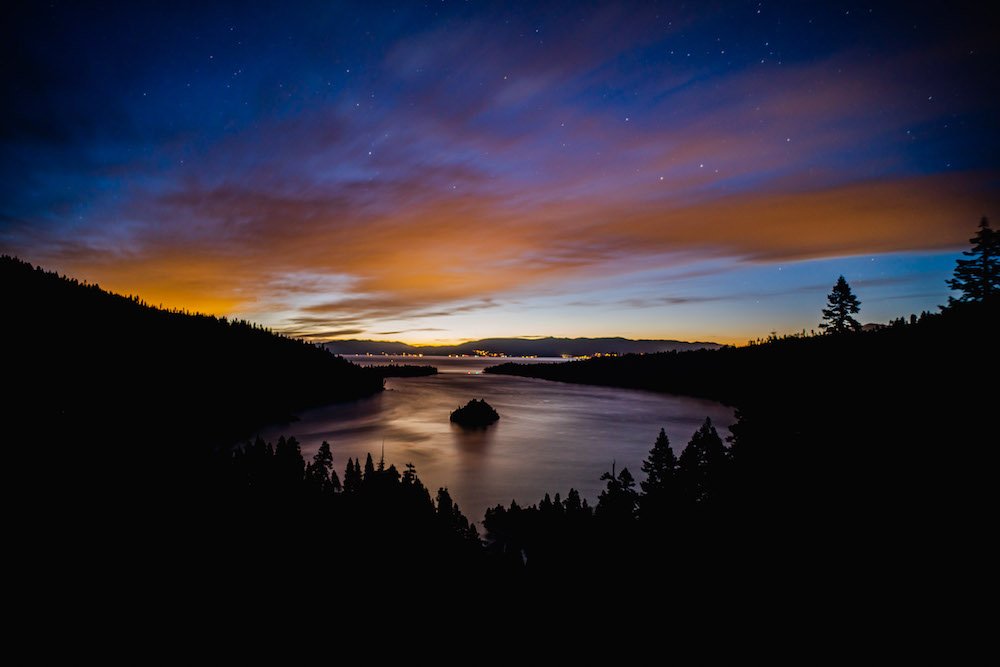
The twinkle of first light and stars high in the sky on a cloudy morning at Emerald Bay in Lake Tahoe. Photograph by Dalton Johnson
It was the last day and the emotions were flooding in.
“I am capable of completing this, all I need to do is finish these 16 miles,” I repeat to myself, delaying my departure. Looking forlornly at breakfast, I add: “Then I will stuff an entire pizza into my belly.”
Oatmeal was getting old, but my options were a bar or a strawberries and cream packet—I had eaten everything else. “I am capable of completing this too,” I bemuse. Fantasies of toppings and melted cheese running through my head, I tossed my pack over my shoulder and started walking down the trail for Tahoe City.
While hiking the Tahoe Rim Trail, panoramic views of Lake Tahoe become common, yet never fade in their beauty. Photograph by Dalton Johnson
The Idea for a Tahoe Rim Trail Thru-Hike
Growing up in a small town outside the city limits on the north shore of the lake, my family spent every opportunity skiing, hiking, swimming, and mountain biking around the blue waters. However, my parents were never keen on sleeping in tents, so backpacking was an activity I fell in love with during my time in college. When I returned home the summer after graduating and told my parents that I was going to thru-hike the 165 mile Tahoe Rim Trail, alone—to collect my thoughts before diving into a career—they rolled their eyes.
My mom has always been a worrier and she started firing questions. Traditionally, I am not a planner, but this time I was ready—to her surprise—and her arsenal of questions were deflected:
“Where do you plan to park?,” she asked. There’s a trailhead lot in Tahoe City.
“How long do you think you’ll be gone?” Most take 10-14 days, but I want to test myself and try to finish in seven.
“What are you going to eat?” I already went to the store, so two packets of oatmeal for breakfast, two bars and trail mix for lunch, and pesto-couscous for dinner. I’ll also bring a couple of protein powders just in case.
“Have you gotten permits to sleep?” Except for Desolation Wilderness, you don’t need a permit, as long as you follow Leave No Trace best practices.
As the questions continued, her worries dissipated. I had done my research.
Taking in the view of Lake Tahoe from Painted Rock while hiking the Tahoe Rim Trail. Photograph by Dalton Johnson
A Bit of Background About the Tahoe Rim Trail
During the planning, I discovered more about the area than I had ever known growing up because my dedication and desire to play a sport in college prevented me from going on several weekend trips with friends. Now, my collegiate career was over and my time to explore was surfacing. I found there were many paths used by the Indigious people of Lake Tahoe, known as the Washoe tribe, but a maintained loop around the rim wasn’t established until 2001.
The concept for the Tahoe Rim Trail was proposed by Glen Hampton back in 1978 and after three years of fundraising it broke ground. A massive endeavor—linking hiking paths, Pony Express routes, and game trails throughout the ridges of the Carson and Emerald range, 165 miles and 31,000 feet of vertical gain in total—took 17 years. It’s a rough patchwork of terrain as I’d come to find.
Regarding the terrain, the east side of the lake is dry, steep, and home to Mount Rose and Mount Freel. In other words, your thighs will be burning and your water bottles will be empty here. Storms often come into the Tahoe basin from the west, so much of the moisture is initially dumped on the western slope—which helps produce one of the country’s most reliable snowpacks and gives Tahoe excellent backcountry skiing—but leaves the Carson Range thirsty. Meanwhile the Emerald range, on the west side of the lake, is heavily covered with trees, filled with creeks and streams, but doesn’t have many high points. While on the trail, you’ll notice a stark difference between the ranges.
As I continued down rabbit holes, there came a point where I knew I needed to pack my bag and go, so that’s what I did.
What I Packed: My Gear List for the Tahoe Rim Trail
My preparations were almost done, my parents’ worries subdued, and now all I needed to do was pack my bag. Since I wanted to move quickly, I didn’t want to resupply, even though there are common places like Brockway Summit, Tramway Market, and Alpenglow Sport along the way.
Opting for a 70L pack, my gear list included:
3-season tent (I was going in summer)
20 degree sleeping bag
MSR whisperlite (I wanted to make couscous)
One pot
3 liters of water (the third was only filled during the dry section on east side of the lake)
Two pairs of shorts
Two shirts
Two pairs of socks
One puffy jacket
One rain jacket
A med kit (minus the ibuprofen)
Bear canister (bear proofing is required while overnight camping in Tahoe)
This unnamed lake was home my first night of hiking the Tahoe Rim Trail, which I had all to myself. Photograph by Dalton Johnson
Exploring My Home Range: On The Tahoe Rim Trail Thru-Hike
Starting in high spirits
Do I go clockwise or counterclockwise? The difference is negligible, but I chose clockwise and headed north, across the bridge and up my first hill. As the parking lot faded behind the trees and the dirt trail became my path to follow, I started to feel the weight of my pack. Warding off thoughts of skepticism, I looked around at the blooming flowers, it looks like I timed this hike perfectly! Between July and early August, the wildflowers blossom, depending on the snow pack, making summer the best time to backpack the Tahoe Rim Trail.
Even though I got an afternoon start on the day, my progress was quick. There are eight sections to the trail, averaging 20 miles in length per leg, and I was already 1.5 sections in as I set up camp on my first night. Camping near a lake, I was able to refill my bottles, eat some food, and crawl into my sleeping bag for a good night’s rest.
Feeling good, for now
Waking up ready to crank out miles, my goal was to push for 35 miles. After some oatmeal I left the lake and headed towards Mount Rose. Passing others along the trail as they enjoyed their morning cup of coffee and eggs over the stove, I was a bit jealous.
I crunched over snow patches, twigs, pine cones, and more. The sky was clear and the sun beat down upon me. Drinking water and keeping up my pace, the only distraction I allowed was to stop and snap a few photographs.
One stop, a waterfall along the Tahoe Rim Trail not far from Mount Rose summit fork, came at the perfect timing. I was low on water, hungry, and ready for an excuse to drop my pack. Feeling as though the weight of the world had dropped off my shoulders, I walked around with my camera, snapping images left and right, the cascading water spraying me. Grateful for the cooldown, I enjoyed my snack, pounded some water—for this might be my only refill for 20 miles—and got on my way.
Passing a large group, near the Mount Rose trailhead, I asked what they were doing. They were day hiking with the Tahoe Rim Trail Association guides, they said, and explained there were three options for guided trips. First, if you’re a beginner hiker looking for tips on how to get started, you could day hike in sections, the guides organizing the logistics. Second, you could section hike, each could be done over a weekend. Lastly, you could do the whole Tahoe Rim Trail thru hike with the help of guides. The best part, the community—laughing, telling jokes, and having a jolly time!
Entering a fairytale
The following day, day three, would be roughly the same distance, but no water. From the Carson range to the Kingsbury Section Connector there is no water. Often, trail fairies leave a gallon, or two, for thru hikers, but don’t count on this. If you don’t plan in advance, you might have to detour two miles to a store down the road.
To help you prepare, you can find water sources from the Tahoe Rim Trail Association.
Towards the end of the day, I had reached my goal. Since I had made good time on this section, I decided to make the side trip to the summit of Mount Freel to watch the sunset. I figured it wouldn’t be an issue to add the extra mileage. Dropping my pack at the cairns marking the split, I worked my way up the sandy slope, reaching the summit in time to watch the last light fade into darkness.
If you time your Tahoe Rim Trail thru hike correctly, you’ll be surrounded by wild lupine meadows. Photograph by Dalton Johnson
The crawl
Day five, I was beat up, everything hurt, and my body wasn’t ready for this. In the back of my head, I continually recalled an early fascination I had about ultra-runners using the full length of the Tahoe Rim Trail, 165 miles and 31,000 feet of vertical gain, as a training ground. I drooled over the Fastest Known Times thinking to myself, “How is that even possible?”
There is no doubt in my mind that I had underestimated the difficulty of the Tahoe Rim Trail. For some reason, I thought it was going to be easy. This hike is serious! My left knee was swollen, my back was in pain, and I really didn’t know if I could continue. Breaking down the tent and packing my bag was difficult. I started down the trail, looking for a stick so I would have a hiking pole. I found two.
The irony is that today was supposed to be my biggest day, roughly 50 miles, through the most beautiful section, Desolation Wilderness. It felt like I was crawling.
With 20 years of high-level sports under my belt, I felt driven by my competitive nature. But in reality, I didn’t know much else. Everything I did was a competition with myself.
In many ways, when I told my parents that I wanted to “collect my thoughts before entering my career,” these were the thoughts I wanted to address.
Entering the Wilderness area, even with a bummed knee and lower back, I opted out of the free wilderness permits for overnight camping in the area. I was committed to trekking the 32 miles, even though it was already 10am.
Before pushing on, I stopped in at Echo Chalet, a grocery store near Echo Lake and the entrance to the wilderness, for a sandwich, a bag of chips, and some ice-cream. I am not sure if I have ever had a meal that tasted so good.
Pulling myself together, I started up the rocky slope.
The trail was gorgeous, a bit rocky, but led towards grand views of Lake Aloha. The lupines were in bloom and the Lake Aloha area hands down has the best views along the Tahoe Rim Trail.
To myself, I muttered, “be smart, stop here for a night, or two, to enjoy this,” but my ego wouldn’t allow it. Conflicted inside, I battle with myself. I came out here to look inside myself, relive those missed opportunities during my childhood, and yet I put myself in a position to where I also didn’t want to disappoint myself by not meeting the standard I had set.
My schedule was tight, my body feeling dilapidated, but I felt compelled to dip in Lake Aloha. Swimming, journaling, and simply being on the banks was a welcomed reprieve. I knew I needed to move on, but I didn’t want to. I considered staying put, but I was afraid of the consequences… of letting myself down.
Putting my pack on, I murmured, “You should have gotten a permit.”
Going up and over Dick’s pass was brutal. My knee was in excruciating pain, I was moving slowly, and I just needed a savior. Luckily, out of no-where, a day hiker came romping down the pass, whistling a tune, and started a conversation. After some time, I asked if they had a wrap for my knee, but they didn’t. Instead they did have some ibuprofen, something I forgot to pack in my medkit. Gulping them down and saying good-bye, I laid on my back, staring up at the pass, wondering if I would ever finish with the trail. It didn’t seem like it.
Soon I was cresting the pass and started down the slope. Pulling over on the side of the trail, I made dinner by headlamp, knowing I had many more miles to walk, in the dark. Just outside the wilderness boundary, a few hours later, I had made my goal.
I looked around for a place to pop my tent and saw a random trail marker glowing. Confused, I wandered towards the reflector until it moved, revealing two eyes staring at me. A mountain lion. Doing everything I could do not to freak out, I walked backwards keeping an eye on the cat, picked up my bag, and kept walking.
The good news, I no longer felt any pain in my knee, or back!
Two more hours of hiking. Ready to collapse. I set up my tent. Bed. I hoped I would wake up the next morning.
16 miles to freedom—and pizza
The morning light warmed my face, and I was grateful to be alive.
Today was going to be my last day. The emotions were flooding in. “I am capable of completing the Tahoe Rim Trail thru hike. All I need to do is finish these final 16 miles. Then I will stuff an entire large pizza into my belly,” I repeated to myself.
Originally, I set out to make this trip for myself, to grow, connect with my home, and learn about myself. I was naive. The Tahoe Rim Trail became another competition instead of a soul search. There were 16 more miles, but, in many ways, I had an undetermined amount of time ahead of me. These were my first steps outside of competition and goals. Unlearning was going to take more than miles, more than fatigue, more than time alone. If I wanted to untether myself, I would need to learn to accept who I am, potentially disappointing those I love and those who’ve invested in my future.
I started down the trail knowing these 16 miles were just the beginning.
Aloha Lake in Desolation Wilderness is one of the best day hikes and lunch stops along the Tahoe Rim Trail. Photograph by Dalton Johnson
When the Boot Hits the Finish Line a New Chapter Is Just About to Begin
Sitting on a picnic table bench, looking out at Lake Tahoe, half a pizza in my belly and the other half waiting to be devoured, my dad asked, “So, what was it like?” Not really knowing what to say, I picked up another slice of pizza and started to recall the memories, trying to decide where to start.
Discover More of Lake Tahoe


How to Have the Most Fun Living in a Van
Having fun while living in a van can be simple, but the distractions of life are ever-present. Keep that in mind and prioritize the fun things. Make a list, check it twice, and fill your bucket with the experiences that help you grow.
As I learn what brings me joy in life, I find the “fun target” to be constantly moving. With that said, I do think there is a recipe for success to having fun while living van life. None of these are top secret, but together this recipe cooks up a delicious pie.
Kristin showing off her balancing skills while at a beach hot spring in Baja, Mexico. Photo by Dalton Johnson
1) Do the things you love!
Simple to say, hard to practice. There are many things which distract us from the things we love… stress, work, desires to be better, family, etc. The list of distractions goes. Thankfully, when you live in a van, life is simple and what you own is minimal. Thus, you should have quick access to the things you love. For myself, rock climbing and surfing are two hobbies I enjoy, so I make sure to keep this equipment accessible and in my van at all times. Additional, I travel to places where I can do one of these hobbies.
2) Push yourself outside of your comfort zone
Living a life of constant growth has added great value to my life. Now what does that mean? Also, if you are constantly growing, how is there time for fun? Yes, growth can hurt, but that typically happens if you try to grow to fast. “Slow and steady wins the race,” my 3rd grade teacher preached. I do find slow growth to be a joyful. To cultivate a life of slow growth, I try to step outside of my comfort zone once a day. A simple example, I used to struggle talking with strangers (a very important skill while living on the road) so I devised a plan to overcome that:
Day One: wave/smile at one random person
Day Two: wave/smile at 10 people
Day Three: wave/smile at 10 people AND compliment one person
Day Four: wave/smile at 10 people AND compliment three people
Day Five: Compliment three people AND hold one conversation
*after the fifth day, I realized people are not scary, just smile and wave.
Sunrise light shines bright on the Middle Teton while Sean racks the climbing gear to start up the first pitch of the Full Exum route on the Grand Teton. Photo by Dalton Johnson
3) Talk with strangers who are in your community
After building up my tolerance to talk with strangers, I started striking up conversations with community members. First, you have to know what community you want to be apart. For myself, this included creatives, van lifers, rock climbers, and surfers. Second, go to where they are and hang out. I’ve found, with the exception of surfing, if you are alone in a space, somebody will talk with you.
4) Make friends and travel together
Once you have made some friends, see if you are traveling in the same direction. If you are, travel together for a day. Maybe camp together. If that feels good, add a second day. You can always drive a little bit more to “escape” them, or go on a solo side trip. If you are not, that is okay, ask if they have friends in that direction. Most likely somebody knows somebody in the direction you are going.
Personally, I enjoy a significant amount of time alone, but traveling with others is nice!
A surfer sprays the lip of a wave at Steamer Lane in Santa Cruz, CA. Photo by Dalton Johnson
5) Make a list of reasons you want to live in a van
Okay, this is HUGE! If you make a list of reasons why you want to live in a van, the list will outline the things you should do, hopefully on the daily. If not daily, at least four times a week. Here is my list:
-Access to nature (daily)
-Photographic opportunities (daily)
-Seeing the world (a general concept and also why I drive more than peers)
-Meeting new people (daily)
For Valentine’s Day, these two set out for a picnic on the beach in Santa Cruz, CA. Ironically, this was a photoshoot for a valentine’s day giveaway, but you get the idea… right? Photo by Dalton Johnson
6) Picnic often
This one is a bit silly, but I love a good picnic. Why? If I am having a picnic this means there is a view, I have some company, and I have intentionally set aside time in my day to be present outside. That is a dream come true for myself. Heck, I might even pull out my camera and snap some sweet shots while filling my face with food!
7) Avoid cities
Cities and I don’t totally get along, thus avoiding these at all costs is best for my overall health. If you are a city person… maybe get an apartment? I mean, don’t get me wrong, cities have a lot of opportunity, but personally I don’t think a van and a city mix well together.
Sam Strohl working through the crux of a boulder in the Happy Boulders of Bishop, CA. Photo by Dalton Johnson
8) Level set your expectations
Underpromise and over-deliver. Yup, try not to overhype the next place you are going to go in you mind, otherwise you might let yourself down. This has happened to me a few times, mainly when I was living on a bicycle, and it doesn’t feel great. Try to level set you mind so you enjoy the experience more than the build up. A trick I use for this while on the road is the break it down into the basics. If I am going to rock climb someplace new, I tell myself, “This will be fun, you will be climbing on sandstone, and you have solid company. There are going to be some easy routes and some hard one. Just go out and have some fun.”
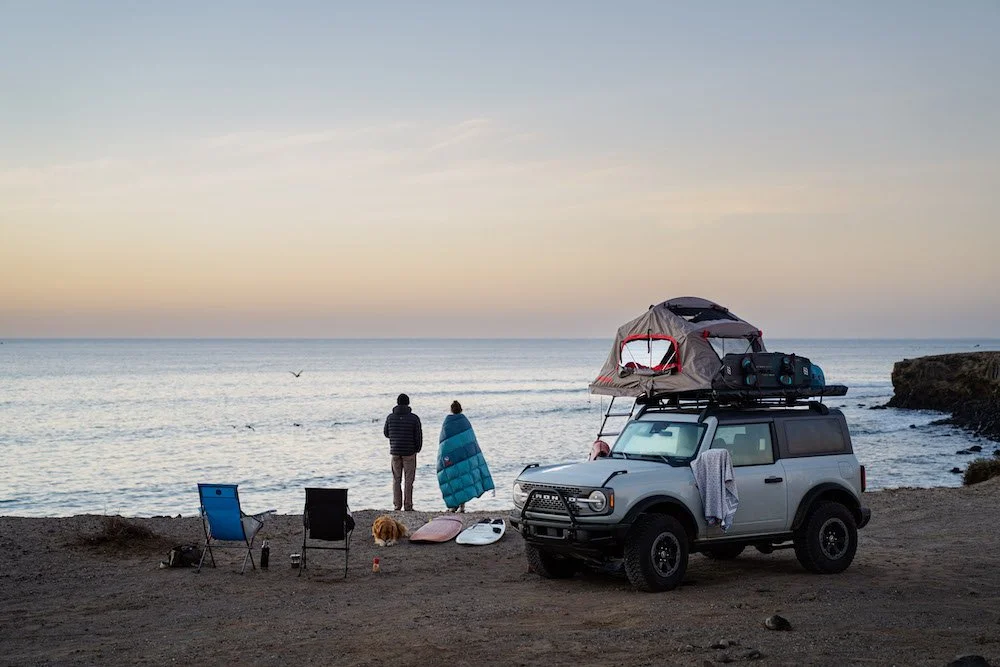
Looking out upon the Pacific ocean, Kristin enjoys the sunrise from a roof top tent. Photo by Dalton Johnson
In the end, having fun while living in a van can be simple, but the distractions of life are ever-present. Keep that in mind and prioritize the fun things. Make a list, check it twice, and fill your bucket with the experiences that help you grow.

It's a Van Tour
I’ve lived on the road for seven years now, five of which have been in a van. While my first vanlife set up was not ideal— I couldn’t stand, it broke down a few times, and it was often referred to as a “creeper van”—my set up for the last two years has been great!… I missed out on showing you all several things, as this was an impromptu to van tour along the California coast. To address and answer other vanlife questions, check out the blog below:
Well… I’ve lived on the road for seven years now, five of which have been in a van. While my first vanlife set up was not ideal— I couldn’t stand, it broke down a few times, and it was often referred to as a “creeper van”—my set up for the last two years has been great! So, why has it taken me two years to make a video showing off the van?
Honestly, there isn’t a good reason. However, I recently got a new gopro and decided to start making vlogs to showcase as much as I can. With that said, here is my first go at holding a gopro, filming myself, and giving you a van tour.
Note, I missed out on showing you all several things, as this was an impromptu to van tour along the California coast. To address and answer other vanlife questions, check out the blog below:
Who Built the Van?
I built the van with my Dad as a father-son project. Luckily, my dad has worked construction for the past 35 years, so he had many of the tools and skills needed to build this van.
How Long Did the Van Take to Build?
As I am a full time photographer, building the van happened in stages. Also, my Dad could only help on weekends, as he still works, so building revolved around long weekends. With that said, it took about a year to build, but we roughly worked on the van for 20 days.
What Was the Hardest Part?
Doing the work! First off, power tools scare me, so building the ground work was a skill in overcoming the fear of saws. Designing the van was fun. Buying the goodies for the van was overwhelming, as there is just so much information… especially around electrical. Actually doing the work was much harder than I expected. Honestly, I thought I was going to be a helper for my Dad as he did the work, that was not the case. For the most part, he gave me guidance and then left. Checking in on me every 15-30 minutes to see how I was doing.
If I had to pinpoint one thing as the hardest, I would say the electrical.
Would You Build Another Van?
I have thought about building another van because there are things I would want to change to make my life in the van easier, but I am not sure if I will. This one has a bunch of memories already and I am getting attached to it. Also, the prices to buy a new van and then build one seems to be out of the question for the time being.

Kristin taking in the last moments of light in Grand Teton National Park. Photo by Dalton Johnson
What Would You Change?
I love the build, but I’ve come to realize I have other people in the van more than I am alone. So, I would want to make the van compatible for two, or three, maybe four. This would look like more upper cabinets for storage, I would revamp the garage to have a slide while also stacking the batteries, and lastly I would add a table and swivel chair to the front.
I could change all of this right now, but the one change I would make that I don’t think would be a good idea would be to add the side pop-outs. This would be a huge game changer for sleeping!
Van Build Basic Specs?
Van: 2019 Dodge 2500 Promaster
Electrical: solar and gel batteries
Insulation: wool and reflective
Cabinets: Made by my buddy Casey, if you want his info, shoot me a DM on Instagram
Water: 3 x water jug with electric pump
Cooking: two burner propane stove
Refrigerator: Mini fridge (I had enough power)
Obviously, the above information is not a deep dive into the build, but I wanted to give an overview of the critical items which hung me up as I started to build this van.
In terms of building, there is a TON of considerations you must make, so take your time and do things correctly. Electrical was the largest challenge for myself (and my dad who helped build the van).
Additional Features I love:
Toilet This is a life saver!!
The cabinets! They look great :-)
Thoughts on the sustainability of Vanlife?
Gosh, in terms of the long term sustainability of living on the road in a van… that is difficult. I would say van life is a good way to combine a passion with traveling. For myself, that means photographing and vanlife. This works well for most passions, but I the limitations are quite stark. For example, I am not very productive when it comes to finishing stories on the road because public wifi is to slow to send files, have zoom calls, ect. So, to combat that, I need to rent a room for a couple of nights… which I am not complaining about, but it is a reality.
For myself, I love living in a van and hope my lifestyle will continue to be simple, allowing me to live on the road, continually practice moving slower, and create more engaging stories every day!
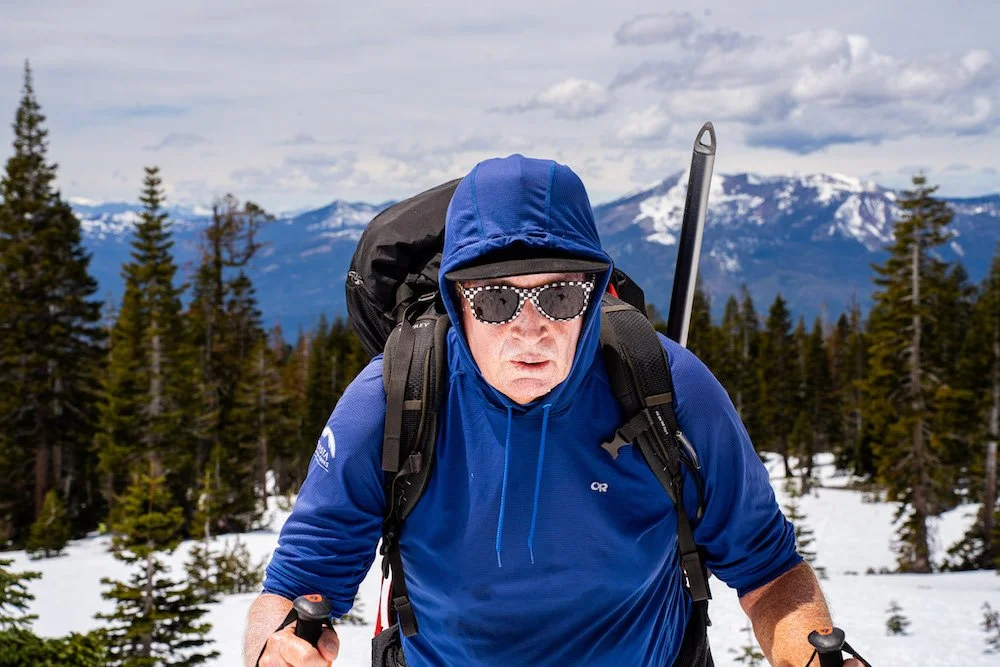
Training with Epic Bill Bradley
“Heyy Dalton, this is EPIC BILL BRADLEY here, um, give me a call. I am looking for a camera guy who is a bad ass. Can you climb mountains with camera gear?” Bill teases me with this voicemail back in February. Now, it is May and we have three more weeks until gear check in Talkeetna, Alaska. Bill and I had not met until this point, but I was intrigued to shake is hand, see if his height matched his energy, and get on a mountain with him.

Bill Bradley on a six hour training session up Mount Whitney, CA. Photo by Dalton Johnson
“Heyy Dalton, this is EPIC BILL BRADLEY here, um, give me a call. I am looking for a camera guy who is a bad ass. Can you climb mountains with camera gear?” Bill teases me with this voicemail back in February. Now, it is May and we have three more weeks until gear check in Talkeetna, Alaska. Bill and I had not met until this point, but I was intrigued to shake is hand, see if his height matched his energy, and get on a mountain with him.

“Show up and suffer” Bill’s favorite slogan and most likely hat on a training day on Mount Shasta, CA. Photo by Dalton Johnson
“Hey Bill, it’s Dalton Johnson. Are we still on for a little training on Mount Shasta?” I ask
“Heyy Dalton!! Great to hear your voice. Yup, yup, we are good to go and I am excited to meet you.” Bill responded.
Arriving at 9:00am to Bill’s hotel room, he greeted me with a massive smile, more energy than a group of six-year-old kids, and a booming voice. “Well, are we hungry? Should we go get a bite to eat?”
Fueling for the day and quickly packing our bags after breakfast, we piled into his Toyota Prius and headed for Bunny Flat.
After a quick decision, we tossed 45lbs in our packs and headed up Mount Shasta. Unclear how far we would go, we set a time. Six hours in total. Four up and two down. To be quite honest, the miles and time didn’t matter, we where training to learn about each other, especially as we were going to be roped together for three weeks on Mount Denali.
“Whoo Hoo!” Bill shouts, “We are in the arena. There are no bad days in the arena!”
Hoping around the mountain, I snap images and record video as the two of us get in the flow. Training is always a little bit different depending on the company, but this trip was unexpected. Bill was cheering for everyone coming off the mountain, regardless if they were day hiking, going for an FKT, or gave a summit attempt. Bill didn’t care, he was happy. He was in his element. He was ready to show up and suffer.
Two days of training came and went, quickly. The two of us got along well and the excitement was high for what is to come… heading to Alaska to climb Mount Denali, North America’s tallest mountain.

Bill almost at the turn around point of our six hour day on Mount Shasta, CA. Photo by Dalton Johnson
Climbing Mount Shasta Details
Typical route: Avalanche Gulch
Trail Head: Bunny Flat
Trail type: Out and back
Elevation Gain: 7,230 feet
Distance: roughly 11 miles
How difficult is climbing Mount Shasta?
Mount Shasta is a mountaineering mountain. While climbing Shasta is considered an easy mountaineering route, you do need technical skills to climb the mountain.
What skills are required to climb Mount shasta?
If you are planning to climb Mount Shasta, you need to be proficient in the following skills:
winter camping
cramponing
ice axe
self-rescue
What gear is needed?
This mountain and route are known for mountaineering. So, a full mountaineering equipment is needed, but there are no glaciers on Avalanche Gulch:
Ice Axe
Crampons
Winter boots
Tent
0 degree sleeping bag
Rain Gear
Puffy bottoms and tops
Thick socks
Backpack
Winter camping and cooking gear
Do people sleep on the mountain?
Yes! There are three typical spots to sleep while climbing Mount Shasta: horse camp, 50/50, and Helen Lake.
Are permits required to summit Mount Shasta?
Yes. You need a summit permit (they cost $25) above 10,000 feet.

Did I Pull an April Fools Joke on Myself?
Two days later, I pedaled away from the hostel the man at the airport had suggested. Winding through the city streets of Christchurch, I was eager to make it to the main road that circles New Zealand’s South Island. Upon arriving at the T, I asked myself, “clockwise or counterclockwise?” For the first time, I had a hunch that I knew what I was doing. Feeling confident, I recall thinking, it’s the second half of summer, I should go south now, so I am in the north for the fall. So, I went right and pedaled along the coast, embracing a freedom that I had never known before.
Only a few days into the trip, I was already blown away by the beauty of New Zealand.
I landed on April 1st with a dream, backpacking equipment, and no idea what I was doing. When I say no idea, I mean a man in the airport lobby walked up to me and said, “Son, you’ve been standing there a while, do you know where you are going tonight? It’s going to be dark soon.”
Surprised by his voice and greener than green, I looked at the man and responded, “I’m going to bike around the country.”
His eyes look around me and in the nicest way possible, he musters up the courage to ask, “Did your bike get lost in route?”
I giggled to myself, I truly had no idea what I had just signed up for, “Nope, I was going to buy one here.”
“You know, all of the stores are closed already, right? You’ll have to get a hostel tonight and then tomorrow get your bike.”
“Okay, that sounds great! Do you know any hostels?”
One of my first nights on the road was spent here, in a storm, on the side of a grassy hill.
Two days later, I pedaled away from the hostel the man at the airport had suggested. Winding through the city streets of Christchurch, I was eager to make it to the main road that circles New Zealand’s South Island. Upon arriving at the T, I asked myself, “clockwise or counterclockwise?” For the first time, I had a hunch that I knew what I was doing. Feeling confident, I recall thinking, it’s the second half of summer, I should go south now, so I am in the north for the fall. So, I went right and pedaled along the coast, embracing a freedom that I had never known before.
Flashback a few weeks, I had graduated early from college, with a BS in Mathematics, but I had no direction. As a kid, I dreamed of seeing the world and being a writer, but, somehow, I studied math. Luckily, I had a professor who took me under his wing and shared travel tale after travel tale. His experiences made him a professor of life, more than a math professor. As I packed my bag, my worried parents barraged me with questions that I did not have answers for. These questions were simple, like; “where do you plan to sleep?” “How much money do you have and is it going to be enough?” “You have never ridden a bike longer than 5 miles, how far do you plan to ride?” All I knew is that I watched a Rocket Power movie about riding bikes in NZ and Professor Klosinski had told me of the natural beauty New Zealand offered.
Standing in front of my trusted steed, Roam’n, I used to cycle around New Zealand's south island.
Armed with a journal, an iPhone (without a data plan), and an overconfident mantra of “I’ll figure it out along the way” I disregarded crazy looks from my family and friends. How hard could riding a bike be? Naïvely, that last question should have been one I asked myself! But, I am glad I didn’t, otherwise, I would not be sharing this story.
Call it beginners luck, but the first two weeks had passed and I had not crashed, nor had I gotten a flat tire. I started to get in the groove and my days, while unplanned, developed a routine. Wake up, eat anything, pack up, ride, eat lunch, talk to myself… A LOT… ride, pitch my tent, read, journal, sleep. Oh yeah, occasionally reference the map that I carried, since I didn’t have GPS. My body was in good shape and to my butt’s surprise, it didn’t get sore! There came a day that I thought to myself, Maybe I have the perfect cycling butt, I never get sore!
As the summer faded into the fall, my dad and brother visited. We packed my bike, that had earned the name Roam’n, into the van they had rented. We drove around the island over 10 days. My wet and stinky self, pissed my dad off from the start. We couldn’t find each other and my sense of time had become non-existent. While a watch was strapped to my wrist, my attachment to social norms had gone out the window. Turns out, I was three hours late. Today, I understand why he was upset, but I was dumbfounded in the moment. As we drove around the island, we created memories. We made many side trips, hiked trails, and, as if I couldn’t get my biking fill, went downhill mountain-biking. Ten days go by quick, but Roam’n and I picked up where we left off.
My dad, brother, and I standing at a road side vista. These are a dime a dozen in New Zealand.
By this time, I had been away from home for over a month. The white line of the road had replaced the black line of the swimming pool, that I had stared at since I was three years old. I did not listen to music nor podcasts, so, I did the unbearable, I learned to sit with myself. When I started the journey, I did not know… well… anything. I was flying by the seat of my pants, without an agenda, only an idea that I honestly didn’t care if I finished because I had tried.
While trying is great, so is finishing, but sometimes you have to ask yourself, Is worth it? Not long after my brother and dad left, things started to break. My back tire had to be completely rebuilt as eleven spokes snapped. I popped two inner-tubes. My panniers were ripping from the constant moisture. Rain became a daily tradition and there was one weekend where I read I sign saying, “Flooding possible, 5 meters of rain expected.” My boots, yes I cycled in mountaineering boots, were sopping wet. I found out the difference between $100 and $600 rain gear is the duration of rain it can repel. I should have sprung for the $600 gear! I got the flu. And to top it all off, I received word from home, that a friend had been diagnosed with cancer and most likely wouldn’t be alive by the time I got home.
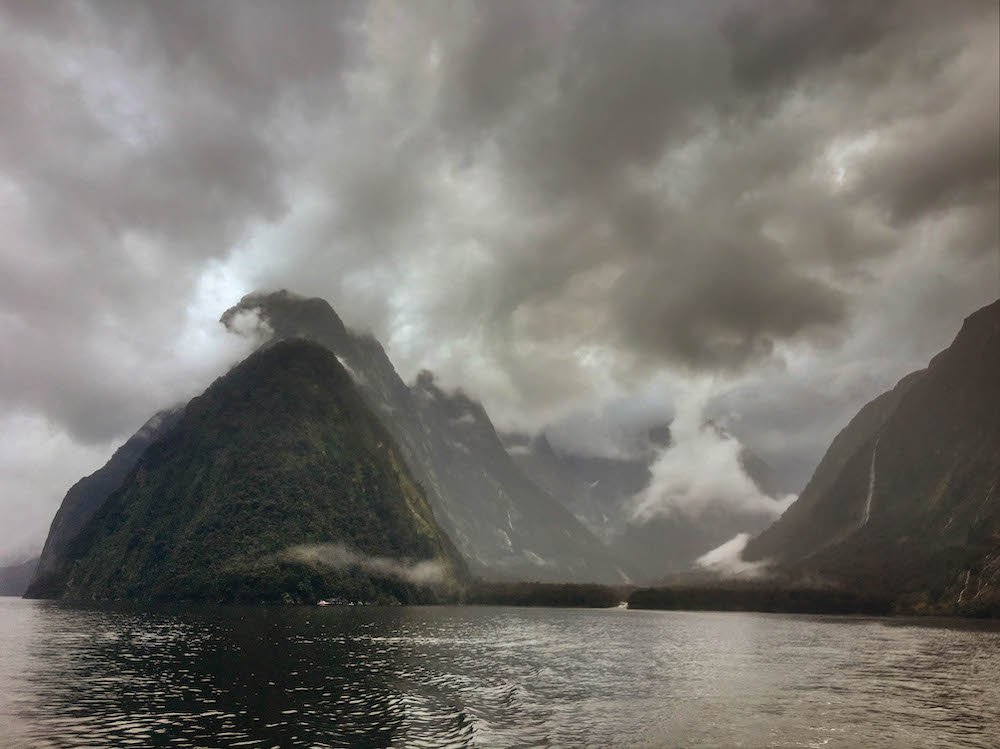
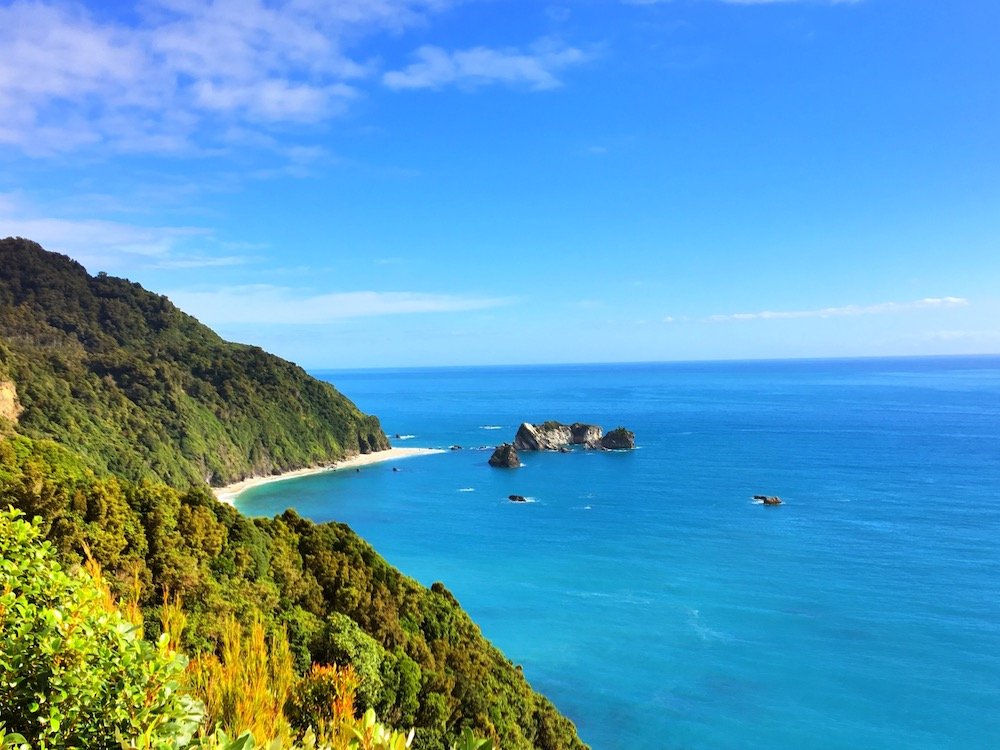
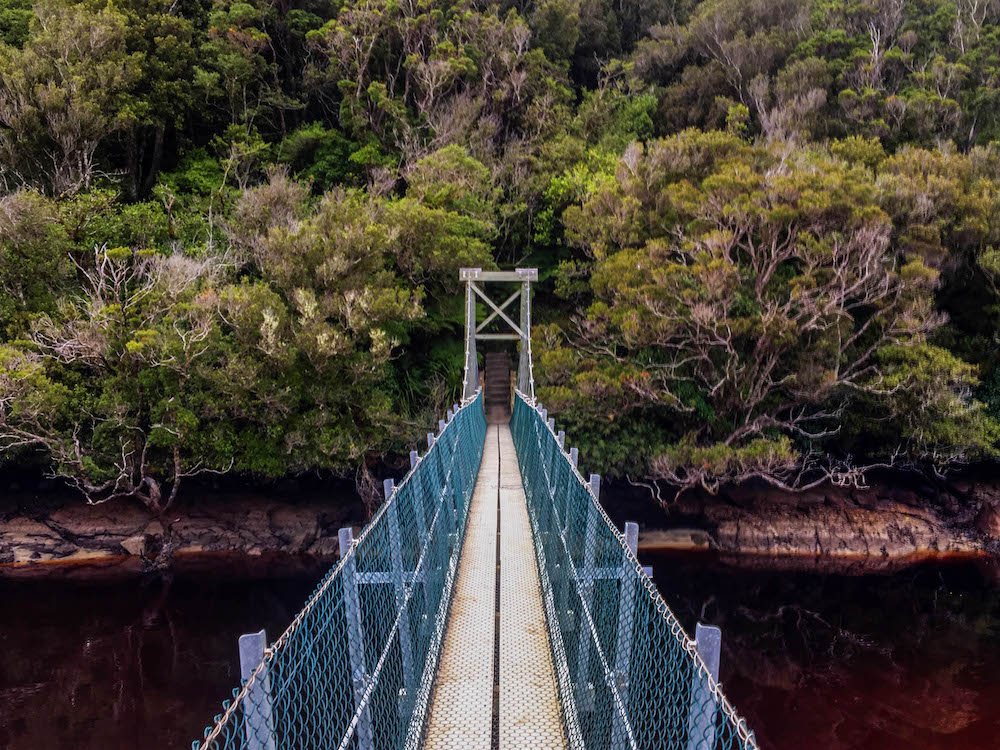
Each day and night was different, sleeping next to farms, on beaches, hell, I slept in a sheep shear shed one night! The further I went into the suffer-fest, the greater joy life brought me! People would stop and invite me, sopping wet, into their vans for midday tea and biscuits. I was offered countless hot tubs (but strangely not many couches or showers). Eventually, I made a Dutch friend to cycle with for two days, that was a delight! Ironically, a French couple had hair buzzers and we shaved my shagged head, putting a J and F into the sides to honor my friend and teammate, Julian Fraser. Other amazing acts of kindness included; my rear tire being rebuilt for free, a tip to use rubber gloves to ward off frost-bite, about seven meals, and honey, lots of free honey!
With only a couple of days left, I watched the sunset every night as I made my dinner. This is just one example of what it was like cycling around New Zealand alone.
As struggle was met with kindness, I continued to pedal. The rain never stopped at the end of the trip, but each night I was greeted with a miraculous thunderstorm. Headwinds turned into tailwinds as I rounded the top of the island for my last week of riding. That final stretch I took slow. So slow, I actually ran out of food the night before making it to Greymouth. With a hungry belly, I pedaled my way to a hostel for my third warm shower in two months. My legs burned in pain and I couldn’t sleep, only stretch. While I waited two days for a bus to take me back to Christchurch, I learned how to make bread from a German couple.
I knew my time in New Zealand had come to an end and it was time for me to return to California. While I had been insistently journaling about what I wanted to do in my life for 62 days, I was coming home with no answer. There was this side of me that wanted to return to the pool and attempt to make Olympic Trials for swimming. There was a side of me that wanted to return to school and get a master’s degree to become a teacher. There was another side of me, the one that weighed the heaviest, that told me I needed to go home and make money. Regardless of my choice, there was a pull that I could not resist, no matter how hard I tried, for me to continue to explore. But, what would that look like?

It’s a Micro-Adventure Kind of Season
A micro-adventure is a mindset and physical outing directed to exploring. Since these are small, most micro-adventures will happen in your backyard, wherever that be. Now, some people will be luckier than others because of where they live, but even a city-dweller can have micro-adventures. The goal is to change your perspective on your current life situation and push yourself to go. Most of the time a micro-adventure will leave you asking yourself, “why would I ever do that?” The answer is “because it sounds like fun… kind of.”
Several years ago, as I was diving into the world of adventure, I was introduced to the concept of micro-adventures. Alastair Humphreys is a human of the grandest and smallest adventures out there. I highly recommend checking him out and his book, Micro-Adventures, where coined the term and revamped backyard adventures in the UK. Some of the after-work adventures are silly, meanwhile, some of them are quite the challenge. In the United States, we would call a micro-adventurer a weekend warrior, but there is a difference.
Kristin Riegel enjoying a night under the stars in Joshua Tree National Park, CA. Photograph by Dalton Johnson
Micro-Adventurer vs Weekend Warrior
Okay, yes, some of you might say that I am splitting hairs here, but I truly believe there is a difference in the mindset of a micro-adventurer and a weekend warrior. So, what is the difference? A weekend warrior lives for the 57 hours they have from the end of work on Friday until they begin work again on Monday. Meanwhile, a micro-adventurer isn’t afraid to make the most of any opportunity, no matter how small. Heck, you could have a micro-adventure during your lunchtime break if you wanted!
Are you a micro-adventurer or a weekend warrior?
Are you more inclined towards quick escapes or epic expeditions? Here's how to discern if you're a micro-adventurer or a weekend warrior:
Time Frame: Do you prefer short, spontaneous adventures (micro-adventurer) or longer, planned excursions (weekend warrior)?
Distance: Are you drawn to nearby experiences (micro-adventurer) or do you seek remote destinations (weekend warrior)?
Intensity: Do you enjoy moderate challenges (micro-adventurer) or crave extreme adventures (weekend warrior)?
Frequency: Do you seek frequent but brief escapes (micro-adventurer) or plan fewer but more significant trips (weekend warrior)?
Preparation: Are you comfortable with minimal gear and planning (micro-adventurer) or do you thrive on detailed preparations (weekend warrior)?
What is a Micro-Adventure?
A micro-adventure is a mindset and physical outing directed to exploring. Since these are small, most micro-adventures will happen in your backyard, wherever that be. Now, some people will be luckier than others because of where they live, but even a city-dweller can have micro-adventures. The goal is to change your perspective on your current life situation and push yourself to go. Most of the time a micro-adventure will leave you asking yourself, “why would I ever do that?” The answer is “because it sounds like fun… kind of.”
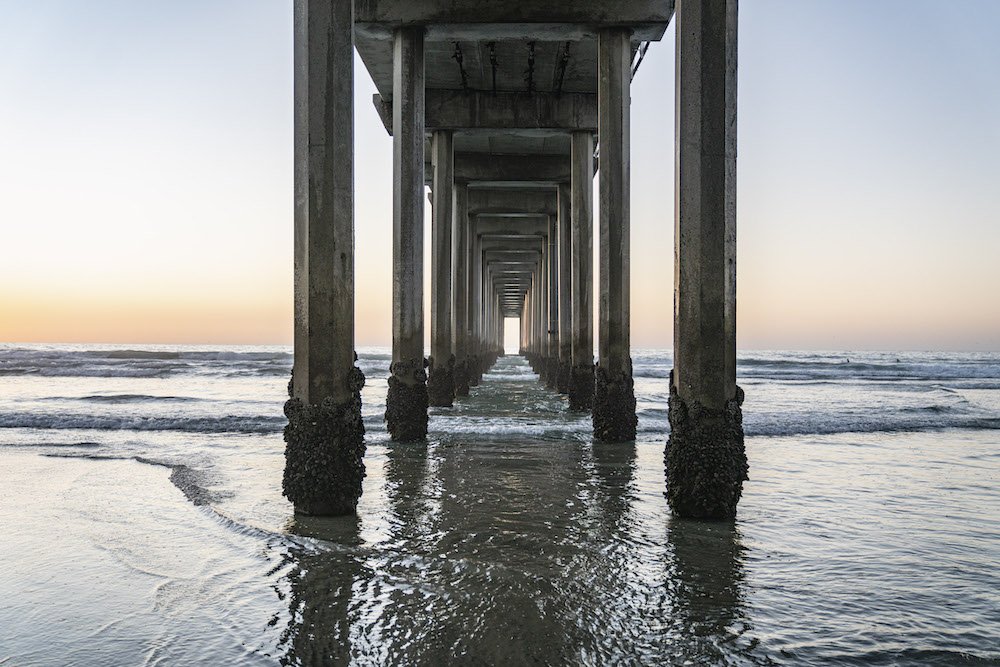


How to Become a Micro-Adventurer?
While having a badge, sticker, or challenge to say “I am a micro-adventurer” would be a great community builder, the fact is, it hasn't happened, yet. Or, maybe the muddy shoes and frizzled hair at work is the badge of honor. Regardless there isn’t glory, nor is there any financial gain, but you will do some pretty fun things! In the beginning, most of your friends will think you are crazy, just embrace the confusion. So, to begin keep your micro-adventures simple. Come up with a micro-adventure, I suggest doing it with a friend and trying it out. Keep it local, keep it simple, keep it fun! Below is a list of micro-adventures for you to try, all of them are accessible in some kind of capacity, but they do require you to get creative… but that is the point of a micro-adventure.
After-work Micro-Adventures
Rappel down a canyon
Ride your bike to the woods
Weekend Micro-Adventures
Paddle down a river with friends
Load up a pack, walk out your front door, and don’t come back until after work on Monday
Head to a lake, or pond, and catch your own food and sleep in a tent
Climb a mountain, sleep on top, come back to work a little bit stinky

Sleeping in tents under the milky-way in the High Sierra Mountains, CA. Photograph by Dalton Johnson
Yup, you might seem crazy to your friends when you ask them to join you, but you just might be! Tell your friends about the trip and share the stories you accumulate. Micro-adventures are a reset to the daily grind, an opportunity for you to hit that reset button and lower your stress levels. Sleeping outdoors, under the stars, you’ll have a perspective change. You’ll appreciate your hot shower a little bit more. You’ll realize how easy it is to cook on a stove, with pots, in comparison to roasting a fish over a fire. So, stop waiting and start planning for your after-work adventure tomorrow. Get outside, explore your backyard, and have a blast!
Discover More Micro-Adventures

How to Stay Fit While Living on the Road
While six pack abs and bikini season are always around the corner, van life might prevent you from getting to those goals. Yes, you are closer to access the outdoors if you plan your van trips correctly, however you aren’t going to have much space for working out, especially if the weather does not agree with your routine. If you plan on being a weekend warrior in a van, fitness won’t be a point of topic you’ll stress much about. However, if you decide to commit full time and have aspirations of maintaining your gym-centric body, guess again! With that said, below are five tips to maintain your fitness level while crammed in your tiny home on wheels.
While six pack abs and bikini season are always around the corner, living on the road might prevent you from reaching to those goals. So, how do you maintain your fitness while living on the road? While traveling in a van you are closer to access the outdoors if you plan your van trips correctly, however you aren’t going to have much space for working out, especially if the weather does not agree with your routine. If you plan on being a weekend warrior in a van, fitness won’t be a point of topic you’ll stress much about. However, if you decide to commit full time and have aspirations of maintaining your gym-centric body, guess again! With that said, below are five tips to maintain your fitness while living on the road.

Dalton Johnson does yoga outside of his van at a trailhead near Bishop, CA
Staying fit while living on the road has been a main focus of mine as a travel photographer. After seven years of living on the road, I have tried I have found the best to stay fit is to be active everyday. Setting aside an intentional 30-60 minutes to be active has kept me healthy while living on the road. Being active can vary, but I have found yoga, running, or going to a gym to be the best.
1) Create a stretch/yoga routine
While stretching in your van can be difficult if you don’t have space, there is almost always a park or beach or parking lot to stretch in. For myself, stretching has been the key ingredient to maintaining a healthy body on the road, because I am driving just so dang much! All that driving means LOTS of sitting. So, to counter this, I have dedicated time daily, to loosen up my body.
Some of the stretching areas are the hips and the shoulders. For the most part, these are my high areas of use and abuse, but that comes with the territory of driving, surfing, hiking, and climbing. Also, tossing in a few core exercises have added significant benefit to my life, so maybe thing about that as well.
The best part about yoga is that you really don’t need much:
-Yoga mat (this one is rad! It is made of recycled wetsuits)
-A strap or belt to be lazy while stretching
I also heavily suggest using a foam roller! These are small, easy to use, and you fell AMAZING afterwards!
Click here to check out my yoga YouTube channel called Yoga for Dad’s
Sherman eats a well balanced diet while on a rock climbing trip through Yosemite National Park.
2) Eat mostly plants, avoid processed sugar
Maybe the influence of Micheal Pollen’s book, Omnivore’s Dilemma, had a greater influence than I thought, but pack your fridge, or cooler, with veggies and leave behind the sugar. At first, the added time of eating vegetables was tedious, then I learned about meal prep and life became just that much easier. Just because you live in a van doesn’t mean you can’t live like you live in a home, the van is just a small home.
The biggest difference was in the snack world. Transitioning from potato chips to no-bake protein balls was a game changer. Yes, I do take a day each week to prep some food, but it is worth the time. Letting go of processed foods has helped settle my stomach as well! Here are couple of ideas for you to whip up:
-Tacos… the easy way out, yet still delicious
Check out these cookbooks designed for healthy ideas while living on the road:
Note: I still love sweets and eat them on the daily. I am a total sucker for Oreos! They make me happy and as long as I don’t eat a whole box, I am going to be okay and happier in life.

Elliot bouldering on a V2 high ball in South Lake Tahoe, CA
3) Do something outdoorsy, like; running, hiking, swimming, surfing, climbing, skiing…
Everyone enters van life for their own reasons, however I have come to realize the majority of those I meet are interested in deepening their relationship with the natural world. Typically moving from one national park to the next, those who travel and seek beautiful places are keen to getting outside. One of the best parts of van life, is the access that is provided. You no longer need to go to a national park to see the beauty, you can explore other places, like BLM, Wilderness areas, and so much more. While you do this, you will find an activity that suits your interests the most. That could be surfing, hiking, photography, climbing… the list goes on and on.
Regardless of your interest, if you are getting outside the chances are you are burning calories. As you move your body more often, you will start to find those uphill hikes to be easier. If you are a surfer, or climber, you’ll find that all of these opportunities to practice, you’ll get better. In many ways, this tip is long winded, but the key here is to find something that lights you up and go do it!
Check out some trip reports from my recent travels:
-Lake Tahoe Sisters Link Up (Mount Freel, Jobs Peak, and Jobs Sister) in a day
-Climbing Mount Langley, a California 14,000 foot peak
-Photographing big wave surf spot, Mavericks, from the water
4) Walk to your errands, save gas along the way
The most expensive part of van life is your gas. Moving your rig takes time and fuel, so why not skip it?! Have a bike, a skateboard, or, heck, just walk to where you are going! Not only will you get your steps in the for the day, you will save money, see the neighborhood a little bit different, and help the environment out.
Now, excuses make it easy to hop in the driver seat and motor you way to the grocery, because you can’t carry those groceries back, but you have options. Here are some easy solutions:
-If you don’t have enough hands, bring a backpack
-If it won’t all fit in a backpack, buy less
-If buying less isn’t an option, make two trips
-If you just don’t want to do it, make it a challenge
I’m not saying do this every time. Just do it a couple of times a week, a month, a year. In the end, these are just ideas to get you out and moving your body instead of locking up those hips while sitting in the drivers seat.
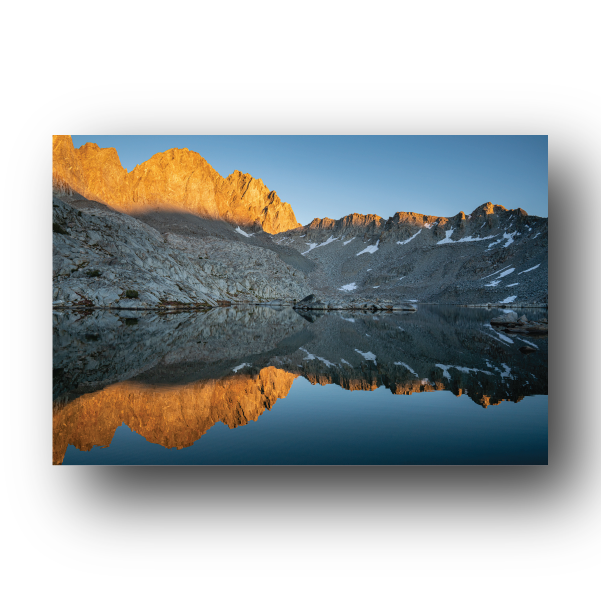
Often the best views take a little extra effort to enjoy, so stay fit and go seek wonderful views while living in a van.
5) Have resistance bands for working out, this can easy be done inside of the van
Resistance band workouts were popular during my time in college for rehab, which made me discount them as a viable workout, but that was my mind trapping me. With the right thickness of band, all exercises with enough reps can become a workout. If you are trying to become Arnold Swartzinigger, the bands are not going to be enough, but if you are trying to avoid muscle fatigue and live a healthy life, they are great.
Bands that I use:
-The Roll… great just in case you break a band
-Circular Bands… you don’t need these but they are nice (just tie yours together)
Upper Body Routine:
Three rounds of:
-Internal Rotation (20 Reps per arm)
-External Rotation (20 Reps per arm)
-Rows (20 Reps)
-Biceps curls (20 Reps per arm)
-Strict Press (20 Reps per arm)
-Wrist wriggles (20 Reps per hand)
-Tricep extensions (20 Reps per arm)
I promise, you’ll feel the burn if you have the correct “weight” to your band.
6) Don’t be afraid to stretch in your bed! This might be your largest area.
Getting out of bed is a key to starting the day, yet, in a van your bed might be the largest area that you have to move your body—queue the middle-school giggles—so make use of the space to stretch. In my van, I don’t have enough space to do the pin-wheel stretch nor supine twists on the floor, but I do on the bed. Often, you’ll find me stretching while journaling before bed. I’ve found once I get out of bed, make the bed, getting back into bed to stretch or work, I don’t have the urge to sleep.
Conclusion:
In the end, enjoy your time in a van and try not to stress about your physicality. As you are closer to nature than you have ever been before, take full advantage of the opportunity. Go for walks, go for hikes, enjoy your time with the access to the outdoors, and find what makes you happy. If you are eating mostly plants and being active, you are probably going to be healthy. On the flip side, if you are training for a goal, get after it and understand you can remain fit and train in a van depending on the type of training you need to do. Either way, go have a blast and enjoy van life!

Best Van Life Destinations
Coinciding with surge of U.S. based road trips and growing popularity among travelers to experience van life, especially in the Western United States, finding the correct places can be overwhelming, especially if this is your first van trip. Understanding rules for where you can park to sleep, which adventures you want be close to, and making the most of the time you have is why this article was written. Below are ten destination areas that are van life friendly, provide access to adventures, and are wonderful for a seasoned van lifer, or a newbie.
Introduction
I have been asking myself, after seven years of road trips, “Where are the best places to road trip?” Coinciding with surge of U.S. based road trips and growing popularity among travelers to experience van life, especially in the Western United States, finding the correct places can be overwhelming, especially if this is your first van trip. Understanding rules for where you can park to sleep, which adventures you want be close to, and making the most of the time you have is why this article was written. Below are ten destination areas that are van life friendly, provide access to adventures, and are wonderful for a seasoned van lifer, or a newbie.
As I reflect upon my seven years of road trip experience, I have been trying to answer the questions, “Where are the best places to road trip?” I have the answer. The best places to road trip in the United States are Nation Parks, scenic highways, and locations with good weather. All of these places are accessible, you can escape the tourist crowds, and you will get to see incredible landscapes that will take your breath away.
Kristin standing on the edge of the the river bank looking down at the vast canyon in Yellowstone National Park.
Yellowstone National Park
Location Pin: https://goo.gl/maps/1jCghSTnkmvDt8dU8
Best Season: Fall
Key Activity: Hiking
Other Recommended Outings:
1) Wildlife Tours
2) Stand Up Paddle-board outings
3) Geyser Watching
What’s so special about this spot?
Yellowstone has been a main attraction for years and an icon of the west, however, for those exploring the United States in a van Yellowstone is often skipped because of its location. While Yellowstone is a national park, aka no boon-docking within the park limits, there is ample free camping outside of the park. Also, the park is vast, making it hard to see its many geysers, ample wildlife, and explore its trail system difficult without the time allotted when traveling in a van. Personally, I have spent seven days wandering around, checking out waterfalls, swimming in rivers, and staring at as many buffalo as I can. Not to mention hiking to vistas, waiting for geysers to shoot to the sky, and so much more. Heck, I am excited to head back here this year so that I can explore this place in more depth.

Sunrise glowing on the Eastern Sierra skyline outside of Bishop, CA
Hwy 395—Lone Pine to Bishop
Location Pin: https://goo.gl/maps/vRtriT7BTsGoamCr5
Best Season: Spring or Fall
Key Activity: Peak Bagging
Other Recommended Outings:
1) Backpacking
2) Rock climbing
3) Alpine lake swimming
What’s so special about this spot?
What is peak bagging? Well, this is the next level up from backpacking. Peak bagging is backpacking with the goal of summiting peaks along the way. Most of the peaks throughout the Highway 395 stretch have at least one route that does not require technical climbing skills, yet still requires a substantial amount of fitness. The Eastern Sierra can be daunting, as the entry fee is typically 6,000-10,000 feet of elevation gain. If you are not ready for it, this slap to the thighs will burn, deep. However, it will be worth it!
Kristin stands and watches Mount Rainier creep out form behind the clouds.
Mount Rainier National Park
Location Pin: https://goo.gl/maps/4yXQvRx2drGWqbaR9
Best Season: Spring
Key Activity: Mountaineering
Other Recommended Outings:
1) Day hiking
2) Backpacking
3) Wild flower searching
What’s so special about this spot?
Not everyone wants to summit Mount Rainier while visiting, and, the best part about visiting this park, you don’t have to. Mount Rainier national park is a beautiful place to visit and see, especially in the spring time, because the hikes are filled with eye-popping blooming wildflowers. The air is crisp in the mornings, but come the afternoon, this rugged landscape is the perfect temperature for any type of outing. Just make sure to always have a rain jacket handy, it’s not called RAINier for nothing!
Kristin standing at an outlook near the Bixby Bridge along the Pacific Coast Highway in Big Sur, CA
Big Sur Coastline
Location Pin: https://goo.gl/maps/QkC1NCSCdHWqbhk69
Best Season: Spring
Key Activity: Hiking
Other Recommended Outings:
1) Surfing
2) Camping
3) Backpacking
What’s so special about this spot?
This rugged coastline has been the highlight of California’s iconic Pacific Coast Highway for years. So, does that mean it isn’t special anymore? Heck no! Big Sur is a magical place and if you are willing to do a little digging you can find tree swings overlooking the Pacific Ocean at sunset, wildlife barking to find their mate, waterfalls you can swim behind, fresh mountain springs to shower, and so much more. Notice, none of the above had to do with how amazing the sights are along the coast! Yes, make sure you hike along the rugged coastline, take many dips in the ocean, and maybe keep your eyes peeled for a spot surf.

Mount Moran reflected upon String Lake with low hanging clouds on a crisp fall morning in Grand Teton National Park, WY
Teton National Park—Jackson Area
Location Pin: https://goo.gl/maps/qHQr3vfwprKmFnRV7
Best Season: Summer
Key Activity: Climbing
Other Recommended Outings:
1) Hot spring soaking
2) Day hiking
3) Fly fishing
What’s so special about this spot?
Talk about a proving ground for adventure. Throughout the year, the variety of adventures seem endless. There is everything from alpine rock climbing, sport climbing, traditional climbing, resort skiing, backcountry skiing, hiking, trail running, ultra-runs, kayaking, paddle boarding, wakeboarding, fishing, canoeing, white water rafting, and so much more! Now, how does that sound to you? Like the place to be if you want to adventure right?!
What is amazing about this I area is that even if you don’t want to do any of the above, there is still something for you. How is this possible? In the town of Jackson, there are several places that show films and display great artwork. In addition, there are hot springs to soak in and wildlife to search after. Teton National Park is small, yet mighty. If you haven’t been, give it a try!
Sam on a traditional climbing route in Indian Creek called Hookers and Blow rated 5.10
Moab and surrounding area
Location Pin: https://goo.gl/maps/ZNGrqEU1L3eBWx457
Best Season: Early Fall
Key Activity: Astro Photography, Climbing, BASE jumping, paddling… heck everything!
Other Recommended Outings:
1) River Rafting
2) Canyoneering
3) Rock Climbing
What’s so special about this spot?
The desert, enough said. No, I will break this down for you all, however I do believe there is something special about a desert. Maybe, it is the direct observation with scarcity of life and water that is often not found in our daily lives? What ever it is, I would enjoy learning more about. Until the day comes that I can spend more time here, the greatest stand out of the area are the stars, they are endless. As day fades into night, the sky speckles with constellations. A little bit counter intuitive, however the best time to observe the stars is late-August, which means late-summer or early-fall is the best time to visit, aka the hottest time of the year. If this is the case, please make sure that you are well hydrated and wear skin protection.

Blanca Lake’s emerald green water observed from the sky on a cloudy day.
Blanca Lake in Washington state
Location Pin: https://goo.gl/maps/QvLaaonnRfzLZA1c6
Best Season: Fall
Key Activity: Backpacking
Other Recommended Outings:
1) Day Hike
2) Visit fire station outposts around the Seattle Area
3) Rock Climb in Index
What’s so special about this spot?
Soft ground squishes under your feet as you take the next step up the incline. Your lungs are stinging because the air is thin, but you have a blue tongue and smile from all of the blue berries you have been stuffing in your face. Blanca lake is a challenging hike up and over a ridge, but once you drop into the valley the glacial green lake comes into view. Winding your way down the trail to the water, keep your eyes peeled for a couple of springs to fill your bottle and quench your thirst.
While camping is not allowed around the lake, it is well worth slogging a tent to ridge so that you can spend extra time exploring around the lake. At first, the river leaving the lake might seem impassable, but there is a log hidden in the trees that you can set up to cross. Once across, enjoy the peace and quiet.
Scott navigating the narrow ridge-line of Matthes Crest in Tuolumne Meadows
Yosemite National Park—Tioga Pass
Location Pin: https://goo.gl/maps/LM1ao2dsmYX9WqGaA
Best Season: Summer
Key Activity: Backpacking
Other Recommended Outings:
1) Climbing
2) Cycling
3) Day Hikes
What’s so special about this spot?
Writing about Yosemite can be difficult because this land was the catalyst John Muir used to convince Teddy Roosevelt to create the infrastructure of the modern day National Park system as we know it. Outside of that, Yosemite is the birth place of climbing in the United States, a breeding ground for conservation movements, and so much more. However, Tioga Pass and the Tuolumne Meadows area is not too missed. If you are saying to yourself, "Why, it doesn’t have Half Dome, Glacier Point, or El Cap?" True, but Tioga pass is a highland that is filled with day adventures, alpine lakes, waterfalls, and endless granite domes. The kicker, due to snow, this area is closed for more than half of the year, so timing is important. For peak water flow, come early-summer and make sure to explore the Grand Canyon of the Tuolumne River in it’s full glory!
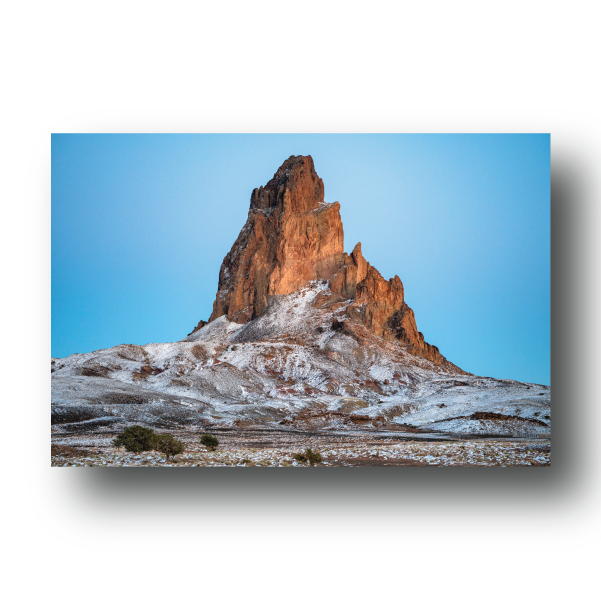
Seeing Agathla Peak for the first time on a road trip though the American South West.
Monument Valley
Location Pin: https://goo.gl/maps/UMXp6hpNvgv81bHZ8
Best Season: Late Fall
Key Activity: Hiking and Photography
Other Recommended Outings:
1) Soul Searching
2) Photography
3) Cultural Immersion
What’s so special about this spot?
Driving into the valley as the sun sets early in the fall months, the temperatures begin to drop as the desert air does not hold in the days heat. If you are in a van, be ready for a chilly night. Turning off my van, and it’s heater, the dashboard thermometer read 2 degrees Fahrenheit. Wandering back to bed, I crawled into my sleeping bag, turned on my red light, and read a quick story before trying to fall asleep. As the chill of the night crept through the walls, I knew I wouldn’t be able to sleep, so I got up, put on as many layers as I could, and headed outside to watch the stars. Taking in the illuminating sky, I understood why this place is said to be magical. This desert holds a power that humbled me, bringing me to my knees, and acknowledging my ephemeral position in this world.
Places and experiences like this bring me closer to why I have decided to live this life on the road. A cold nose and a few uncomfortable sleepless hours are the entry fee to a life of accessibility and perspective.

The popular paddle boarding location, bonzi rock, on a still morning in Lake Tahoe, NV.
Lake Tahoe
Location Pin: https://goo.gl/maps/y3PXMXC2uVLDj9b57
Best Season: Winter or Summer
Key Activity: Skiing or Paddle-boarding
Other Recommended Outings:
1) Rock Climbing
2) Thru-hiking
3) Cliff jumping
What’s so special about this spot?
Lake Tahoe and the surrounding area is a place that never gets old. Growing up only a stones throw away from here, my brother and dad worked at the ski resorts in the winter as a ski instructors, and many long weekends were spent around the lake. With that said, my exploration of Lake Tahoe’s seemingly endless potential for adventures didn’t begin until spent four nights and five days hiking the Tahoe Rim trail. This 160-mile thru-hike was a one of those spontaneous adventures that fueled my early days of adventures. After that trek, I started to see what other adventures I could find and boy did I find them. Rock climbing, paddle-boarding, mountain biking, and so much more.
As my Northern California roots call me home, I have come to love spending a month in Lake Tahoe for the early summer months before the heat turns up. At first, finding parking spots feels difficult in a van, but as you look around, you’ll find they are ample!
Conclusion
Well, the times is now here, which destination do you plan to visit first? Or, are you going to take a leap of faith and start a road trip through the Western United States you have been considering for the past few years? Regardless, the above ideal locations will provide you with a solid foundation to plan your next trip. Now, all you will need to do is load the van and hit the road.
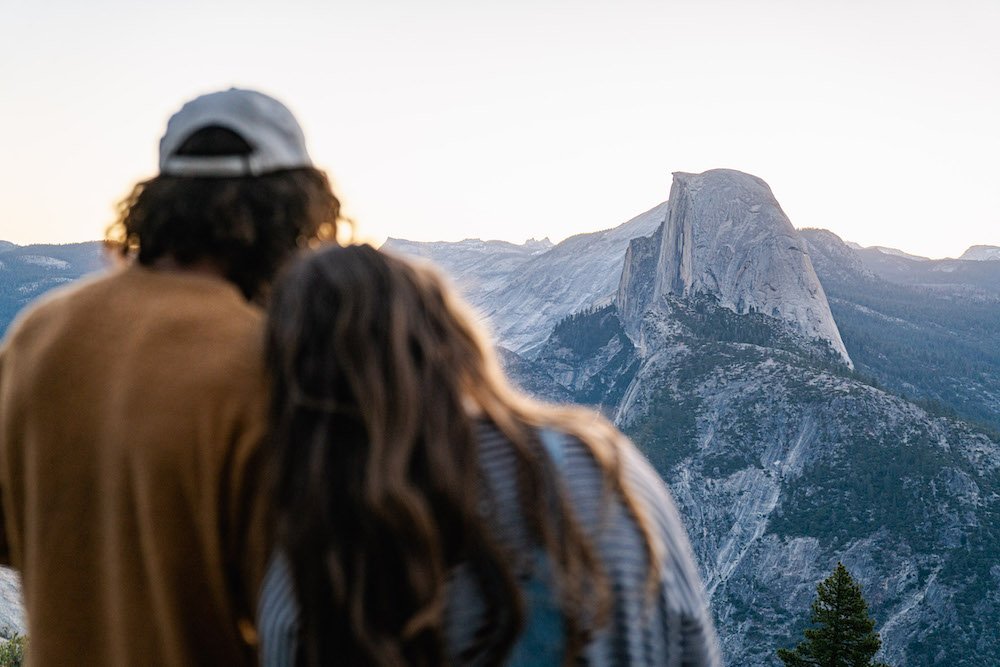
Lifestyle Photoshoot in Yosemite
Today is February 1st, which means it is time to flip your calendar :-) In addition to the video and calendar flip, I wanted to share some insights for your next visit to Yosemite National Park. If you are looking for a good day hike, iconic photographs to recreate, or just want to brainstorm ideas for your next trip to Yosemite, this is the blog for you.
Today is February 1st, which means it is time to flip your calendar :-) In addition to the video and calendar flip, I wanted to share some insights for your next visit to Yosemite National Park. If you are looking for a good day hike, iconic photographs to recreate, or just want to brainstorm ideas for your next trip to Yosemite, this is the blog for you.
Story Behind February Calendar Photograph

Why did I select this image:
Since this month is February, aka Valentines Day is almost here, I wanted to share an image that conveyed the feeling of love, happiness, and freedom. What better way to show this off than a couple dancing during sunrise at one of America's most iconic locations, Glacier Point. With Yosemite's Half Dome in the background, Victoria and Bryce dance on the diving board. All in all, this image captures the loving, playful vibe I wanted to convey for the month of February in celebration of Valentine’s Day.
Location:
If you decide that you want to visit this location, please make sure that you are careful as this location is dangerous for those who are unfamiliar with standing on a cliffs edge.
Directions to Glacier Point in Yosemite National Park
Make sure to check road conditions before going, this spot closes due to snow seasonally: https://www.nps.gov/yose/planyourvisit/glacierpoint.htm
Ideas for Your Next Yosemite National Park Trip
Five great day hikes:
1) Vernal and Nevada Falls via Mist Trail
2) Half Dome via John Muir Trail (make sure to get permits)
5) Sentinel Dome and Taft Point Loop
Day-hiking gear/resource recommendations:
-Perfect STARTER camera… this was my first set up!!
Other Classic Images to Recreate:
Glacier Point Road

Skateboarding Glacier Point at sunrise in Yosemite National Park, CA.
In the land of awe, trademarked by granite monoliths, Glacier Point is one of those places you can sit and stare, probably for a lifetime. As a climber, Yosemite is a place I often visit in search of testing my skills and endurance on rock. The Yosemite climbing culture has an obsession with pushing your limits and finding your current capacity. These climbers come from all walks of life, but a few common threads are lacing us all together; dirtiness, commitment, vitality. If you have the chance to visit this place, make sure to look beyond the awe and find a place to play.
Yosemite Falls

Yosemite Falls reflection in Yosemite Valley, CA
Yosemite National Park is a national icon that attracts a record number tourists annually. Luckily, most tourists enjoy their morning cup of coffee, warm shower, and time with a significant other. If you are chasing the sights, skip the shower, convince your partner to join you, and hike with your coffee to see the beautiful reflections that are abundant during a flood year in the late spring of Yosemite Valley. Most likely, you will only see a few others who brave the morning chill.
Current Waterfall status: https://www.nps.gov/yose/planyourvisit/waterfalls.htm
Driving Directions: https://goo.gl/maps/MabaSecTbNwYYSug6
Mirror Lake
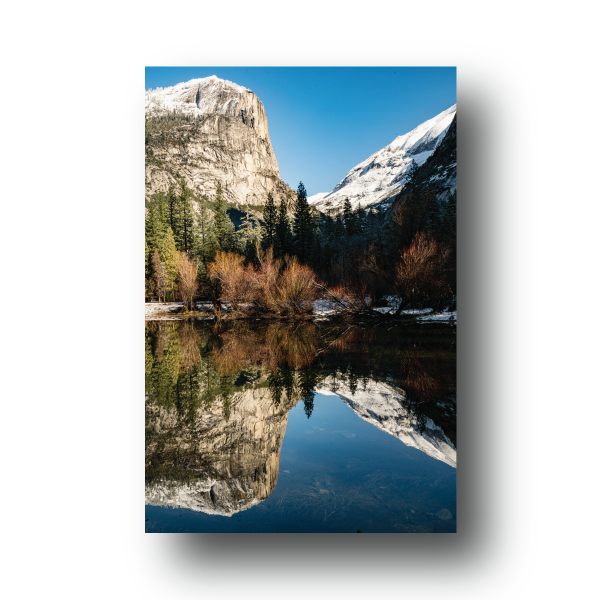
The perfect reflection of Mirror Lake in Yosemite National Park, CA
Mirror Lake is famous for its perfect reflection of Half Dome and Washington Column. For those who are not climbers, the lesser known Washington Column, photographed here, sits directly across the valley from Half Dome and has been the proving ground for many aid climbers throughout climbings history because of it’s steep walls and large ledge in the middle, allowing climbers to sleep without a porta-ledge. Throughout the year, sediment collects in the bottom of Mirror Lake, making this once iconic stop for hikers less common. If you want to see Yosemite’s Mirror Lake in it’s full grandeur, make sure to plan your visit during the spring, or early summer.
Little Yosemite Valley

Little Yosemite Valley of Yosemite National Park dusted with a recent snow in December.
Slugging a pack over my shoulder filled with snowshoes, multiple puffy jackets, two sleeping pads, two sleeping bags, my food, and a few other essential items, I headed into Yosemite’s backcountry for a few solo nights among the snow and granite. The movement was slow, but I dreamed of walking alone to clear my head. Searching for nothing, each step brought greater solace. The air was cold, the days were short, but I wandered without a shirt for the pack load was making me sweat. After a full day of incline, I turned around, only to find a moody, snow-dusted, little Yosemite Valley standing stoic, as it has for thousands of years. For the next few days, this would be my home away from home and the search for nothing was found.
Lodging Options:
-Places to stay inside of the National Park
Final Thoughts:
Exploring Yosemite National park has become one of the most important outings in my life to date. Since graduating college, this American landscape has taught me the importance of planning, shown me the power of community and solitude, and transformed my thinking from a desire to work a job from 9-5 into a nomadic life. Often, I revisit Yosemite to ground myself, stretch my creative juices, and find comfort in the discomfort of physically exercise. Year-round, the Sierra Nevada Mountains can be a playground for those who seek adventure. It doesn’t matter if you want to climb a big wall or go for a day hike, Yosemite Valley can inspire all those who take the time to settle into its awe-inspiring landscapes.
LASTLY, thank you for everyone who purchased a calendar this year, your support allows me to take my creative pursuits further!
46 Vanlife Tips for the Newbie to the Expert

How to have the most fun:
1) Do the things you love!
2) Push yourself outside of your comfort zone
3) Talk with strangers who are in your community
4) Make friends and travel together
5) Make a list of reasons you want to live in a van
6) Picnic often
7) Avoid cities
8) Level set your expectations
How to maintain comfort of a home:
9) Give yourself a few convinces you REALLY enjoy, like coffee or tea in the morning
10) Incorporate personal touches like a rug, photos on the wall, a candle/incense, a fuzzy blanket.
11) Get a HOT shower every now and then
12) Treat yourself and rent an room from time to time
How to stay fit:
13) Create a stretch/yoga routine
14) Eat mostly plants, avoid sugar
15) Do something outdoorsy, like; running, hiking, swimming, surfing, climbing, skiing…
16) Walk to your errands, save gas along the way
17) Have resistance bands for working out, this can easy be done inside of the van
18) Don’t be afraid to stretch in your bed! This might be your largest area
How to meet people:
19) Online groups like Facebook, meetups, etc.
20) Go to the places your community hangs out
21) Go to Cafes
22) Campsites/BLM land where fires are permitted
How to make money on the road:
23) Be a creative
24) Freelance
25) Digital Nomad
26) Seasonal Work
27) Consulting
How to find parking:
28) Walmart parking lots
29) Street parking in residential housing (controversial)
30) BLM land
31) Paid Campgrounds
32) iOverlander
33) Grocery Store parking lots
How to avoid being a total vanlife newbie:
34) Propping the back doors open to watch the view
35) Leaving the door open in cities
36) Know how to park your van
37) Gawking at every other van build… just come say hi!
38) Either stick out, or blend in. Avoid that awkward middle ground
Vanlife hacks!
39) Heat water once, put your extra in an insulated water bottle
40) Starbucks and libraries have free wifi
41) Use window coverings
42) Have a broom!
43) Be ready for rainy days inside the van
44) Have a heater and a fan
45) Download movies/tv shows ahead of time
46) Learn how to do everything while laying in bed
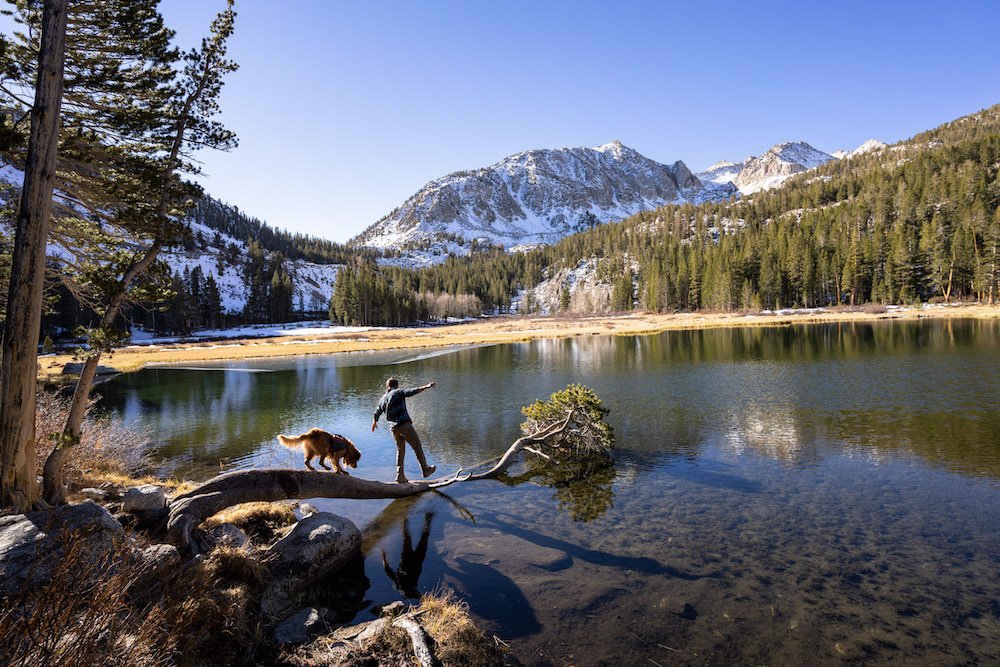
Best Adventures of the Eastern Sierra
DANG!! This was a cold one. Lake Sabrina is one of my favorite lakes to swim in during the summer, but I had not taken a dip in the winter… or late fall. When I say cold, I mean that I was shaking, my lips turned purple, and at some point, I ended up throwing up because I was so dang cold! Swimming in the Eastern Sierra during the winter was a fun challenge I am not sure I would take on for myself again. Once out of the water, I hunkered down in a sleeping bag, inside of my van, turned the heater on, and tried to warm up. Andrew was laughing at me the whole time!
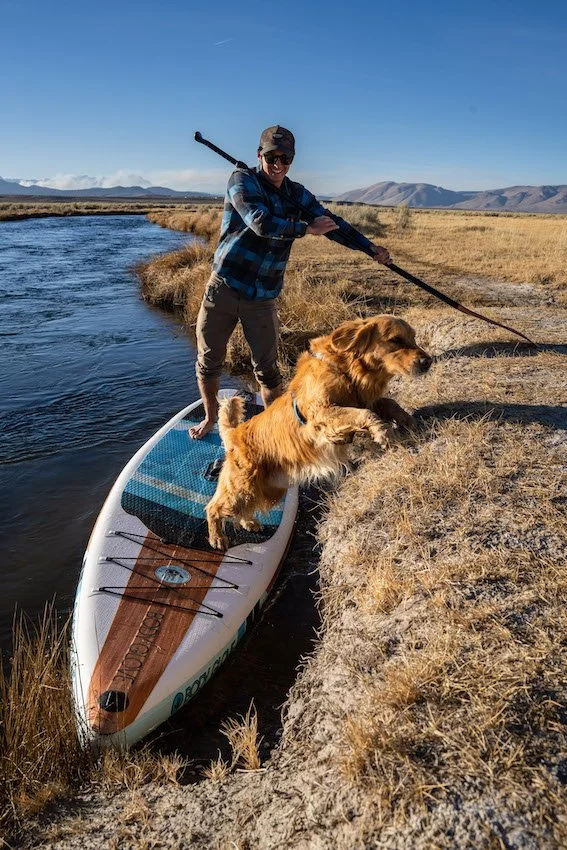
What to do in the Eastern Sierra?
Paddleboard on Owen’s River:
Along HWY 395, the possibilities of fun are just about endless. One of the great delights are the rivers. If you are a fisherman, go cast a line. If you are a paddler, go inflate that board and hit the river. Or, better yet, do both! Getting on the river with the paddle board was quite a joy, especially as the water was cool and moving at the right speed.
Swim in Lake Sabrina (even though it was FREEZING COLD):
DANG!! This was a cold one. Lake Sabrina is one of my favorite lakes to swim in during the summer, but I had not taken a dip in the winter… or late fall. When I say cold, I mean that I was shaking, my lips turned purple, and at some point, I ended up throwing up because I was so dang cold! Swimming in the Eastern Sierra during the winter was a fun challenge I am not sure I would take on for myself again. Once out of the water, I hunkered down in a sleeping bag, inside of my van, turned the heater on, and tried to warm up. Andrew was laughing at me the whole time!
Hike Out of the North Lake Trailhead to a Lake Jump above 12,000 feet:
Okay, okay, I know that I said in the paragraph above that swimming in a lake in the Eastern Sierra during the winter was not a very good idea, and one that I would not take on again, but I lied to myself. The next day, waking up at the North Lake trailhead, I crawled out of my van, only to find snow on the ground. As I put on my boots and layered up for the day’s hiking and photoshoot, I just couldn’t let this lake go without a dip. As the snow became impassable to access the upper Lamarck Lake, the lower was the only option.
Lower Lamarck Lake Location… CLICK HERE!
Soak in Wild WiLly’s Hot Spring:
If you are ever feeling a little bit sore after a long day of ski touring, rock climbing, or just got out of the backcountry from a week-long backpacking trip, these hot springs are a must. Why? Well, these hot springs are just one of many around the Mammoth area, just off HWY 395, so you can find a hidden gem without many people if you are willing to look. One key to looking is to watch for steam!
Location: https://www.outdoorproject.com/united-states/california/wild-willys-hot-springs
Boulder Around Bishop:
For those who are not climbers, the town of Bishop, CA—which highway 395 passes directly through—is a hub of climbing for much of the strong climbers. Bishop is home to every discipline of climbing; bouldering, alpine climbing, sport climbing, and good ole mountain scrambling. If you are a climber, Bishop is one of those places you’ll visit, just give it some time.
The two bouldering areas you will hear ALL OF THE TIME will be either the Buttermilks or the Tablelands (often referred to as the Happy’s or the Sad’s). These two areas have vastly different rock, which leads to a variety of styles and fun to be had. The buttermilks are crimpy, slippery, and hard granite. Meanwhile, the Happy’s or the Sad’s are more like gym climbing on volcanic rock; aka big moves on okay holds.
If you want to check this place out, here is the link to Mountain Project: https://www.mountainproject.com/area/105876411/buttermilk-country
Watch Breath-Taking Sunsets:
With everything said, some of the best times were the sunsets. The highway 395 corridor, which provides access to the Eastern Sierra, was referred to as the Range of Light by Ansel Adams. Ontop of that, Ansel Adams Wilderness is named after the iconic photographer. I mean, how prolific of a creative do you have to be to have the highest protected land designation named after you? That is quite an honor. I mean, just look at those sunset colors in the photo below… I’m drooling!
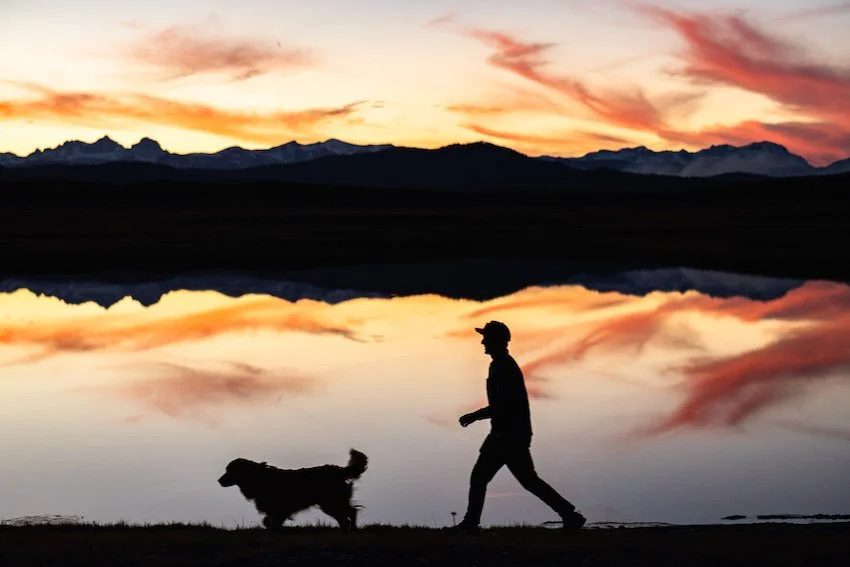
Conclusion
These last few days here in the eastern Sierra have a been a blast and the sunsets/sunrises have been out of this world. Much like the colors of the sky, the experiences have been a blast! From paddle boarding to hot springs to bouldering, I kinda feel like we have been getting our fair share of fun! As @andrew__muse and I head different directions for a couple weeks, I am grateful and stoked for what is to come.
Now, it’s time to put my head down and start grinding away on some editing! Lots and lots of editing. Good news is, I should be close the ocean, so surfing is back on the docket 😊
Discover More of the Eastern Sierra
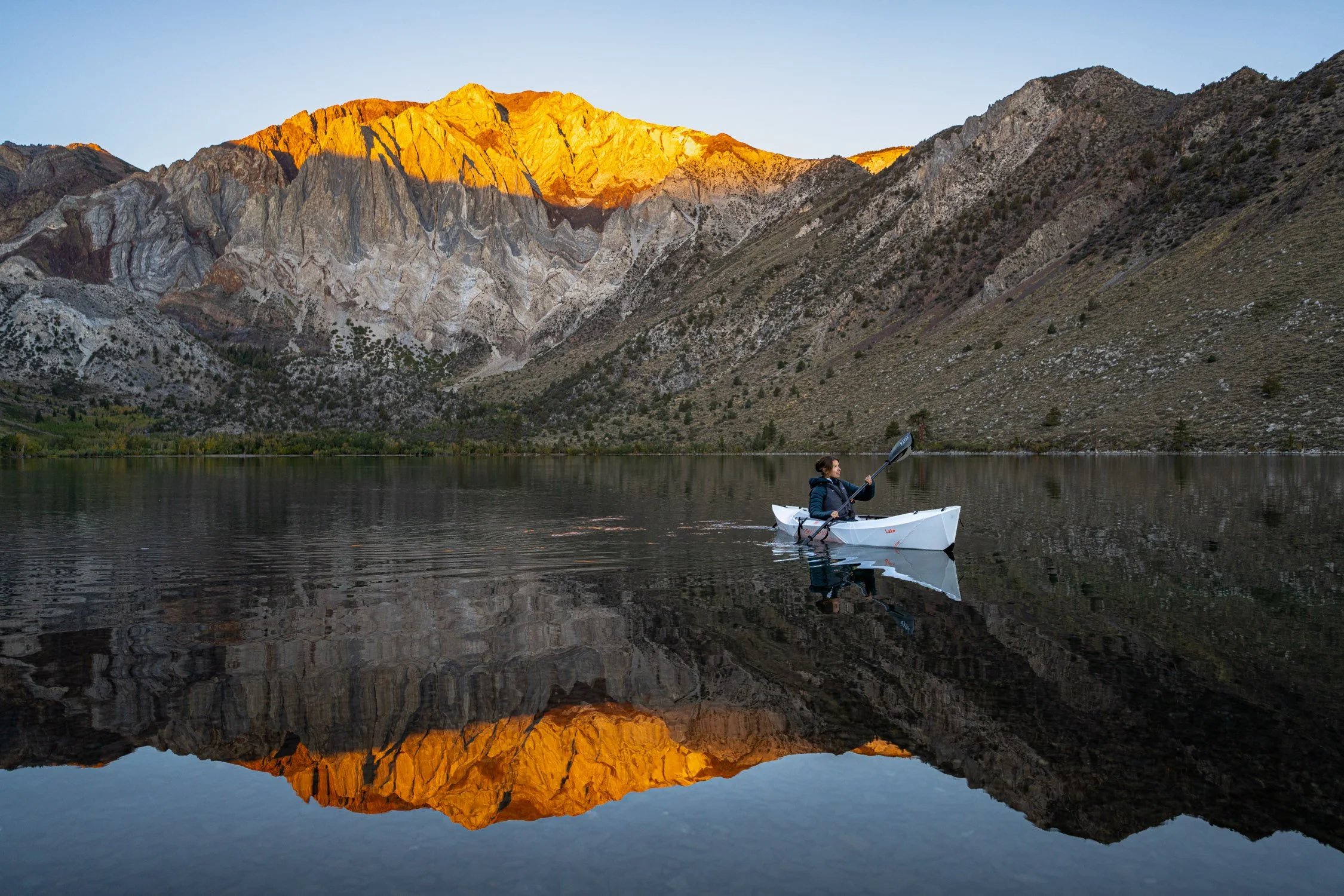
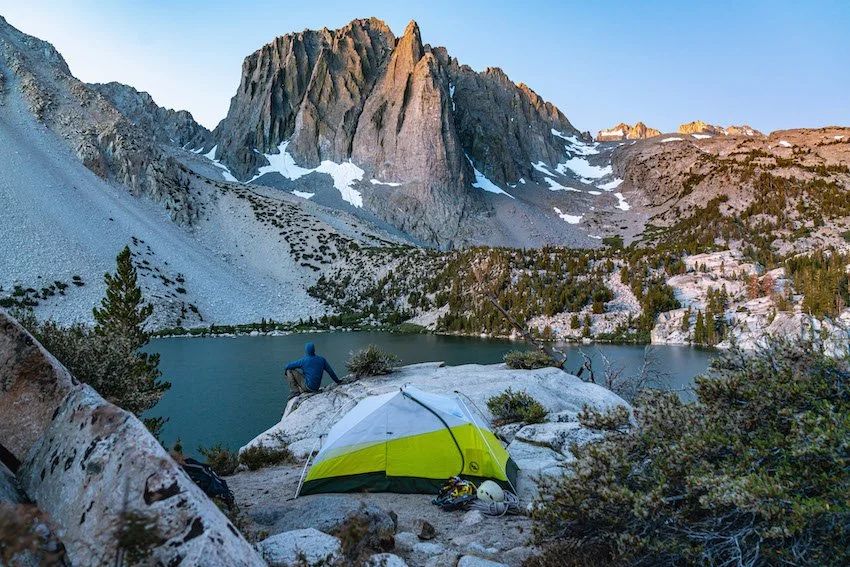
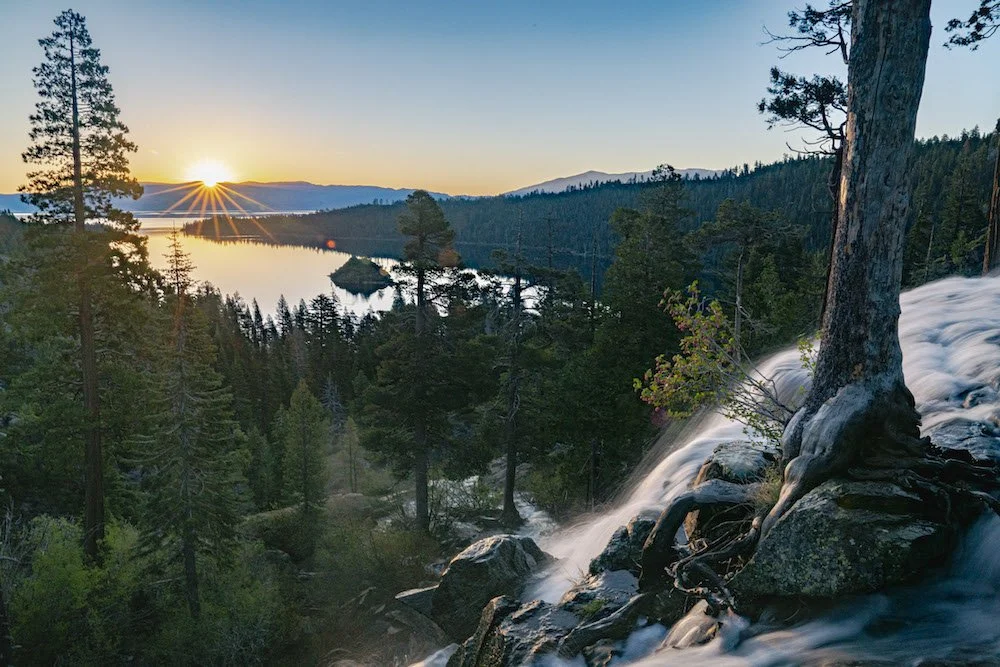

One Week of Van Life in the Eastern Sierra
Upon finishing the week long VLOG challenge, I am very excited to say that I completed the challenge and have been continuing with videos. They are fun to make and share with you all. Providing a glimpse into vanlife, a career of photography, and the long term value of living an engaging life.
Day 1: A crazy rainbow after a mountain storm breaks
It’s not every day you get to watch a storm break over the mountains, a full rainbow, and an epic sunset. I mean, starting the day in Bishop, CA I awoke to rain. At first, I thought the day was going to be a bust, because I didn’t get to climb, but instead it was quite the opposite. I mean, yeah, I didn’t climb, but whatever.
I ran around chasing rainbows with my camera and favorite @tamronusa lenses. I captured a few epic timelapses of the storm breaking, and eventually snapped a few sunset shots in the Alabama hills of Mount Whitney and Lone Pine. What a blessing today turned out to be! Well, I hope you enjoy day three of this vlog. If you like what you see, give me a like or comment. Heck, if you wanna be totally awesome, give this a share on your story and tag me.
Thank you so much for watching! If there is anything specific you want me to share let me know. You can DM me or drop it in the comments below 🤙
In this episode: Storm breaking Trail run Bishop, CA Whitney Portal Drone footage Sunset photos Driving Breakfast @daltonjohnsonmedia
Day 2: How to make the BEST pancakes in a van!
Pancakes!!!
Quite honestly, today was a day of bopping around and making the most of it. This morning was a slow one focused on journaling, business strategy, and photo ideas. From there I finished a blog, drank coffee, stretched, and MADE PANCAKES! I actually went into a deep dive of how to make pancakes my favorite way.
I met up with @andrew__muse and his adorable pup @kickerdogmuse Andrew drove to the Whitney portal from San Diego with a few packages for me from @tamronusa @kleankanteen and @timbersurfco so now we are set to head to Baja!
As the day progressed, I chased those two around in search of photos and epic landscapes. Pretty sure we nailed it. More for you all to watch and see here in the coming days!
Anyways, I hope you have a wonderful evening!
Sleep well and keep being awesome 🤙🤙
day 3: The start to the funniest video I have made to date
Why do we take ourselves so dang serious?! Well, today, I decided to stop! After a sunrise shoot with capitalizing on the alpine glow, @andrew__muse allowed me to suit up and put some creative ideas into practice.
While I still need to edit the video and put out for you all. As well as finish up the shooting, there are still a couple of ideas in the trunk that need to be pulled out. I am already excited for how outlandish this thing is. My guess, I find this funnier than you, but, hey, who is comparing?!
Anyways, we wrapped the rest of the day up with a few fun shoots, took the dirt bike for a ride and did some donuts, and then had a very peaceful and PG photoshoot in a tent.
All in all, today was fun. Lots of content was made, and we just had a great time doing it! I hope you had a fun day 🤙
Shout out to @timbersurfco for getting a board to me quickly before heading to Baja!
day 4: The MOST creative photo portrait session I have had!
Creativity for creativities sake! That was the mantra for todays.
At 5:20 am I awoke and started the day off with a photoshoot in a classic Alabama Hills locations with @andrew__muse
Once back at camp @mindbodywithleah and I put together a photo idea. Brainstorming an idea to try to balance the masculine and feminine.
Around 2:00pm we headed off on a hike to a really sweet location in the mountains that has a bit of cool climbing history to shoot the idea.
All in all, this was a blast to shoot!
Note, while I was shooting stills, Andrew was shooting video. I think he might be making a little cut from this outing as well!
Today is day 6 of my 7 day challenge. If you all have been liking these videos, let me know! Also, if you would like these to continue on, you should let me know as well!
day 5: I did it! One week of daily VLOGS
Well, it is day seven and it looks like I succeeded here! Very stoked to have given this a try and shared with you all along the way.
A fun week and honestly, these little pieces have been very fun to create! On top of that,the daily reflection has made this quite introspective. Life can definitely be fun if you look at the little details.
Heck, getting groceries today was fun and rewarding, especially because I knew I had nothing left to eat but a can of olives 😂
Anyways, I am totally rambling. However, I am thankful for you all! Hope you have had a great week 🤙
day 6: If money was not a thing, what would you be doing everyday?
If money was not a thing, what would you be doing everyday?
As life on the road has become my norm, I fill my days with fun, work, and curiosity. Through these three lenses I make my way through the day, typically finding something amazing I wouldn’t otherwise expect.
Todays gift was @mindbodywithleah taking the time to help me work out some chronic back pain I have had for the past few years. Turns out, my breathing, belly breathing, will be the driving habit to correct the pain.
Learning is cool!
Discover More of the Eastern Sierra


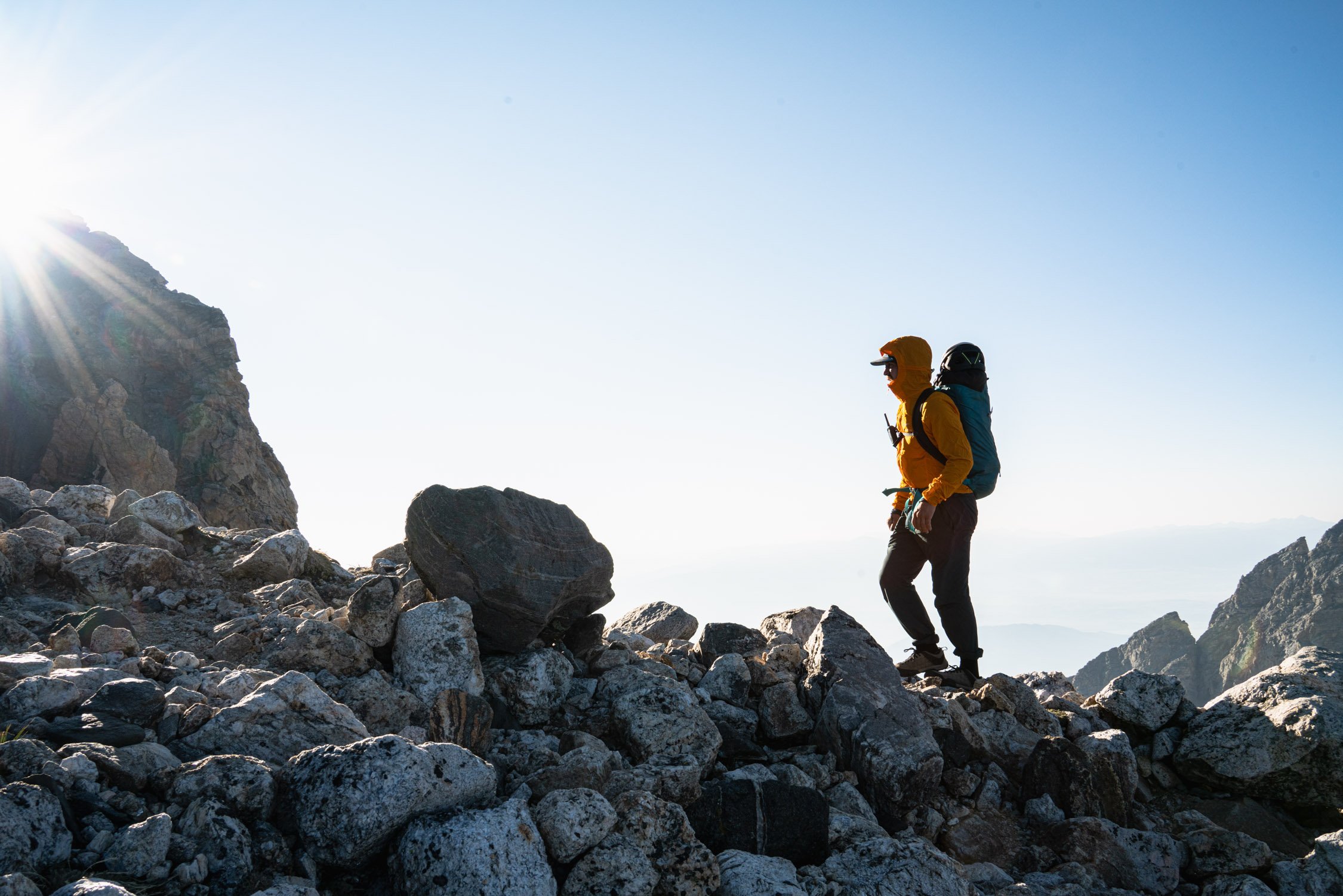
Rock Climbing with Comedian Influencer Beau Martino
After a little mix up, @cbeaumartino and I met up in the buttermilks just outside of Bishop, CA for some climbing. While waiting, the morning was quite productive as I worked on a blog about cool camping spots in the Eastern Sierra.
After a little mix up, @cbeaumartino and I met up in the buttermilks just outside of Bishop, CA for some climbing. While waiting, the morning was quite productive as I worked on a blog about cool camping spots in the Eastern Sierra.
Once Beau arrived, him and I went on a little circuit of V0-V2s and then scrambled the buttermilk scramble. It’s been a little while since I had climbed with Beau, but it’s fun every time! I’m this episode:
Bouldering
Rock climbing in Bishop, CA
Coffee
Van Life
Daily chores
Morning routine
Follow Beau Martino on Instagram!
Discover More of the Eastern Sierra
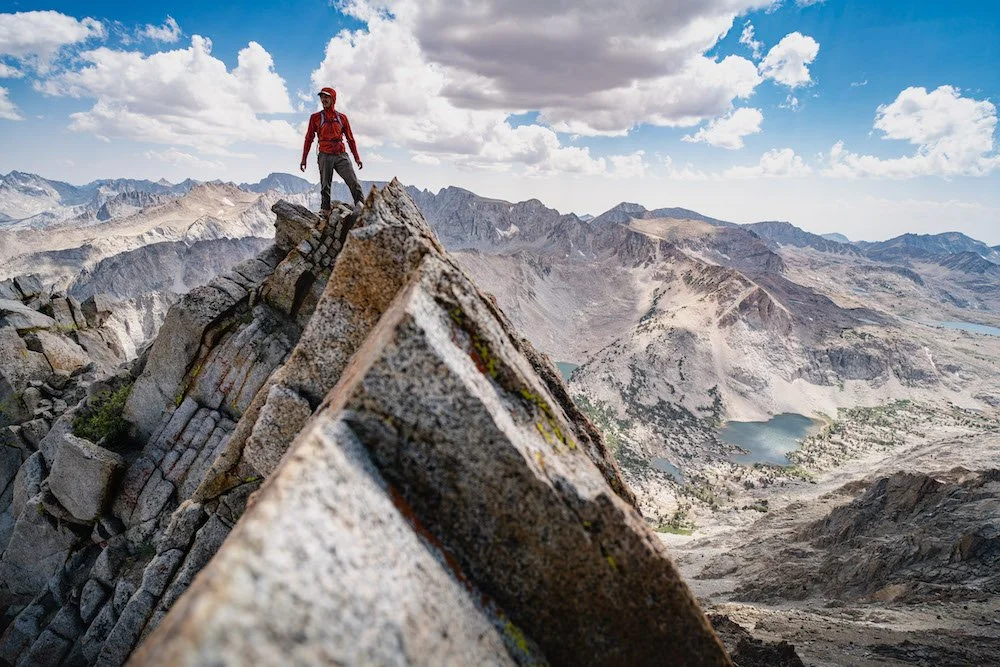
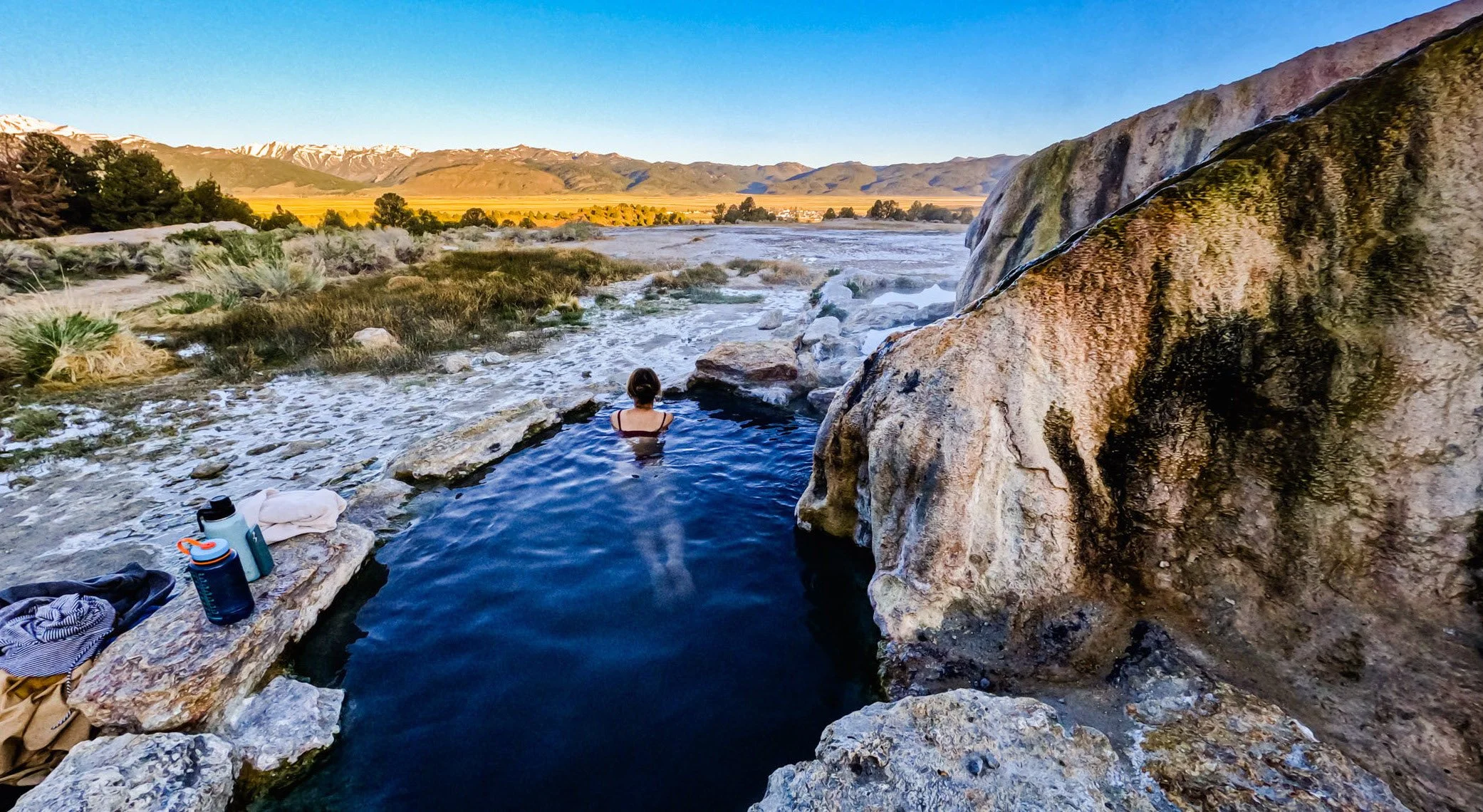
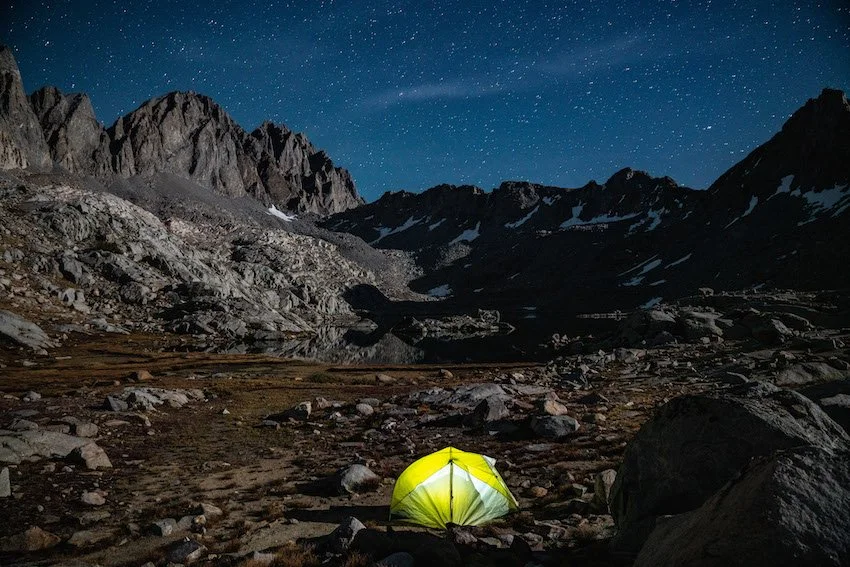

Is Van Life Right for Me?
Van life has become a popular lifestyle choice for individuals seeking adventure, freedom, and a closer connection to nature. For many, the idea of traveling the open road, waking up to breathtaking views, and living a minimalist life sounds like a dream come true. However, before diving headfirst into the van life movement, it's essential to evaluate whether this lifestyle is the right fit for you. In this article, we'll explore the pros and cons of van life, how to test if it's suitable for you, common mistakes to avoid, and tips for beginners.
Van life has become a popular lifestyle choice for individuals seeking adventure, freedom, and a closer connection to nature. For many, the idea of traveling the open road, waking up to breathtaking views, and living a minimalist life sounds like a dream come true. However, before diving headfirst into the van life movement, it's essential to evaluate whether this lifestyle is the right fit for you. In this article, we'll explore the pros and cons of van life, how to test if it's suitable for you, common mistakes to avoid, and tips for beginners.

Pros:
Freedom: Van life offers unparalleled freedom to travel where you want, when you want. You can wake up to a new view every day and explore diverse landscapes without being tied down to a specific location.
Connection to Nature: Living on the road allows you to immerse yourself in nature. Whether it's waking up to mountain vistas, camping by the ocean, or stargazing in remote areas, van life fosters a deep connection with the natural world.
Minimalist Lifestyle: Embracing minimalism can be liberating. In a van, you're forced to prioritize essential belongings, decluttering your life and focusing on experiences rather than material possessions.
Cost Savings: Depending on your lifestyle, van life can be more cost-effective than traditional living. You save on rent or mortgage payments, utility bills, and other expenses associated with stationary living.
Cons:
Lack of Space: Living in a van means limited space for belongings and activities. You'll need to downsize significantly and adapt to a minimalist lifestyle, which can be challenging for some.
Limited Amenities: Van life often means forgoing luxuries like a consistent hot shower, a full kitchen, or ample storage space. It requires adjusting to simpler living conditions and embracing alternative solutions for everyday needs.
Maintenance and Repairs: Vans require regular maintenance, and breakdowns can occur unexpectedly. Being handy with basic repairs or having access to reliable mechanics is essential for van dwellers.
Social Isolation: While van life can be incredibly freeing, it can also lead to social isolation, especially if you're constantly on the move. Building and maintaining relationships may require extra effort and creativity.
The Appeal of Van Life
For individuals in their mid-20s to mid-30s who crave adventure and freedom, van life holds a unique allure. As an affordable way to travel the world, today’s youth have capitalized on the influencer economy and work from home opportunities while living on the road. But, that they are not the only ones seeking nature and freedom. The Baby boomers are discovering van life as they move into retirement, purchasing prebuilt rigs from Airstream. What do they have in common? The idea of waking up in different locations, exploring national parks, and experiencing the diversity of the United States firsthand can be incredibly enticing. Van life offers a sense of autonomy and flexibility that traditional lifestyles often lack. It allows you to break free from the constraints of a stationary existence and embrace a more nomadic way of living.
Testing the Waters
If you're intrigued by van life but uncertain if it's right for you, there are several ways to test the waters before committing fully:
Rent a Van: Many companies now offer weekend or short-term campervan rentals. This allows you to experience van life without the long-term commitment. Spend a weekend or a week exploring in a rented van to see how you adapt to the lifestyle.
Car Camping: Load up your vehicle with a tent and camping gear and head to a nearby Bureau of Land Management (BLM) area or national park. Car camping gives you a taste of living on the road while still having the option to retreat to a traditional tent setup.
Live on a Bicycle: For the adventurous souls, living on a bicycle tour can provide insights into minimalist living and self-sufficiency. If you can thrive with limited possessions and adapt to changing environments on a bike tour, you may find van life appealing.
Common Mistakes to Avoid
Underestimating Costs: Van life isn't always as cheap as it seems. Factor in fuel, maintenance, insurance, campground fees, and unexpected expenses when budgeting for life on the road. Looking for a deep dive on how to do van life on a budget? Here’s a full article about van life on a budget.
Ignoring Local Laws and Regulations: Be aware of parking restrictions, camping regulations, and other laws in the areas you visit. Respect the environment and communities you encounter during your travels.
Overpacking: Resist the temptation to bring too many belongings. Overpacking leads to clutter and reduces the functionality of your living space.
Neglecting Safety and Security: Prioritize safety measures such as securing valuables, having emergency supplies, and familiarizing yourself with basic self-defense strategies.
Beginner Tips for a Successful Van Life Experience
Plan and Research: Research potential routes, campsites, and resources before hitting the road. Having a rough plan can prevent unnecessary stress and help you make the most of your journey.
Stay Flexible: Embrace spontaneity while remaining flexible with your plans. Weather conditions, road closures, and unexpected opportunities may alter your itinerary, so adaptability is key.
Invest in Quality Gear: Opt for durable and efficient equipment that suits your lifestyle. From solar panels for power generation to compact kitchen essentials, invest in gear that enhances your van life experience.
Connect with the Community: Join online forums, attend van life gatherings, and network with fellow travelers. The van life community offers valuable support, resources, and camaraderie.
Is Van Life Dying?
While van life has gained popularity in recent years, there are concerns about its sustainability and impact on local communities and the environment. Overcrowding at popular destinations, waste management challenges, and increased regulations in some areas have raised questions about the future of van life.
However, the essence of van life—freedom, exploration, and a deeper connection to nature—remains appealing to many. As the movement evolves, responsible van dwellers prioritize environmental stewardship, community engagement, and sustainable practices to ensure the longevity of this lifestyle.
If you are curious why van lifers are quitting, here’s a deep dive into the topic.

Sorting gear for the next rock climbing outing with fellow van life rock climbers. Photo by Dalton Johnson
Ultimately, whether van life is right for you depends on your personality, priorities, and willingness to embrace the challenges and rewards it offers. Testing the waters through short-term experiences, understanding the pros and cons, avoiding common pitfalls, and seeking support from the van life community can help you make an informed decision.
Van life is not without its challenges, but for those who crave adventure, freedom, and a deeper connection to the world around them, it can be a transformative and fulfilling journey. As you contemplate embarking on this lifestyle, remember that the open road awaits, ready to unveil its wonders to those brave enough to explore it from the comfort of their rolling home.