

What is Adventure Photography?
Taking photographs from the mountains, deep in the woods, dangling from ropes, under the ocean… the limitation to adventure photography is your mind and ability to access places. While adventure photography traditionally focused on authentic photojournalist ethics, the commercialization of the industry has changed the landscape of adventure photography. This broadening of the genre has helped build many sustainable photography careers for those who have adapted to the changing times and stories. But, what is adventure photography?
Taking photographs from the mountains, deep in the woods, dangling from ropes, under the ocean… the limitation to adventure photography is your mind and ability to access places. While adventure photography traditionally focused on authentic photojournalist ethics, the commercialization of the industry has changed the landscape of adventure photography. This broadening of the genre has helped build many sustainable photography careers for those who have adapted to the changing times and stories. But, what is adventure photography?
Adventure photography, originally an off-shoot of photojournalism, is the blend of landscape photography with action sports photography focused on telling a story. This combination showcases humans pushing their limits in physically demanding outdoor sports, often considered extreme sports, like rock climbing, mountaineering, white water kayaking, BASE jumping, surfing, skiing, SCUBA diving, free-diving, backpacking and so much more. The end goal of adventure photography is to tell a visual story of an adventure.
Read on to discover the types of adventure photography, the gear needed, leading adventure photographers, how to become an adventure photographer, how much adventure photographers make, and so much more.
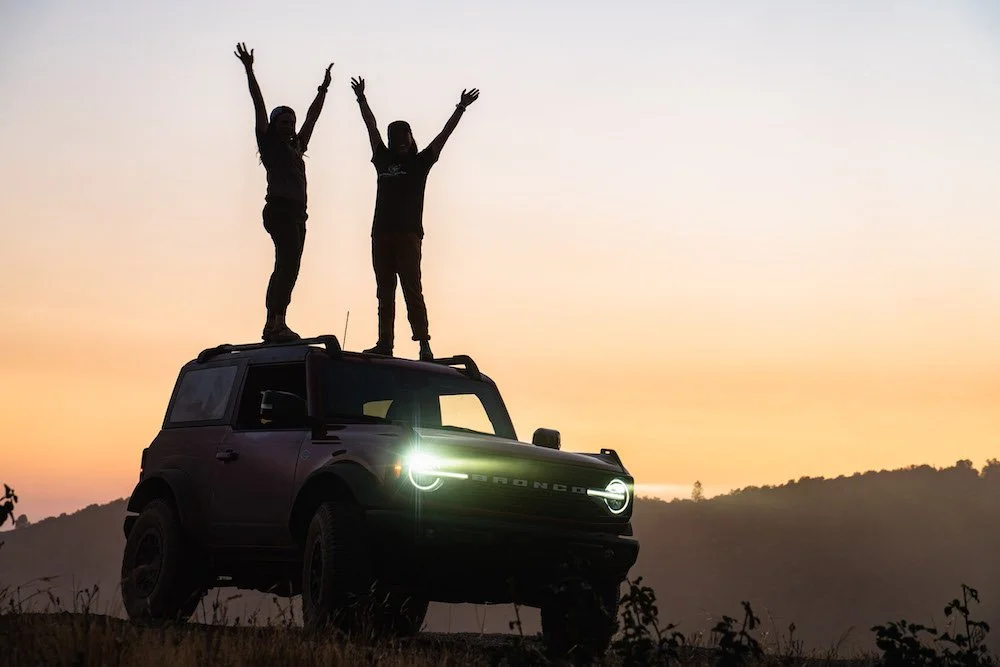
An example of commercial adventure photography for the Ford Bronco. Photograph by Dalton Johnson
types of adventure photography
Adventure photography has grown and expanded over the years, but the overall look/feel of adventure photography remains the same. Adventure photography is rooted in adventure, which means dirty hands, sore bodies, and wonderful stories to tell. As the genre of adventure photography expands there have been five distinct types of adventure photography which are:
Documentary/editorial - Authentic stories told using a photojournalistic approach. Editorial adventure photography is considered the original form of adventure photography.
Commercial/advertising - As the outdoor industry blossomed and money has flooded into the adventure space, companies now fund content creation that sells their products in combination with the raw and real look of adventure photography. This is where the most money is at for those looking for a sustainable career in adventure photography.
Lifestyle - Lifestyle is a broader, more encompassing type of adventure photography that is more focused on travelers. The adventure stories told are less about extreme sports and more focused on adventures that do not require a high level of skill like hiking to beautiful vistas, road trips, and guided excursions.
Artistic - The artistic trend of adventure photography encompasses the concept of adventure, but does not tell a story in the traditional manner. This form breaks the barrier and pushes adventure photography forward.
Influencer - Social media is omnipresent for photographers todays and has been the foundation for jump-starting many careers. Adventure photographer influencers are often a combination of all the above, but have built an audience of their own. Often, the stories they tell are of themselves, focused on “inspiring others”.
What gear is needed for Adventure photography
Adventure photography doesn’t require much in terms of photography gear. Most beginner adventure photographers have a single camera and one lens (typically a 24-70mm). The demand is not in gear, but in the ability to “get the shot” in hard to reach places, meanwhile tell a story that will captivate audiences. But, what do you really need?
Beginner Gear:
One camera (most likely mirrorless)
One lens (24-70mm)
Intermeidate Gear:
1 or 2 cameras (most likely mirrorless)
Several lenses, most popular would be the zoom lens trio: wide (12-24), standard (24-70), telephoto (70-200)
Drone
Tripod
Filters
Advanced Gear:
Several cameras (both stills and video capable)
Several lenses
Tripod
Gimbal
Drone, maybe several
Filters
Sliders and time-lapse equipment
Who are adventure photographers?
Adventure photographers are becoming the “cool kids on the block” as social media glamorizes gorgeous landscapes that are hard to reach. The field is predominately male, however there are several female adventure photographers stirring things up. Below is a collection of up-and-coming and established adventure photographers you should know, follow, and study their work:
An example of lifestyle adventure photography showcasing a hike during sunrise while on a national park road trip. Photograph by Dalton Johnson
HOw much do adventure photographers get paid?
The career path of adventure photographs varies widely. Because of this, creating an “average pay” for photographers is not possible, however you can have a sustainable and fruitful life as an adventure photographer.
Beginners:
$10,000 - $30,000 a year. These photographers often do not understand the industry, don’t have many connection, and are typically unknown. Many will only have one revenue stream and do not know who/what they can create. Building a portfolio you can share is critical at this stage.
Intermediate:
$30,000 - $75,000 a year. These photographers are stuck between a rock and a hard place. They make enough money to get a taste of how fun being an adventure photographer can be, but they don’t have much freedom yet. While in this stage, you are constantly working, shooting spec pieces, marketing, and trying to make a name for yourself. Keep your head high and work your buns off. You can make it to the next grouping.
Advanced:
$75,000 - $250,000 a year. These adventure photographers have made a name for themselves and are sought after for their work. Most of these photographers have been in the industry for several years (7+) and have several revenue streams. While they may create good work, they might not be well known on social media. Much of their work will be commercial based. Some in this grouping will have assistants and/or agents that represent them.
The Top 1%":
250,000 - $1,000,000+ a year. These are the top of the top and have full teams behind them, supporting them. They have a diverse grouping of revenue streams and often combo photo and video in some capacity. Often these creators have large social media followings because their work has created a change in some capacity. The majority of their projects will be a combination of commercial and editorial work.
How to become an adventure photographer:
At the moment, there is no clear path to becoming an adventure photographer, but there is a general outline of milestones that can act as guardrails for your career trajectory. At the end of the day, building a sustainable career in adventure photography is not an easy path, often having several years of little, to no pay, that can be done, if you want it bad enough. A few important milestones for along the career path of adventure photography (note these are in no particular order):
First time getting paid for your work
Landing your first publication
Going “full time” as a content creator
Getting a cover photography
Shooting a small commercial project
Shooting a commercial campaign
Becoming and sustaining a full-time freelance career
Learning to license your images in your archive
Getting staffed at a magazine or company
Creating/being published in National Geographic
Growing a social media account
Making 100k in a year
Making 250k in a year
Hiring a full time assistant
Shooting personal projects to build a portfolio and name for yourself
If you want to learn how to land commercial photography jobs, check out this blog I wrote about it!
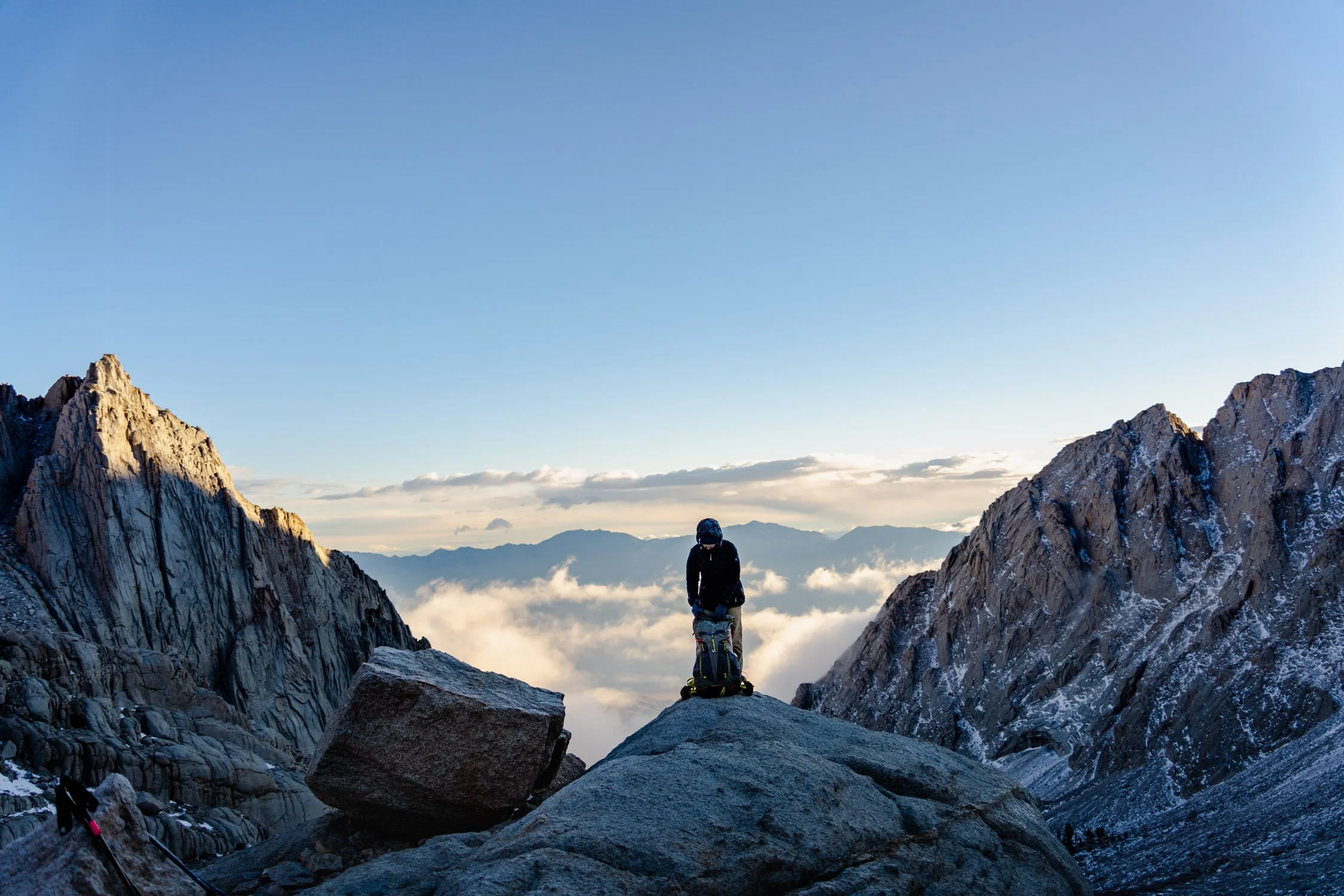
An editorial style adventure photograph of Sam while on a rock climbing road trip around the western United States. Photograph by Dalton Johnson
Now that you have discovered the types of adventure photography, the gear needed, leading adventure photographers, how to become an adventure photographer, and how much adventure photographers make, it is your turn to chase after the dream and become an adventure photographer. If you have any advice, or additional questions, about becoming an adventure photographer, please drop a comment below and I will do my best to help you all out!
Discover more of adventure photography

Dreamland
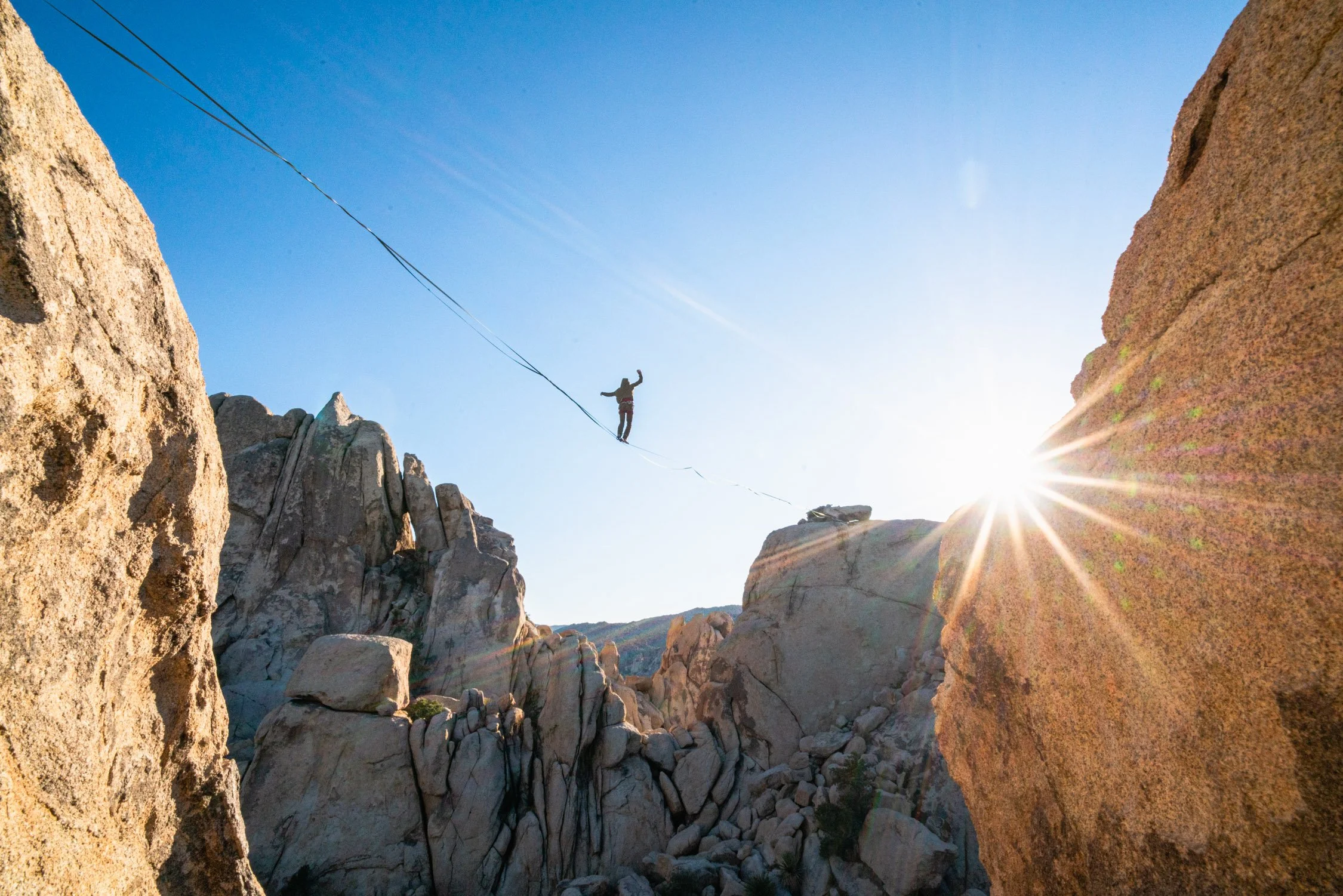
We headed to places like Baja and Joshua Tree to surf, rock climb, high-line, and engage with the natural world instead of feeding into the addition of consumerism. We traded new clothes for dirty ones that smelled of sweat from a fun day out in the sun. There wasn’t a whole lot of computer time, but, boy oh boy, was it stressful as we learned to place our lives in cams and nuts while climbing cracks.
Have you ever gone to bed and dreamed about the life you wish you had?
Well, this video is a play on that concept, but we lived it. Instead of just dreaming about the life we could live, together, we accepted the challenge and made those dreams a reality.
We headed to places like Baja and Joshua Tree to surf, rock climb, high-line, and engage with the natural world instead of feeding into the addition of consumerism. We traded new clothes for dirty ones that smelled of sweat from a fun day out in the sun. There wasn’t a whole lot of computer time, but, boy oh boy, was it stressful as we learned to place our lives in cams and nuts while climbing cracks.
Overall, we all are not the strongest group of dirtbags, nor are we the dirtiest, but we are a group of humans that love getting outside and living our dreams.
Discover other creative works by dalton


Type 2 Fun | A Cinematic Adventure
Now that we understand what type 2 fun is, where does inspiration come from behind this video? My adventures. Since 2016, I have dedicated my life to adventures that range from the grand to the micro. Just the idea of adventure get’s me excited and I often read books about adventures just to get the ideas flowing.
Type 2 Fun Script
I have no idea why I keep going on these adventures. Half the time I am asking myself, “what the hell am I doing?”
Things are always breaking, often I am shivering alone in a sleeping bag, pedaling into a horrific head wind, or puking my guts out from altitude sickness… Like, does that even sound fun to you?
If it does, I think you are kinda messed up. But, the good kind of messed up because it means you and I are alike.
Ehhh then again, maybe that’s a bad thing. Does the world really need two of us?
We are the weirdos. Lovers of monotony. Freaks of nature who fancy a good a ole fashioned suffer fest.
Pedaling down dirt roads in search of something, anything really. If we are lucky, it’ll be a hot spring or a pretty view, but most of the time it, is nothing more than some flat ground to lay our heads.
Even if that’s the case, you’ll find me dancing like a fool. It’s just one of those things that brings me joy.
The funny part of these trips, I hate them. Like really, I don’t enjoy it. Yet, I love them once the trip is over and find myself asking, “what stupid thing is next?”
A trip to the mountains, another bike packing trip, endurance trail run, who knows?
For now, I’ll just keep scrolling though the memory bank, happy I elected to suffer for week.
I guess that is why they call it type two fun.
Idea Behind the Video
As a lover of type 2 fun, the script above landed on a piece of paper as I journaled one morning. Most of the video content had already been shot, so I just needed to have the editing work done, but where did the inspiration come from? First, let’s answer the basic question, what is type 2 fun?
Type 2 fun occurs when a task is difficult at the time, but feels rewarding afterward, often because it challenges the practitioner to test their limits and grow.
Now that we understand what type 2 fun is, where does inspiration come from behind this video? My adventures. Since 2016, I have dedicated my life to adventures that range from the grand to the micro. Just the idea of adventure get’s me excited and I often read books about adventures just to get the ideas flowing.
Yet, this video predominantly comes from a semi-recent supported bikepacking adventure that I did from Lake Tahoe to Mount Whitney, where I bikepacked and tried to hike to the summits of both peaks.
Shooting the Video
I wish I could say that this was filmed on a high end camera, but the reality is I used a GoPro because I didn’t want to carry much weight, as this trip was a personal project. The content for this video was shot during a supported bikepacking trip from Freel Peak to Mount Whitney. Honestly, this video was kind of one of those “what do I do with this footage” kind of videos, which gives the video its raw and authentic feeling.
In many ways, some of the best adventure movies in the world are created this way.
The goal with this video was to take the content from the trip and showcase the spirit of type 2 fun, aka the suffering an adventurer goes through on an adventure. Mostly, this is a mental battle, but sometimes this is a physical one as well. In my case for this trip, it was both.
Discover More Creative Works By Dalton

How to Bootstrap a Summer in Alaska
Our morning was the start to a perfect Alaskan day. The sun was out and a cool breeze from the Arctic Ocean kept the fog away as we commuted across Kachemak Bay. Stepping off The Far Side, a two story boat, onto Stillpoint Lodge’s dock in Halibut Cove, Alaska where we were greeted by the staff – they already knew our names – and escorted us to the main lodge. We enjoyed any drink of our choice and a charcuterie board as we learned about the float plane flights, glacial kayaking, and wildlife tours in store for us this week. A quick tour of the grounds, ending at our private cabin overlooking the cove. My girlfriend, Kristin, and I were out of place. A single night at the lodge cost more than I make in a month, yet we were here for a week and it wouldn’t cost us a dime. So, how is that possible?
Our morning was the start to a perfect Alaskan day. The sun was out and a cool breeze from the Arctic Ocean kept the fog away as we commuted across Kachemak Bay. Stepping off The Far Side, a two story boat, onto Stillpoint Lodge’s dock in Halibut Cove, Alaska where we were greeted by the staff – they already knew our names – and escorted us to the main lodge. We enjoyed any drink of our choice and a charcuterie board as we learned about the float plane flights, glacial kayaking, and wildlife tours in store for us this week. A quick tour of the grounds, ending at our private cabin overlooking the cove. My girlfriend, Kristin, and I were out of place. A single night at the lodge cost more than I make in a month, yet we were here for a week and it wouldn’t cost us a dime. So, how is that possible?
Pros of work trades
You get to be creative! You can extend your trip
You feel appreciated and wanted, as your collaborator is investing in you as well
You might build a side hustle to fuel your passions
CONS of work trades
You might have to take work home from vacation
It’s possible everyone will say no, but that rarely happens
Jumping into Halibut Cove while on a van life road trip in Alaska. Photograph by Dalton Johnson
Connecting with Potential Clients
Flash back one month. I had just gotten off Denali, where I was making a mini-documentary on a climber attempting to summit North America’s tallest peak, and was beginning to sort through the footage in my van, in a grocery parking lot, waiting for Kristin to land in Anchorage. Our plan was simple: a road trip around the Kenai Peninsula for a month, then begin the 3,200 mile drive back to California.
For the past seven years, I had been building a sustainable career in the outdoor space as a content creator focused mainly on adventure sports, like surfing and mountaineering. During these seven years, I had been dreaming of visiting Alaska, but the cost was always far too great for me to afford on my own. With a bit of luck, I landed the job to film on Denali, but I knew I wanted to stay longer. I wanted to explore the vastness of Alaska and I wanted to expand my work into the tourism industry. I mean, come on, who doesn’t want to be paid to go around the world and do fun things?! So, before our road trip began, I gave myself the goal of building a portfolio for tourism, specifically adventure tourism. But, I kept asking myself, “Where do I start?”
Thinking back to when I started creating content, I recalled starting with speculation work. Work that you do for free, to build the thing you want, in hopes of making money later. Once this memory popped into my head, I realized I just needed to accept Alaska is big and full of more opportunities than I can do in a single trip, so I should just reach out to potential clients and see who is open to an exchange.
Tips for connecting with clients:
Reach out three different ways; social media, email, phone call
This is a numbers game, so reach out to anyone that interests you
Follow up, several times if needed, people are busy and forget easily
Connecting and getting a yes takes time, so begin this process 2-3 months in advance
I’ve found showing up, in person, and asking it’s likely to be a yes
Shifting gears from sorting footage, I pulled out my phone and layed on the bed in the back of my van to start hunting for tourism clients. Starting on Google with a simple search, “must do adventures near anchorage” I found a few lists that linked to touristy things to do. At first, wildlife tours seemed to pop up most, so I started to copy and paste a template pitch to every company that would be along our route via Instagram DM’s, but I really wanted to get on a float plane ride and see some glaciers. Eventually, I found a company and started to send a message, but… buzz, buzz, buzz, my phone was ringing.
“Hey! We landed a bit early. I am headed to grab my bags now. How far away are you?” Kristin asked.
“Not far, I’ll be there in 20 minutes.”
Our adventure was about to begin.
Looking out the window while on a bush plane flight in Alaska. Photograph by Dalton Johnson
Playing the Long Game
During our first week on the road, we did a multi-pitch rock climb, surfed the bore tide, went on several hikes, sought out waterfalls, and filmed everything along the way. Why? I’m playing the long game and investing in my future. What do I mean?
Kristin and I are both on this road trip to have fun, but it is also work. Alaska isn’t cheap and paying for the gas to drive the 3,200 miles home is going to hurt the bank account. Additionally, I don’t want this trip to end once I get back to California. So, I have to think about the long term and the sellability of most things we are doing. This means staging photo shoots, hiking to drastic landscapes to snap photographs that could sell as prints, finding wildlife, filming everything to make Youtube videos in the future, and taking notes in my journal at the end of everyday so I can reference them later for blogs like this.
Before coming to Alaska, I pitched over 150 companies the idea of an adventurous road trip around Alaska. By the numbers, roughly 15 responded asking for me details, two wanted to create something together after Alaska, and one said yes. Overall, I would say this is the standard response rate for outdoor content creation. That job I secured was a glacial kayaking trip on Portage Lake.
The budget was small, but that didn’t matter. We loaded up the van with two kayaks from Anchorage and made our way to Portage Lake to enjoy ourselves and create a couple pieces of content for Dermatone, a sunscreen company. The skies were a clear blue, unusual for Alaska, and we paddled on calm water for half a day to reach the glacier. Hooting and hollering to each other, Kristin and I splashed around, ate iceberg ice, and attempted taking in the glacier view. This single day of creating content would yield the start to the portfolio I had been hoping to build on this trip.
What was the best part of this day? Ending it with a charcuterie board and drinking tea with the back doors to the van open, allowing us to drink in the midnight sunset that occurs during the Alaskan Summers.
Sea kayaking in Halibut Cove, Alaska while on a van life road trip. Photograph by Dalton Johnson
How Long Does it Take to Land a Client? But wait, do you even need a client?
Returning the kayaks to Anchorage felt like a metaphor for a new beginning as we officially had no more clients to offset the costs of the trip. Meaning, it was time to bootstrap. Yes, I have money, but I am not made of money. This trip is an investment in my future, but I didn’t want to tap into my savings unless I had to. Which meant I needed to come up with a way to go for flightseeing tours, get on fishing boats, and see wildlife without it costing me my savings. So, I was back on social media hunting for clients, but that wasn’t going to be enough.
We had roughly three more weeks before summer would turn to fall, signaling it was time for Kristin and I to head home. With a burning desire to share rad experiences, we committed three full days at a cafe to shop ideas to potential companies. Thankfully, we had the time as we were fully committed to Alaska at this point. So, we drank our coffees and searched google for wildlife excursions, flightseeing tours, and unique stays – the van was getting stinky and a house would be nice – to refresh ourselves. However, on the third day, we had no responses, which is expected, so we loaded up the van and headed for Homer, Alaska to go on a week-long backpacking trip we had been planning.
We tossed our backpacking bags into a Mako’s Water Taxi and met our captain, Lance. A friendly soul who pulled out a map and genuinely wanted to learn about our trip, as well as share his local knowledge of the area. There seemed to be a recurring theme I had noticed during my Alaskan experience, everyone looked out for each other. Lance was a talker and loved to share anything you had an interest in. During the hour-long taxi across Kachemak Bay, Lance stopped several times for me to snap images of sea otters, told us about the history behind peak names, pointed out ski lines that we needed to come back for in the winter, and rerouted us to see a few whales.
Walking up the dock, we looked over our shoulders as Lance motored away. Then it hit, we had no quick way of getting back if something were to happen. Kristin and I wandered into the woods for our week of walking, getting scared by bears, getting soaked by the rain, finding a remote cabin with a sauna, attempting to summit peaks in high winds, and cooking a gifted salmon filet over a propane stove. Needless to say, this trip was what we were looking for out of our Alaskan Adventure. But, a week goes quick!
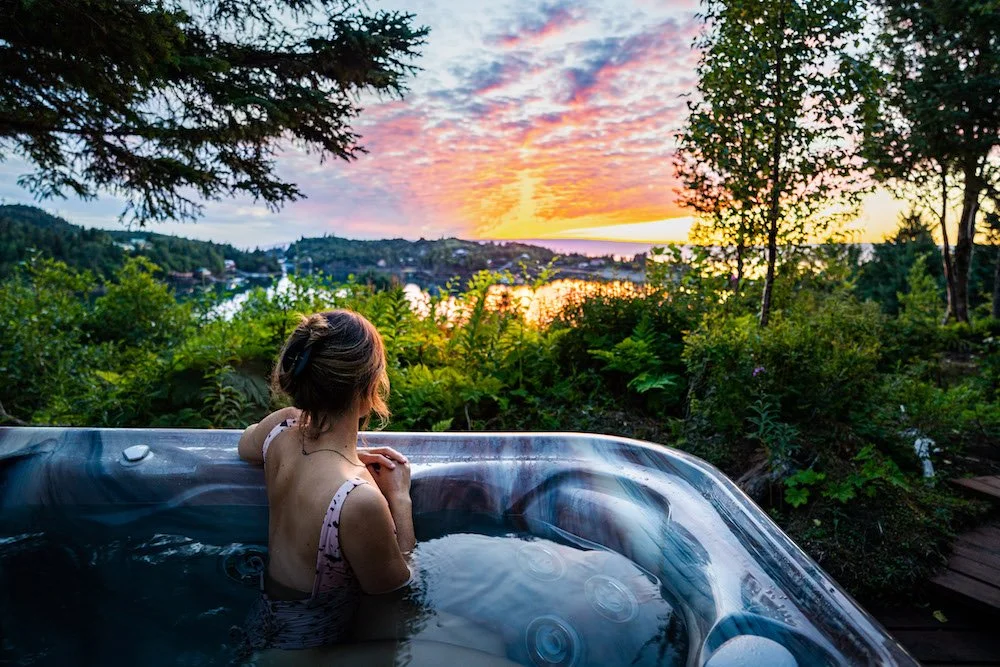
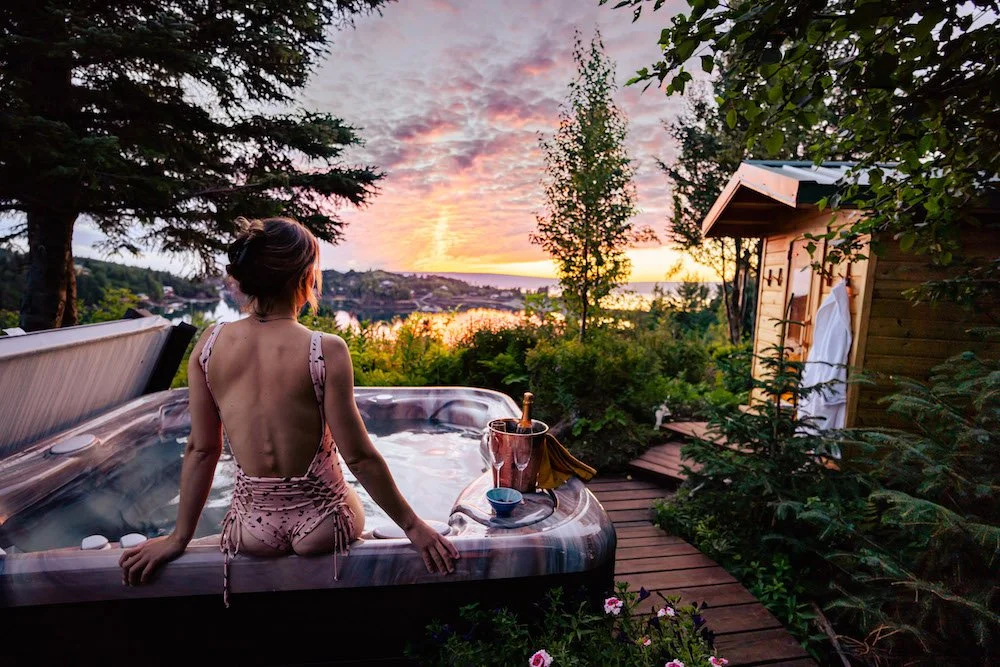
Kristin enjoying a hot tub during sunset in Alaska. Photograph by Dalton Johnson
Becoming VIP Guests
To our surprise, Lance picked us up. Sitting down inside the cabin of the Mulligan, his boat, Lance offered us a beer in exchange for stories. Laughing and smiling, we recapped our week in the woods, away from our computers, and our attempt to stay dry during the storm which rolled through.
Once back in Homer, Alaska, we checked our emails for the first time in a week. A couple of no’s and thankfully one email that read:
Hey Dalton!
Thank you for reaching out. We would love to hear more about your ideas. Can you hop on a call soon?
Best,
Beka
A maybe, yes! Excited to share this potential with Kristin, I quickly responded to the email to set up a call. Within 10 minutes, I was chatting with Beka and setting dates for us to visit in just a few days. Kristin was excited, she wanted a week of pampering after our last week in the woods. Turns out, we would have to stay in their only room available during our stay, the VIP cabin, which rents between $10-15,000 a night per person. Yup, if you did that mental math, that means it would have cost $20-30,000 a night for both Kristin and I to stay there. I don’t have that kind of money, but I do have the skill to create content for them. So, a few days later, Kristin and I were stepping off The Far Side and being escorted to our cabin.
Perfect light in halibut cove while on a van life road trip to Alaska. Photograph by Dalton Johnson
Conclusion:
With trips like this, you don’t know how the trip will end. Are you broke, or did you make out ahead? What I have come to realize is that it doesn’t totally matter. I went to Alaska to make a documentary about an athlete climbing Denali, then took a chance by spending all the money I had made into a personal trip adventuring Alaska’s Kenai Peninsula in my van. Yes, I did come back with a portfolio that I am happy to share, once I edit it. Yes, I did get to experience things I never thought would be possible, like staying at Stillpoint Lodge. And yes, I was given the opportunity to do it all with the love of my life. But, after five months on the road, I returned with terabytes of content to edit and $200 richer. Depending on your priorities, this might not be okay for you. For me, this was a good way to spend five months of my life.

For She is the Drug of Choice
This nature poem is a thank you to mother nature. As a little boy, I would run around the “woods” of my backyard naked letting my imagination run free. In many ways, my work allows me to continue this adventure through my imagination (not so much the naked part), and explore the natural beauty of our planet. I am unsure why, but any chance I get to see this planet, I take it. From mountains to the ocean, I crave the beauty of our planet and attempt to share it with you all.
For She is the Drug of Choice
Laying exposed for all to see
Men, women, even children
Admiring and craving
to be with her.
The early morning sun accentuates her beauty,
radiating lustful thoughts.
Men want to climb her,
women want to befriend her,
children wish to be held by her.
Her presence,
a lasting ecstasy, a mind-altering drug,
bringing all people to their knees.
Unconquerable, steadfast to all, yet
unable to take advantage of her. No spirits
will waver her mind. Her vastness and beauty
incomprehensible.
For she is Mother Nature.
About the Poem:
This nature poem is a thank you to mother nature. As a little boy, I would run around the “woods” of my backyard naked letting my imagination run free. In many ways, my work allows me to continue this adventure through my imagination (not so much the naked part), and explore the natural beauty of our planet. I am unsure why, but any chance I get to see this planet, I take it. From mountains to the ocean, I crave the beauty of our planet and attempt to share it with you all.
My dreams as a kid have stayed with me; see the world, play a sport in college, and be a writer. Well, I am happy to say all three of those goals are getting checked. The best part, see the world and be a writer are journey’s that will never end.
In college, I was captivated by poetry and wrote every night. Most of my writings ended in the trash, but several have not seen the light of day. For I am scared to share my writing as it is the closest thing to my heart. My brain used to tell me, don’t you dare share this, you wont be accepted. However, I am coming to a point in my life to accept my writing as a safe space for me to express my experience on this planet.
So, here is the first for me, a combination of a poem and visuals. All of which documents mother earth.
I hope to share more.
Discover more Creative works by Dalton

How to Create Commercial Photography on a Budget
There is nothing more annoying than a company low balling you to create content. At least that is what I originally thought! Companies are just trying to get as much as they can within their budget, there is nothing wrong with that. Heck, I always try to get as much money as possible for a job, so am I any different? Not really. So, what should we do to try to fix this budget confusion around creating content?
There is nothing more annoying than a company low balling you to create content. At least that is what I originally thought! Companies are just trying to get as much as they can within their budget, there is nothing wrong with that. Heck, I always try to get as much money as possible for a job, so am I any different? Not really. So, what should we do to try to fix this budget confusion around creating content?
As a creator, you can always say, "NO!" But, what if you take a different approach? An approach where we focused on value proposition and worked together to create the best content we can with the resources we have hand. What would that approach look like and feel like? As a content creator, could we just create what you can within clients budget. Yes, we can! How is that so? A dirty little secret, not everything you create needs to be portfolio work.
If we realign our goals as creators and become happy the company reached out to us and to understand our value, that would be perfect. As a creator, if we spoke with honesty and showed real numbers, then we could work together to achieve the best that we can. Budgets don’t need to be an enemy, they are just a metric for what is possible! In this article we will explore how a content creator can do the best work with the limited resources at hand, and most importantly have fun!
What is branded content?
Branded Content is a broad term for marketing materials created specifically for a brand to put their logos on. The type of content here ranges from photography, videography, short form videos, and copywriting. Most companies use branded content for marketing purposes making the goal of branded content to attract customers and sales through a curated brand identity.
The words “branded content” can be swapped out for “commercial content” or “ commercial photography”.
I mean, who doesn’t love a good jump photograph? While I still have more to edit from Alaska, this is one of my favorite self-portraits of the trip. Photograph by Dalton Johnson
What are the budget constraints you’ll often run into?
Budget constraints don’t have to be the enemy, nor a devaluation of your work. As a content creator, the goal is to understand the budget your client has so that you can build a project within the allotted budget. Most companies have a range they need the project to fall into, if so, they will share. If not, then they are shopping, or just don’t know, so you will need to educate the client on the costs. So, what budget constraints will you typically run into?
Client doesn’t understand the true cost of production
Client has a lump some of money and it is an all or nothing solution
You, the content creator, don’t know how to quote a job
You, the content creator, don’t understand the industry
The both of you are not speaking the same language
Let’s dive into these five common budget constraint issues:
Client does not understand the true cost of production
Solution: This is an easy fix. After you have a conversation with the client about creating their dream project, send them an estimate with the line items built out. When doing this, most likely you know that the price is higher than their budget, so you ask do two things. First, educate the client on the cost difference. Second, propose a solution to fix/adjust the budget and ask for their imput as well, they might be willing to cut something. One of my favorite “go-to’s” in situations like this is to deliver three “packages” showing the difference in deliverables with price-points.
Client has a lump some of money and it is an all or nothing solution
Solution: This is a hard fix. If a client is playing the “all-or-nothing” game with you, I suggest walking away. This is a power play, but you have to stand up for yourself. I’ve found in the end, these clients are a pain to work with and often make you feel icky inside when the job is done. However, if you believe in your heart you “need this job” then take it, but make sure to lay out the harmful short cuts will you have to take to complete the job. Additionally, make sure your contract is well written and signed before starting the project!
You, the content creator, don’t know how to quote a job
Solution: Ask around and search the web. If you are unsure how to quote a job, ask your peers for help. Most are willing to help. Additionally, seek out advice from agents and peers who are a bit “ahead” of you. If you don’t have access to either of those, then give the company a price you think is fair. To do this, calculate your cost of doing business, add a little fluff to the price (roughly 10%) for negotiations, and give it to the client. If they say no, ask for feedback. If they say yes, ask for feedback. Regardless, this is a learning process, embrace it.
You, the content creator, don’t understand the industry
Solution: This is a content creator problem. Yup, it is a you problem, but have no worries, you can fix that. Education. I would suggest getting on CreativeLive and watch course after course. Additionally, find creators who are willing to help you. This might mean they share blogs, have online courses, or offer digital downloads. Regardless of how you consume your knowledge, make sure you are learning about the industry you are working in, that is your responsibility. If you are just starting out, calculate your cost of doing business and start quoting jobs. Most likely your difficulty isn’t going to be pricing, it’ll be getting a client.
The both of you are not speaking the same language
Solution: A tricky situation. If you realize that you and the client are not speaking the same language, you need to change how you are talking. If the client wants to talk in terms of deliverables, talk in terms of deliverables. If the client wants to talk in terms of creativity, talk in terms of creativity. If the client wants to talk in terms of dollar signs, talk in terms of dollar signs. I think you get the picture, listen to the client. They will tell you what they need, follow along with that. Ultimately, the goal is to create something fun and get paid to create it.
Tips and Tricks for talking with a small budget client:
If you are given the opportunity to create for a company with a small budget, most likely they just don’t know what it takes to create branded content. So, part of your job is going to be educating the client. At times, educating a client can be frustrating, but remember, you are the specialist and that is why they are coming to you! So, here are a few pointers for talking with a client who has a small budget to create commercial content:
Be honest and realistic with what you can create
Be patient and open with a client
Voice what you need to create the job
Share what could be done with a larger budget
Provide a realistic timeline
When should you say no and walk away as a content creator?
There are tons of reasons to say yes to projects and it takes a certain level of privilege and prestige to be able to walk away saying “no” to paid work. But, when should you say no to a client as a content creator? For myself, I do a triple check and it kinda goes like this:
Is this a project I want to do? yes/no
Is this project going to make me money to do something else I want to do? yes/no
Is this project going to be a portfolio piece? yes/no
If I get two yes’s I will most likely do the job. If I get two no’s I will most likely not do the job. However, that is not totally the case.
The second question, in this grouping, is the most important to me, “Is this project going to make me money to do something else I want to do?” If a door is going to open because I take this job, I will most likely do it. If a job gives me access to something I want to do in the future, I will most likely take it. However, I do have to weigh the other options. Having doors open to us is the most difficult part of the job. Access to new clients, a peak behind the door to the next level, different opportunities are all hard to manifest as a content creator. So, as a content creator weighing saying yes or no to a project, access to something new is the most important key for myself.
Sometimes a client just wants a simple shot, hold our product to the sky with a pretty backdrop. There’s nothing wrong with that. Photograph by Dalton Johnson
Gear to help you create on a budget?
I will be the first to admit that I am not a gear head, nor do I think we should rely on gear as crutch, but sometimes you just have to, especially if you are solo shooting. So, what gear have I found to be a great crutch?
Helps with run and gun shooting. Additionally, you can set up on a tripod and control it remotely from your phone.
Drone (I use the DJI Mavic Air 2)
This is a MUST for me! I use a drone in almost every shoot as a drone allows me to be a subject and still get the shot.
Full-frame camera (I use the Sony a7r4)
I suggest a large sensor camera with a high mega-pixel count so that you can crop if need be. You might have to set this up on a tripod and shoot via interval timer to capture yourself.
A Lens Quiver (I use the Tamron f/2.8 line up)
Having a variety of lenses allows you to create several different photographs all in the same location.
This is a jack of all trade, master of none tool. I keep this around for all the quick and dirty shots that would take a long time to get using a larger camera.
Commercial photography is often product driven, so make sure to capture the product in use. Photograph by Dalton Johnson
Final Thoughts on Budget Content Creation
If you are doing work on a budget, be respectful all the way around. That means to yourself and your client. The best way to do that is to be honest a transparent with your pricing and what you are capable of doing. That is exactly what I did in this video while in Alaska. Dermatone knew that their budget was low and they were asking for a lot of content. So, they knew we couldn’t hire talent, there wasn’t the budget for an assistant, and they had to release creative control to me. Overall, we were both happy with the project. Why was that? Taking on this sunscreen project gave me an opportunity to do something with my girlfriend that I would not have done otherwise and Dermatone got the content they wanted within their budget.
Discover more about photography
How to Make Money as a Freelance Content Creator | Part 2 of 5
If you are a freelance content creator, or have aspirations on becoming a freelance content creator, this five part series will help you lay the foundation for making money. In episode two of this five part series, I cover ways to generate active income streams for freelance careers. To do this, I dive deep into what types of active income exist and what the end results will look like. All of these are focused on freelance jobs.
How to Make Money as a Content Creator
If you are a freelance content creator, or have aspirations on becoming a freelance content creator, this five part series will help you lay the foundation for making money. In episode two of this five part series, I cover ways to generate active income streams for freelance careers. To do this, I dive deep into what types of active income exist and what the end results will look like. All of these are focused on freelance jobs.
What is Active Income?
Active Income as a freelancer means you are actively pursuing and creating the work you are hoping to sell. This work often takes up the bulk of your time and creative energy.
Another way to think about active income is work you are creating for a client.
Active Income Jobs
Jobs in the active income category have a wide range, but are typically what you might expect in terms of freelance jobs for content creators. These jobs are:
Create Branded Content
As a freelance creative, creating branded content is the quickest way to money. This means creating marketing assets that a company will put their logo onto. Branded content is also the most sure way to get paid as a freelance creative.
Copywriting
If you are a writer, copywriting is a wonderful way to get paid for your craft. Initially, I thought of a copywriter as a person who wrote blogs. That could be true, but a copywriter also writes newsletter, webpages, about me bios, and so so much more. Think of a copywriter as a person who writes for a brand.
Video Creation
Video creation is a growing need for all companies as the rise of short form video is taking over the social world. Outside of short form video editing, there is also long form, and commercial work. Video creation doesn’t have to be branded work, it could be Youtube, educational videos, video editing, and so much more. If you are a skilled editor, you will be in high demand!
Project Sponsorship
This is my favorite and most lucrative type of work. Project sponsorship takes the most work as the freelance creative must do everything and a company simple exchanges money for the opportunity to be apart of the project. This type of work isn’t for the faint of heart as you never know if the work will see the light of day, get funded, or gain traction. I like to think of project sponsorship like gaining VC funding for Entrepreneurship. You are seeking a backer who believes in your work for a return of assets.
Building a social media presence
The modern way of becoming a creator is to build an audience yourself. As a freelancer, if you can bring an audience to a client you are a step ahead of most other creatives. Now, this isn’t an easy thing to do at all! Building an audience takes a lot of persistence and dedication to the cause you are working on. If you decide to go down this path, good luck! I only kid a little bit here. If you want to become an influencer, just try your best not to wrap your self worth into the numbers.
Repurposing your archived content into new content
For creatives that have been around for a while and are looking to expand their base income level, I suggest figuring out how to repurpose your content so that it works for you. What do I mean by this? Look at your archive and ask yourself, what is sitting around that I could turn into a money making machine? For example, could you start a social media account? Could you develop a blog? Could you develop a youtube channel? Could you sell prints? What can you do to make your old work worth money… again!
Final Thoughts
Thank you for taking the time to read through this blog about how to make money as a freelancer. The goal of this series is to help other creatives find a way to remain in the field longer and make money doing what they love. If you have any questions please, send me an email. We don’t have to do everything ourselves and should rely on each other to grow as a community. That is why I write these blogs and put out these videos. Below you will find a variety of articles that are full of useful information.
Addtional Articles to Read:
Part 1 - How To Make Money as a Freelancer
Examples of Content Creation - Big Agnes
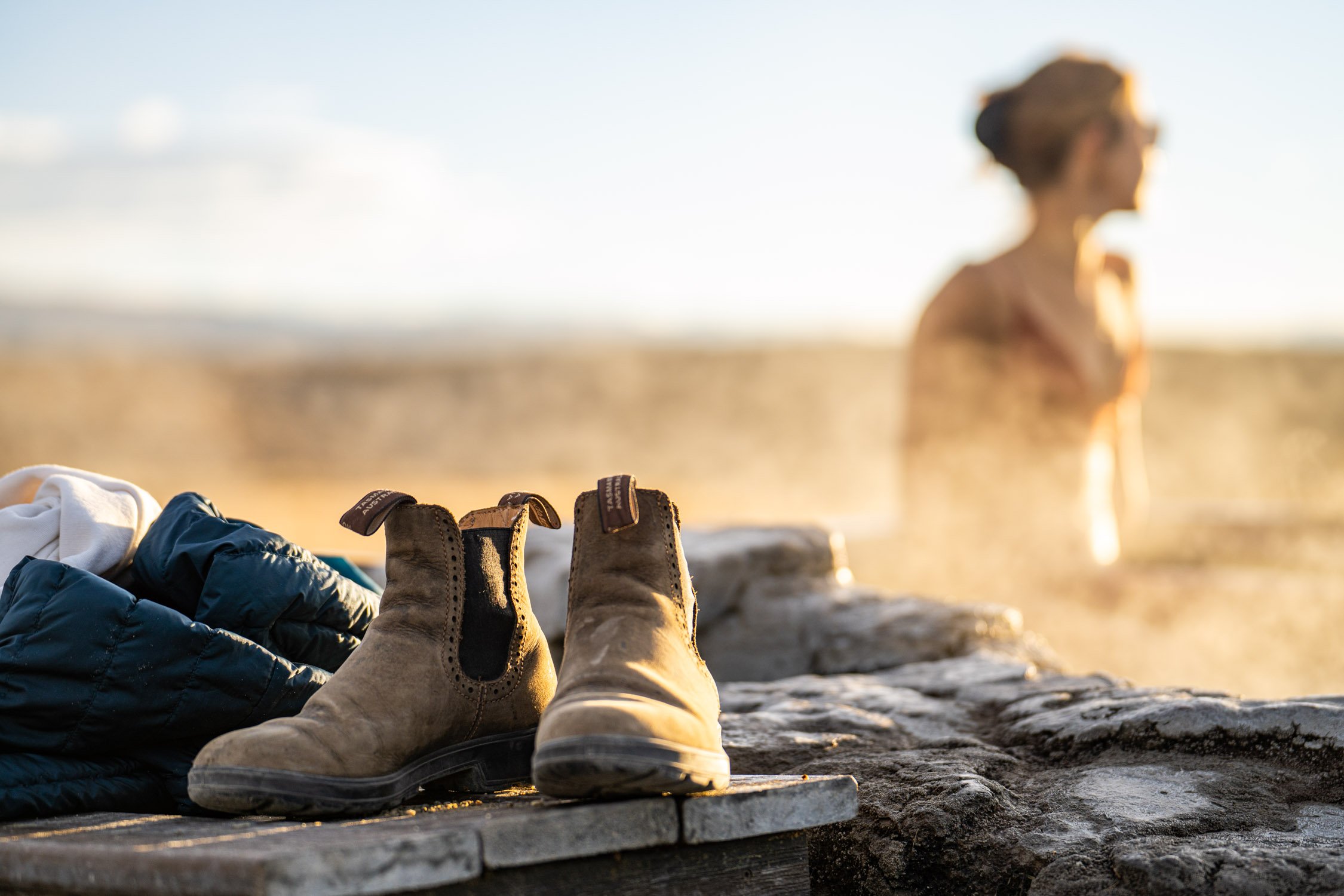
Creating Speculation Work for Blundstone Boots
I have been wanting to expand my lifestyle work to expand beyond the outdoor action sports field, so, I took a little bit of time and came up with a concept to shoot a speculation project for Blundstone Boots. This project was a good challenge for me as I had never photographed a shoe before. I have captured socks, but never shoes.
Image Specs
Location: Mammoth, California
Aperture: f/2.8
Shutter Speed: 1/1000
Focal Length: 90 mm
Story Behind the Image
I have been wanting to expand my lifestyle work to expand beyond the outdoor action sports field, so, I took a little bit of time and came up with a concept to shoot a speculation project for Blundstone Boots. This project was a good challenge for me as I had never photographed a shoe before. I have captured socks, but never shoes.
Where the idea came from:
Throughout a year, I take online courses to see what else is out there in the world. Lately, I have been on a CreativeLive kick and watched a class with Theron Humphrey. Towards the end of the class, he gives every student a challenge of conducting a shoe shoot. At first, I thought this sounded a bit boring, especially coming from action sports, but I gave in. Looking around at the shoes I had available to shoot, the only ones which did not have holes in them were my girlfriends Blundstone. I guess I might need to get some new shoes! With the Blundstone’s in mind, I started to look up concepts for the shoot. My thoughts landed on a shoot in Mammoth around the hot springs.
Setting Up the shoot:
This shoot took a little bit of planning, but nothing overwhelming. I was already heading to Mammoth, California for a different photo project, so I squeezed this spec shoot into the mix. The talent is my lovely girlfriend, Kristin Riegel, who already owns a pair of Blundstone boots. Grateful she was willing to help out on the shoot, I kinda didn’t tell her the full story of the spec shoot. What had I fibbed about? The early and cold morning.
I really wanted to show off the early morning light which hits the Mammoth area so beautifully. Also, I was hoping the outside temperature would be cold enough to get lots of steam billowing off the hot spring. Thankfully, I got both :-) Making Kristin some coffee, I was able to get her into the cold and snap a few images. This one has been my favorite thus far.
I would love to hear your feedback on the image and/or the post. Please drop a comment below or send me an email by CLICKING HERE
Miracles During My Second Seasonal Job
While in Yosemite National Park climbing and sleeping in the boulders, a couple of things happened. First, I committed to my second seasonal job as an outdoor educator. Second, I met some famous climbers. Both of which pulled me in opposite directions.
While in Yosemite National Park climbing and sleeping in the boulders, a couple of things happened. First, I committed to my second seasonal job as an outdoor educator. Second, I met some famous climbers. Both of which pulled me in opposite directions.
The seasonal job was on the east coast in Baltimore and the famous climbers, Conrad Anchor and Graham Zimmerman, offered me a position at a diner just outside of Yosemite. At the time, all I cared about was climbing and seeing new things, so I wanted to take the diner position, but I also had a gut feeling that if I committed to the diner, I would have to stop climb and work all of the time. So, I stayed committed and headed to the East Coast.
Arriving at the Baltimore Outward Bound school with my bicycle, climbing and backpacking gear, and my Sony a6000 with a kit lens, I had no idea what I was getting myself into. Heck, all I knew was that I wanted to see new places and the east coast was new. Additionally, I knew that if I committed and finished this apprenticeship, I would have enough money where I could ride my bicycle home to California. So, that was my goal.
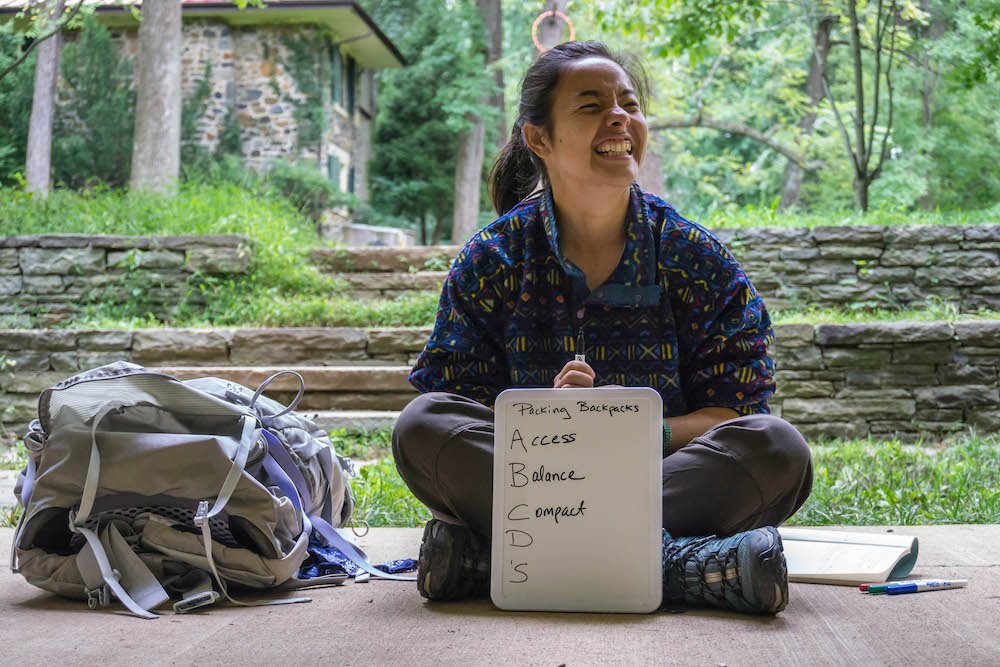
Yoshie sharing the ABC’s of backpacking with a new group of students. Photograph by Dalton Johnson
Unloading my gear, I quickly found a few awesome places in this converted mansion we would be living in for the next three months. There was a bouldering room and a coupala (the name given to a watch tower kind of place at the top of the mansion) which would become my home. Now, it was time to meet the people.
I’m not sure why, or how, but I have always felt like an outcast. My mom has playfully called me “the king of misfits” as I am kinda like a stray cat who brings home the weirdos. And, ironically, I found the people at Outward Bound to speak a similar language. We loved the outdoors, getting dirty, and went to the beat of our own drum.
The kind faces met everyone with smiles. It was awesome, but where did I fit in? Of this, I was unsure. I am always unsure. For the most part, I am an overconfident human that is down for almost anything. Well, not anything, but most things. As the group of apprentices got to know each other, we found common threads. However, everyone kinda filled a niche of their own. Mine was using a camera and helping the Marketing Director, Ben Worden.
We had three months to learn the ropes of the Baltimore Outward Bound way of things. In a somewhat good metaphor for life, we were challenged to try everything at the school. We taught backpacking courses, rock climbing days, school group day lessons, worked in logistics, packed food and cleaned gear, we did it all. Then, a turning point came about for myself. I found myself wandering into Ben’s office just to talk, to see what he was working on, or share a creative idea.
Ben was always kind and encouraging, responding to my ideas like, “Heck yeah, I love it! You should try it out. Do you want to barrow one of our cameras?” While swiveling around in his chair to find the right camera and lens for the job. It was in that moment when something began to click for me. I actually enjoyed this. I was going out and taking photographs or recording video for fun. I officially had a hobby.
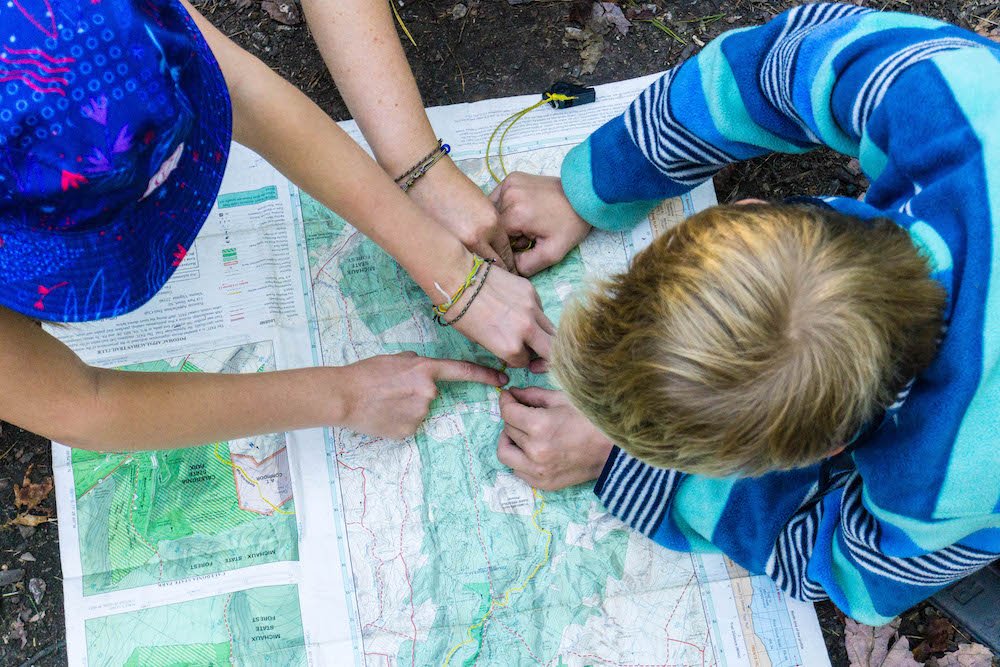
Two students refining their map reading skills while on a backpacking course with Outward Bound Baltimore. Photograph by Dalton Johnson
Growing up and throughout college, I was consumed by sports, so the idea of a hobby never existed. I forwent friendships so I could focus on getting out of my childhood town. Not because it was a terrible place or anything, but because I wanted to see more. I wanted to see the world. My sports dreams were over and I now had a hobby. So, I did what any washed-up athlete does when they find something new, get competitive with themselves about it.
Everyday, I went out and photographed. I did everything I could to be in a position to snap a photograph. My knowledge didn’t exist, so I just snapped away and review later. There wasn’t a goal to achieve, just a way to express myself. I wanted to tell a story or show an emotion. Heck, I just loved showing Ben my favorite image from the day and him smiling saying, “Dude! That is awesome!”
There came a point that I was spending so much time in Ben’s office that a desk was somehow put into his office for me to sit at and edit. I am not totally sure how this came to be, but I would just sit there and edit images everyday. Bouncing ideas off Ben and then going out with a camera to try to capture this idea. But, it didn’t stop there. Video came into the picture as well. This was another ball game that was challenging. There were so many moving parts, I was just unsure how to move forward. However, Ben was there to help me.
I told him that I wanted to try to do a video project, so he gave me a challenge to create a video about the life of an apprentice at Outward Bound. Without thinking twice, I accepted. For about a week, I chased down a variety of people in hopes of making the this video. Interviews, b-roll, a-roll (is that thing?), I really had no idea what I was doing. What I did know is that I had fun doing it. So, I kept pushing and here was the result:
Now, I know this isn’t very good now, but at the time, I was impressed! For my first ever video that I strung together, I was happy with how it came out. Additionally, Ben was as well. He helped get all of the branding and name plates for the video, I had no idea how to do that.
As my time as an apprentice came to a close, the time for me to begin biking back to California was quickly approaching. For that, I had no plan, which I was happy about. There is something about the unknown which appeals to me. Discovering along the way is better than planning it out and just following the road map you have made for yourself. I guess I might do this to protect myself from not trying something, for I knew what I was committing too, I most likely would not do it. However, setting a destination and slowing working your way towards it is romantic in the sense of self-discovery. I start feeling instead of thinking.
Just a week left until I would leave the east coast, Ben asked me, “Would you be interested in coming back next year to be a photographer?”
I thought for a second and naively contemplated, “Do people get paid to take photographs?”
“Yeah! You would get paid about 10x what you were paid for this apprenticeship.” Ben explained.
“Really?” I asked in disbelief.
“Well, not 10x but definitely double to triple.”
“I’m in!”
“Okay, you’ll have to set up a business over the winter. I’ll send you the paperwork you’ll need to do. After that, we can set a date and we will fly you back to the east coast for a project.”
“Awesome! Thank You!” I couldn’t believe this was happening to me.
How to Make Money as a Freelance Content Creator | Part 1 of 5
Converting your content into a money making machine provides you freedom. As more money comes in, you can let go of other responsibilities and focus on your creative work that fills your cup. Additionally, getting paid for your work feels great, motivates you to continue, and provides a not-so-healthy validation that your work is good. So, how do you make money as a content creator?
How to Make Money as a Content Creator
Converting your content into a money making machine provides you freedom. As more money comes in, you can let go of other responsibilities and focus on your creative work that fills your cup. Additionally, getting paid for your work feels great, motivates you to continue, and provides a not-so-healthy validation that your work is good. So, how do you make money as a content creator?
Active Income Methods
Active Income means you are actively pursuing and creating the work you are hoping to sell. This work often takes up the bulk of your time and creative energy. At first, this will be how you build your archive of content.
Create Branded Content
Copywriting
Video Creation
Project Sponsorship
Building a social media presence
Repurposing your archived content into new content
Passive Income Methods
Passive Income means you are passively making money from work you previously created. To insure this income persists, you do need to maintain the streams of income, via marketing, but minimal work needs to be done.
Licensing Content
Ad Revenue
Selling Prints
Selling Books or E-Books
Selling Education Courses
Affiliate Marketing
Influencing*
*Influencing could go in both methods, but I am putting influencing under passive income with the pretense you are leveraging your audience and repurposing content from your archive that fits the company you are influencing for.

A Year of Creating Content with Big Agnes
Thank you Big Agnes for the opportunity to create with you all. I have enjoyed the process of learning your style and doing my best to contribute to you all!
There are those full circle stories that are always kinda nice to read from time to time, this is one of them.
Throwback to 2016, I really wanted to get my work in-front of the Big Agnes marketing team. Having wrapped up a two month bike-packing trip around the South Island of New Zealand, with a Big Agnes Tent, I thought I had taken some banger shots.
At the time, I was only starting a photography career and had no idea how to share my work with a potential client. Actually, I had no idea how to connect with a brand at all. I was so green! However, I had these blinders on that told me I was good enough to pursue photography and that is what I did.
Fast forward to 2020. I was now in a place where I was getting jobs here and there for photography. Most of my income came from my work behind the camera, but then again I was a dirtbag, so I didn’t need much. While in the Tetons on a perpetual road trip for climbing, I had gotten into the habit of guessing emails. Well, Big Agnes was still on my radar and I guessed a couple of emails correctly, the same day. Turns out, I had guessed almost everyone in the marketing departments email and they all received the same email.
I made an impression!
After a few days, I received and email (that I wish I still had) which went a little something like:
Dalton,
Thank you for your email, looks like the whole team got it. We don’t know what you are looking for, but it looks like you are a photographer and an athlete. Are you trying to submit images, or are you asking for a sponsorship?
Best,
BA Marketing
I was a blow away, I didn’t know what to say and felt a bit silly for sending everyone the same message. My goal was to share images, so that is what I ask for. They were kind, I think they laughed at me in their little office (at a later date I had a video call with a marketing team member, everyone sits next to each other).
After a couple of months and a few submissions later, the Big Agnes team and I clicked. What I was shooting was perfect for them and I enjoyed the process of shooting spec work keeping them in the back of my mind.
Fast Forward to 2022. I have done a good amount of work with Big Agnes. Below is just a sample of the work that has come out this year and I know there is much much more on the horizon :-)
Brand Identity Videos
Video Ads
Website Headers
Emails
Catalog
Blogs I have Written for Big Agnes
Go for the Slowest Known Time
A funny one about moving slow on purpose:
https://www.bigagnes.com/blogs/sleep-in-the-dirt/make-it-an-adventure-and-go-for-the-skt
Five Jaw-Dropping Campsites of HWY 395
An SEO based blog focused on camping spots along HWY 395:
https://www.bigagnes.com/blogs/sleep-in-the-dirt/five-jaw-dropping-camping-spots-along-highway-395
How to Pack for Backpacking
An educational blog designed to education and sell Big Agnes’s newly released backpacks:
https://www.bigagnes.com/blogs/sleep-in-the-dirt/how-to-pack-for-backpacking
5 Easy Steps to Make Ceviche While Beach Camping
A how to guide for making Ceviche while on a Baja Road trip:
Trust Your Friends’ Outlandish Voicemail Ideas
A really fun and entertaining recap to adventures around the western United States:
https://www.bigagnes.com/blogs/sleep-in-the-dirt/trust-your-friends-outlandish-voicemail-ideas
Thank You Big Agnes
Thank you Big Agnes for the opportunity to create with you all. I have enjoyed the process of learning your style and doing my best to contribute to you all!

Your Reminder to Wake Up Early
Waking up early is a novelty. Crawling out from under your covers is difficult, but worth it. Throughout a year, at least one of my highlights comes from waking up early to catch a sunrise. Often my motivation is a photo idea, but sometimes it is a climbing mission, or an outing with a friend. Regardless, do something hard and wake up early a few times a year! It’ll be worth it.
Waking up early is hard. There is no doubt in my mind, the most difficult time of the day is crawling out from under the warm blankets, placing me feet on the cold ground, and getting out the door. However, waking up early provides opportunities that make up for the challenge.
As a commercial photographer focused on outdoor lifestyle, the best light comes at sunrise and sunset. So, I always aim to be photographing at sunrise and sunset. However, early mornings are not my favorite. So, how do I overcome this?
Sunrise on the Middle Tetons after waking up early to be at the base of the route to climb the Grand Teton. Photograph by Dalton Johnson
I think about the reward of waking up early.
I am embarrassed to admit it, but, I love to hit snooze several times before crawling out from under my covers. Living in a van, I don’t don’t have a thermostat, so every morning is cold! The ground is cold, the van is cold, and I just want to keep sleeping. But, I know I need to get out of bed. To do this, I think about the benfits.
I think about the awesome photographs I will take, which usually motivates me to get out of bed. However, if it doesn’t help, I think about the athlete that will be outside of the van waiting, or what I would have to say to a client. Surely, those last two will get me out of bed.
Tips for waking up early:
Have a reason to wake up (a passion project, a goal, a dream)
Meet somebody at a location, this will hold you accountable
Set multiple alarms
Have something to motivate waking up early (a reward, caffeine, etc.)
Go to bed early
Two love birds dancing at Glacier Point for sunrise in Yosemite National Park. Photograph by Dalton Johnson
Benefits of Waking Up Early:
The world is quiet
You can watch sunrise
Time to reflect
You can have unique places to yourself
Waking up early is a novelty. Crawling out from under your covers is difficult, but worth it. Throughout a year, at least one of my highlights comes from waking up early to catch a sunrise. Often my motivation is a photo idea, but sometimes it is a climbing mission, or an outing with a friend. Regardless, do something hard and wake up early a few times a year! It’ll be worth it.
How to Hand Shape Surfboards
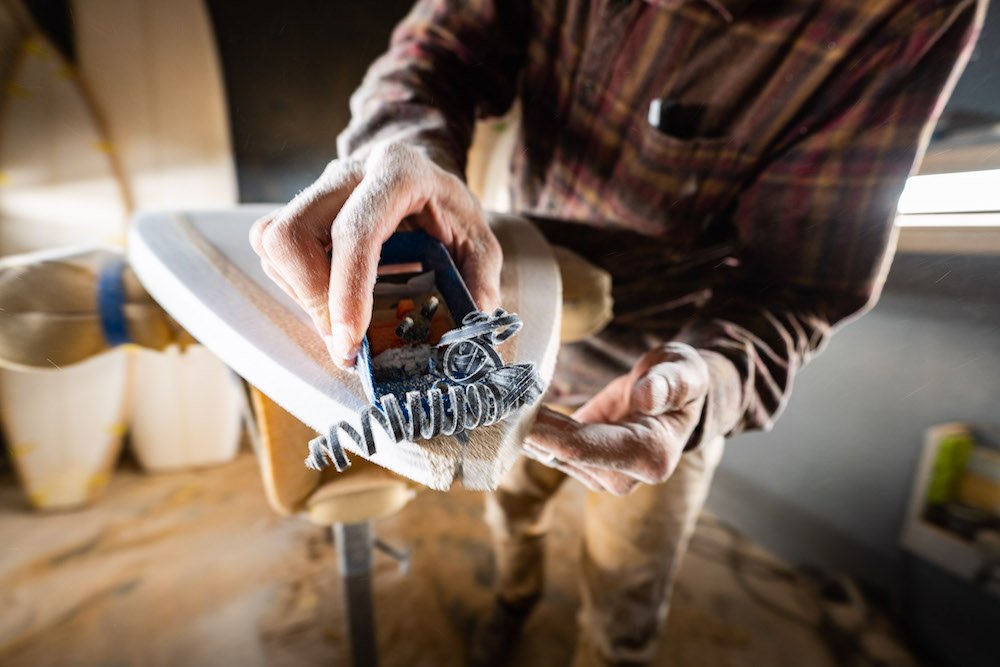
In this photo essay Dalton Johnson documents Ryan Lynch hand shaping a surfboard from a blank. Documenting the process of how to make a surfboard from start to finish, this photo essay shows the beauty of the hand made process. If you are curious on how to make a surfboard, this photo essay will give you a look behind the curtain at how to make a surfboard.
Thank you Ryan Lynch and Timber Surf Co
for welcoming me into your workshop
Start by listening
then look, touch, and feel the blank
the board is inside.
Like marble, you can’t
put back the foam you remove
so every stroke counts.
The smallest details
will shape the experience
of how this board rides.

The Freelancer's Conundrum
The message is clear, distractions happen, learn how to handle them. In the end, I wrote the above as a stress relief exercise and to spew out an idea that I had been festering away in my brain for the last few days. In many ways, it was pestering me so much, I just wanted to get it down on paper so I could forget about it.
Creative Storyline (Future Video Script?):
It’s quite easy to get distracted. I mean, who really wants to sit down and edit all of those photos? You have been working so hard, already. Just take a second to think about all of the work that you have already put in:
As a freelance photographer, I find myself exploring and challenging my creativity by shooting outside of niche. Photograph by Dalton Johnson
You connected with the client
Chatted about their needs
Came up with an idea for them
Built a treatment
Revised the treatment
Wrote the contract
Got the talent, but not that one
Built your production team
Did all the permit work
Set a date
Changed the date
Changed the date back, this time for weather
Scouted the location
Prepped the gear
Photographed
Imported all of the images into the hard drives
I mean, at this point, doesn’t it seem like a break is needed? Will somebody, please, just hand me my phone so that I may scroll Instagram, check the analytics on my website, give my friend a call, maybe just quick text message to that old college buddy I have been meaning to reconnect.
Okay, phew, that was kinda nice. Sorry about that, everyone, I was just getting a little stressed out. Here, you can have my phone back… oh, but let me just call my mom real quick, it’s been a little while… she didn’t pick up, “I wonder what she is doing?”
Hey, what should we have for dinner?
Do you know who won the super bowl in 1938? Was the NFL even around that year? I guess I should wiki this…
Dang it! How did I go down this worm-hole.
Okay, let’s get back to editing those images. Where was I. Ah, yes, I need to make my… BUZZ, BUZZ, BUZZ
“Oh hey man, thanks for calling me back, it’s been so long. What are you up to?… Oh yeah, I can talk right now, I mean, I should be editing, but I have time to chat, it’s been far to long…”
Hour and half later.
Ah, yes, it’s time to… BUZZ, BUZZ, BUZZ
“Hey Mom! How are you?… I know, I am sorry it’s been a while since I called last, what have you and Dad been doing?…”
Two hours later.
“Ah SH$&”, these images are due in a couple of days, I really need to get to work! Okay, time for the phone to go… BUZZ, BUZZ, BUZZ
Oh, “Hey Client! How is it going?… Mhmm. Mhmm. Oh… Mhmm… Dang. Okay. Yeah, I can do my best to get these images to you a couple of days early. Oh… tonight? EEEK!”
Saying yes, is also saying no to other opportunities. As a freelance photographer, I have to weigh the opportunity costs of taking a job. A skill you learn overtime. Photograph by Dalton Johnson
Tips and Tricks for success as a Freelance Creative:
How to stay focused as a freelancer?
Caffeine. Okay, yes this works once you sit down and get to work, but that is only if you do not get distracted along the way. So, here are 5 tips to staying focused as a freelancer:
Turn off and put away anything you do not need
Set a timer, every 90 minutes, and take a break to refocus
Have a “work space” that you can go to
Have a working playlist that is only used while working… I suggest something without words like LoFi
Always get dressed, even if you are working from your bedroom!
As a freelance photographer, not every photograph will become a portfolio piece as you meet the clients needs. The good news is, you will build a portfolio over time from the work and spec work you photograph. Photograph by Dalton Johnson
How to stay motivated as a freelancer?
Know Your Path
Motivation is a trick that is hard to overcome, but the key here is to be doing something you actually want to be doing. How do you know that you want to be doing it, here are three questions to ask yourself:
What did you want to do as a child?
What do you think about when not working?
What are you good at? This can be a soft-skill like analytical, being an ideas person, etc.
Overcome Monotony
If you find the common thread between these three questions, that is a great place to start. But, even if you are on the correct path, you can get bogged down by monotonous tasks. The easy solution would be to hire somebody to do these tasks, but if you don’t have the money… what do you do?
Work harder! That is the typical response, but no, that is not the solution. The solution here is to set blocks of time to manage what you do. A routine is wonderful in the world of business. Block out the times to do the tasks, then when you are financially ready, allow somebody else to do those tasks for you.
What can you do if you are already committed, but you are losing motivation? Most likely you are not loving it, so do everything you can to finish ASAP. Once you are done, review what went wrong. Remember, you said yes! So that means there was some kind of incentive for you to take the client onboard. Learn from the opportunity and adjust for the future.
To overcome the monotony of photographing the same things as a freelance photographer, go out on your own and photograph a personal project. Photograph by Dalton Johnson
Personal thoughts on workflows as a freelancer…
While I was writing this, I was giggling. Overall, I would say that my work flow is pretty sweet! Being a freelance photographer, I can control my own schedule, for the most part. In the end, the client will dictate how and when things get done at a 10,000 foot level (maybe a hot topic here), but the small details are my own process, which I like.
I am not sure when this developed, but I have always been a late worker. Throughout the day, I like to do things. Everything from photographing to surfing to working out, those are all daytime things. Towards 5 or 6pm, however, I start getting into a headspace where work is ready. So, I pour myself a cup of coffee, maybe a pot, and start to work. It is during the night, that my head is clear and the eagerness inside of me stops yearning to do something.
Often I am up late, 2 or 3am, working on the computer. From time to time, I wake up early, but those days are growing rarer and rarer.
There isn’t much here in terms of metaphorical take-aways. The message is clear, distractions happen, learn how to handle them. In the end, I wrote the above as a stress relief exercise and to spew out an idea that I had been festering away in my brain for the last few days. In many ways, it was pestering me so much, I just wanted to get it down on paper so I could forget about it.
What are your thoughts? Should I make a skit around the opening creative story?
It's My Job - Commercial Photography
At the end of the day, my job as a commercial photographer is to sell a product. While photographing a campaign, a thought constantly repeats in the back of my mind and kinda goes like, “You are shooting a (insert product), that is the focus.” This mantra helps balance the struggle between creativity and capturing an image that will sell the product. Overall, the limitation in creating commercial photography is not an art director or creative freedom, the constraint is usually time and money.

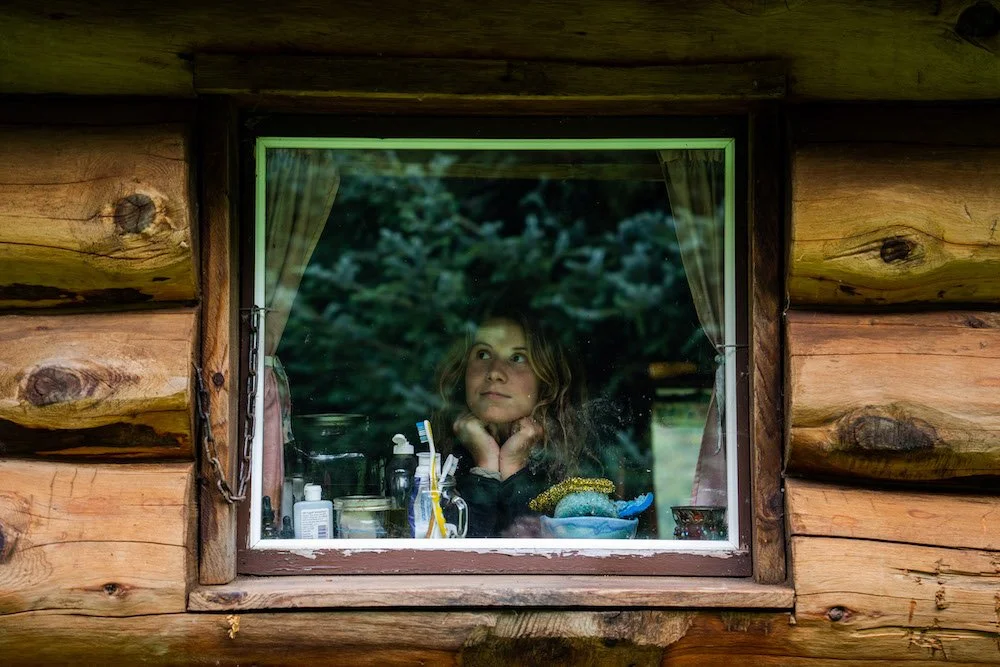
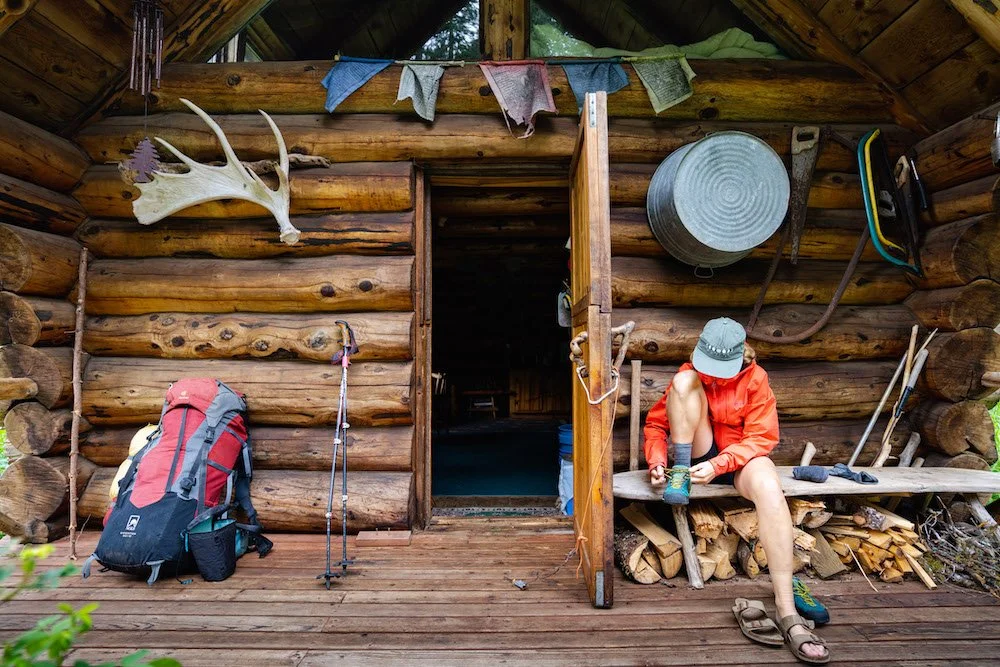
Telling a story of a hiker staying at a cabin in the woods for a commercial photography lifestyle campaign. Photograph by Dalton Johnson
At the end of the day, my job as a commercial photographer is to sell a product. While photographing a campaign, a thought constantly repeats in the back of my mind and kinda goes like, “You are shooting a (insert product), that is the focus.” This mantra helps balance the struggle between creativity and capturing an image that will sell the product. Overall, the limitation in creating commercial photography is not an art director or creative freedom, the constraint is usually time and money.
What is the Constraint in Commercial Photography?
In commercial photography, time is money. Now, I understand “time is money” is an old adage that typically would not be combined with art, but in this case the statement is fitting. Why? You have a burn rate that goes beyond yourself. When I started out as a photographer, every shoot I did was myself and the talent. The cost of production was low, say a few hundred dollars. Now, six years later, the costs go beyond myself.

Telling a road trip story for a commercial photography automotive campaign. Photograph by Dalton Johnson
A set can range from 10-20 people, just to make one photograph. Which means you are paying 10-20 people for every day that you are photographing a commercial project. It’s time to break this down to understand a bit better. Let’s just say the average rate per person was a very modest $400 a day, for a low budget production. With 10 people on the set, that would translate to $4000 a day, just to pay the people. With 20 people, that would be $8,000 a day. This cost doesn’t include the pre-production work, production costs, nor the post-production costs.
The constraint in commercial photography comes down to time and money. If you had unlimited money, creatives could shoot until every possible idea was shot, or the crew got bored and left. Let’s be real, unlimited time does not exist.
So, where does this leave a photographer who is trying to balance being creative and capturing an image that will sell the product you are hired to shoot?

A simple photograph highlighting a beverage for a commercial photography beverage campaign. Photograph by Dalton Johnson
Roles on a Commercial Set:
Photographer
Photo Assistant
Videographer
Video Assistant
Model(s)… I would say expect 3-5
Art Director
Producer
Digit-Tech
Hair and Make-Up
Stylist
Food Crew
Safety
This list is not complete, but gets you a pretty good idea of what roles exist on a commercial shoot.
Finding the Balance
The balance between being creative and getting a photograph to sell the product is tight. Being creative is great, it is fun, and it fills my cup, but an overly creative shot can confuse the viewer. Meanwhile, a product shot is often boring and a viewer will overlook the photograph. So, how do I overcome this balance?
I’ve found two ways to balance the desires of commercial work; tell a story and keep it simple.

A storytelling image showcasing the allure of traveling for a commercial photography travel campaign. Photograph by Dalton Johnson
Tell a Story
First, telling a story around the product I am photographing can engage a viewer and showcase why they need to buy the product. More than just show the viewer who, what, where, when, and how the product works, telling a story around the product brings the viewer into the product and they can emotionally connect with they story. They might see themselves and think, “You know what, that would really help me out.” Or, “wow, I didn’t know that I could do “X” with “Y” product.” Which opens the door for the viewer to purchase the product.

A simple image showcasing a scenario of “how to use” the product for a commercial photography product campaign. Photograph by Dalton Johnson
Keep it Simple
Simple is great, but simple is boring. At first, this is what I thought, but now I disagree. Simple does not have to be boring, but it should be straight to the point. A simple photograph should unlock the barriers between the viewer and the product. Giving the viewer of the photograph the understanding of why they need the product at a quick glance.
It’s My Job as a Commercial Photographer
If we all had endless time and money, yes, we could create anything, but that isn’t the case. Often working around budget and time constraints, it’s my job as a commercial photographer to deliver images, on time, and within the budget. Thankfully, this world is filled with rad products that are fun to photograph. Often, the products have a great story behind why they were built and the needs they were designed to overcome. Building a storyline around a product gets me excited and filled with joy as I build out a fun idea that can take me around the world. At times, products are boring from the outside, but it is my job, as a commercial photograph, to make it simple and convey a story. At the end of the day, my job as a commercial photographer is to sell a product.

Reviving the Lost Art of Letter Writing
After a three day digital detox in Joshua Tree National Park, void of vibrations and pings, penning a note felt like the perfect way to continue the slowed down lifestyle and show some gratitude for time well spent with good friends. Pulling a pen from the drawer, tearing out a blank sheet from his notebook, and sitting down with a fresh cup of coffee, Dalton Johnson shares the story of a weekend adventure.
After a three day digital detox in Joshua Tree National Park, void of vibrations and pings, penning a note felt like the perfect way to continue the slowed down lifestyle and show some gratitude for time well spent with good friends. Pulling a pen from the drawer, tearing out a blank sheet from his notebook, and sitting down with a fresh cup of coffee, Dalton Johnson shares the story of a weekend adventure.
Dear Kay Kay,
Thank you and, at the same time, I am sorry this letter has taken so long to reach you. It’s been well over two months since we last connected, as I don’t totally know what to say, but now feels correct. I’m sitting at my table, cherishing a warm cup of coffee, looking at the photos from our latest adventure. Wild, yet tame. Full of yummy snacks and warm beverages, yet I was always reaching for that next bite until the food tins were empty. I am not kidding when I say that I often thought about licking the tin clean.
But, I must say, I am quite happy that I didn’t lick the hummus tin clean, because I just stumbled upon a photo of Jason’s dirty hands squishing into the hummus during that chess tournament. Ha! Do you recall the chess game between Jason and Ray? I mean, they played for so long, I refilled the chip and dip container twice. TWICE! Either they were super hungry from climbing all day in Joshua Tree, or they really just played for that long. I’ll have to ask.
With a wilderness permit, we took our digital detox to the Joshua Trees and camped under the stars for a night. Photo by Dalton Johnson
OH! Can you take me back already. I miss the cold nights and warm days in the dessert. I mean, the weather is perfect. Waking up, drinking a nice warm cup of coffee as the sun rises, filling our water bottles with cold water, then heading out for a full day adventure. In many ways this trip was perfect. Everyone had the ability to do something they wanted and had a forced digital detox. I had forgotten what it was like be out of service for a few days.
In just three days, we did everything from climbing and high-lining to hiking and picnicking, we really packed this outing to the brim with fun. Also, it was a blast communicating through hand written notes… maybe that is what has inspired this letter!
Jason Crist taking full advantage of the digital detox head space by snagging an onsight on Intersection Rock in Joshua Tree National Park. Photo by Dalton Johnson
OMG, I am totally forgetting if you came out to watch, but did you see Ray effortlessly walk the Little Candy Mountain line? I don’t know how he did it! He hadn’t walked a line in three years and just got on and walked the line, at sunset, as if it was nothing. Gorgeous. Maybe someday I’ll be able to walk that line!
Without the distractions of phones during our digital detox, I had the pleasure of observing the Joshua Trees at sunset. Photo by Dalton Johnson
With that said, I do wish we had a little bit more time, for I really wanted to check out the Cholla Garden, especially at sunrise, on the eastern side of the park. If we went back, is there anything you would want to do? I know you mentioned wanting to go on an overnight trip to cowboy camp under the milky way. Is that still on your mind? If so, let me know and count me as your plus one, please.
Did you have a favorite day? What about a favorite activity while in the park?
I’ll be honest though, I think my favorite part of the outing was our final night, once we returned to San Diego. I know, it may seem silly, but it was great seeing everyone and having a bonfire. You’ll have to send me that recipe for the hot tottie you made! It was so good, especially with the s’mores. I guess I am just a sucker for a classic bonfire and warm drinks with friends.
Anyways, thank you for putting together this awesome trip and I really hope we can make another one happen ASAP. I am in need of a quick escape from work, even if it means taking a mental health day to make the most out of a weekend.
Thank you for being an amazing friend,
Dalton
Blue Bells Ringing
When I sat down to write this poem, I imagined an older women living alone, off the grind, in a cabin. The cabin I had stayed at. This nature poem was an attempt at showcasing the mental battle of being alone in the woods, mixed with the reality of curiousity. I wanted the poem to have a sense of fun, yet be serious. Attempt a small commentary about living off the land and a slower pace life.

Blue Bells, a wildflower, dancing in the wind. Photo by Dalton Johnson
Blue Bells Ringing
What is that, that which I hear?
Like a curious cat, I kneel and seal my ear
to the ground, so I may not fear:
the bear, so large, it makes the ground quake.
the mountain lion, so sly, it pounces upon its prey.
My mind conjures mysterious muses
Why do you betray me like this?
As I toil on my knees, alone, in the woods.
I want to go home, to the warmth of a fire
I just want to look out the window, so I can admire;
Blue Bells ringing in the gentle spring breeze
Honeybees dancing atop the pedal leaves
But, my bucket of berries still has some space…
Peeling my ear from the soil,
I place my hands on my knees, so I may stand
For I dare not dilly-dally no…
Shhhhh.
There it is, again.
Frozen, I remain,
only to realize, the growl of my belly
began the fright which paralyzed, and started the fright.
I laugh at the fantasy a bored mind can build and
allow my purple stained fingers to fill
The bucket until the bounty breaches the rim.
My job here is done,
so I may seek the comfort of
the window, a fire, and a wild berry pie.
Staying at a cabin in the woods, completely off the grid, near Homer, Alaska. Photo by Dalton Johnson
While on a backpacking trip along the Kenai Peninsula, I came across wildflower blooms of Bluebells. For some reason, these little flowers caught my eye. I wanted to capture them and share a story with the concept of these bells ringing, an imaginary noise. As this idea for the poem developed in my head, I stayed at a cabin deep in the woods and off the grid.
Collecting my water, using fire to heat the cabin, and drinking endless coffee, I scratched ideas down in my journal as I looked out the window at the blooms of wildflowers. The poem wouldn’t shake my mind, so I knew I need to write something, even if it was total crud.
While staying at the cabin, tucked away from society, I dreamed of collecting enough berries to bake a berry pie. The ironic thing… I was preoccupied with wild bear encounters, sweating in the sauna, and cold dips in the river.
When I sat down to write this poem, I imagined an older woman living alone, off the grid, in a cabin. The cabin I had stayed at in Alaska. This nature poem was an attempt at showcasing the mental battle of being alone in the woods, mixed with the reality of curiosity. I wanted the poem to have a sense of fun, yet be serious. Attempt a small commentary about living off the land and a slower-paced life.
Often, I am pulled in several directions, unsure where or what to do, because the omnipresent distractions overpower the present moment.

Arc'teryx and Dirtbag Living
The second episode of the podcast has dropped! In this episode, we dive into the world of dirtbag living with the Manager and Community Lead at Arc’teryx, Krista Coole. Personally, I met Krista through Beau Martino, about a year ago. Throughout that time, Krista has focused on building out the ambassador program for Arc’teryx Norcal.
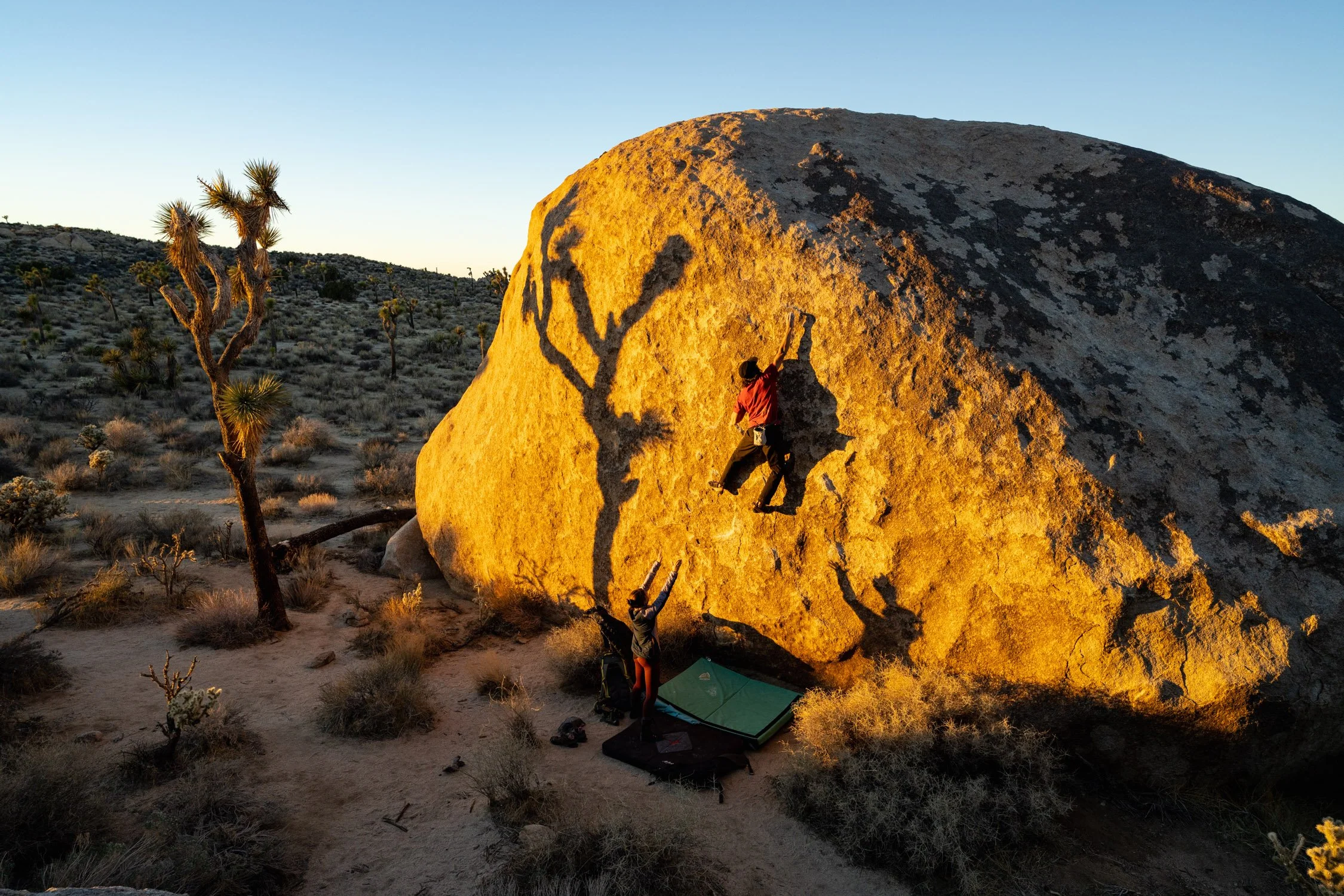
Arc’teryx dirtbag ambassador Ray Diaz rock climbing in Joshua Tree National Park. Photo by Dalton Johnson
The second episode of the podcast has dropped!
In this episode, we dive into the world of dirtbag living with the Manager and Community Lead at Arc’teryx, Krista Coole. Personally, I met Krista through Beau Martino, about a year ago. Throughout that time, Krista has focused on building out the ambassador program for Arc’teryx Norcal.
Reasons to listen to the podcast:
How to become a brand ambassador (for Arc’teryx and other brands)
A deep dive into why dirtbags are cool
How to start rock climbing (at any age)
How to build a community
Listen to the Podcast:

Arc’teryx dirtbag ambassador Jason Crist rock climbing in Joshua Tree National Park. Photo by Dalton Johnson
Because of Krista:
In late 2021, Krista brought me onto the Arc’teryx Corte Madera ambassador team. During that time, she has embodied the community role, pushing myself to become more involved and connected with the team. In doing so, I have grown to rely on the ambassador team for adventure photoshoots that are based on storytelling, over product placement. Often, the other ambassadors become the models.
Some of the projects that Krista has supported:
Four Wheel Campers one minute promo video about surfing and climbing
Escape Campervans adventure travel stills for summer social campaign
Featherstone Outdoor brand revamp
In addition to her help with talent for projects, she has also helped integrate me into some of the projects Arc’teryx has going on, like rock climbing clinics, community dinners, and beer collaborations! SO RAD!
Thank you Krista for coming onto the podcast for getting me involved/feel included into the community!