How I Photographed the Golden Gate Bridge at Sunset
I photographed the Golden Gate Bridge at sunset on the San Francisco side, in late March, with a Sony body and a Tamron 70 to 180 lens set to 70 millimeters. The first lens I reached for was the wrong one, and finding the right one is what made the photograph, so it is worth telling the whole story.

Spring flowers line the California hillside overlooking the Golden Gate Bridge. From here, I snap this stunning photograph of the Golden Gate Bridge, perfect for any wall in a home or a office.
Additional Information:
Please allow 5-10 days for printing and shipping.
I have the ability to print custom sizes and material (like wood, gatorboard, etc.). If this interests you, please reach out to dj@dalton-johnson.com for a free quote with the size and material you desire.
I had been on the road for two weeks. My fiancée, Kristin, our dog, Chestnut, and I drove the Pacific Coast Highway from Southern California up to San Francisco in a van, and the city was the last stop. By the time we got there, the light was running out. Sunset does not wait for you, and it does not care that you were stuck in traffic. We drove toward the Presidio with the sky already turning, found a place to park, and I grabbed my whole camera bag, one body and three lenses, and left Kristin with the keys and the dog.
I had a plan on the walk up. I thought I would use my widest lens, the Tamron 16 to 30, to take in as much of the scene as possible. It sounded right in my head. Then I got there and put it on, and the bridge looked tiny. It sat far off in the frame, all that beautiful color dwarfed by everything around it. I knew immediately that it was not going to work.
So I switched to the Tamron 70 to 180 and started shooting. Almost right away I realized that 70 millimeters was close to perfect. It pulled the bridge closer, gave it weight, and left room for the hillside in the foreground. I had assumed I needed to fit everything in. What I really needed was to choose what to leave out.
I started in a very typical place. I found a lovely frame with the bridge sitting between two trees, and I would be happy with that photograph on its own. But there were no wildflowers, and I really wanted flowers. So I wandered toward the hillside where the yellow was thickest. Part of that area sits near a steep drop, and a fall there would be serious. The ground felt solid, and I took my time, but I do not recommend it. If you go, stay well back from the edge.
Once I found my spot, the scene came together on its own. The sunset was clean, with light clouds that were not too thin and not too heavy. The sky stayed blue. The ocean read blue below it. The red of the bridge glowed against both, and the yellow flowers filled the foreground. In a low rain year the bloom had come early, so I got to it just in time.
I shot a lot of frames, both vertical and horizontal. In the end I liked the horizontals better. The bridge is a wide, stretching subject, and a horizontal frame lets it breathe across the hillside and the water.
Photographing the Golden Gate Bridge is a challenge because everyone else has done it. It is one of the most overshot subjects there is, so making something unique takes more thought. For me, it took a spring bloom, a good sky, a lens that fit, and a few minutes of scrambling before the light was gone.
The photograph became my print, Sunset at Golden Gate Bridge. It is a real photograph, made by a person, not by AI. It is an open print run, and I am trying to sign as many as I can, though I cannot promise every one will be signed. It comes in sizes from 8x10 to 24x36 on paper, metal, or canvas.
Go check out all the prints by Dalton Johnson.
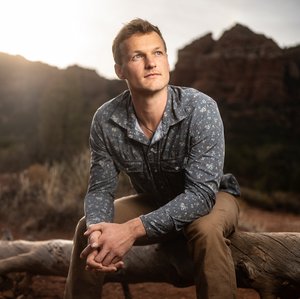
About the Author
Dalton Johnson is a photographer, writer, and filmmaker who tells stories about real people pushing themselves in the outdoors, from the High Sierra to the far reaches of every continent. He has shot and written for brands, tourism boards, and editorial outlets, including Nike, Patagonia, Four Seasons, PBS, GoPro, and Ford, with more than 160 campaigns and hundreds of published articles to his name. Off assignment, he bikepacks, trail runs, swims open water, chases big waves, and rock climbs.