72 Miles of Blue
A filmmaker, his best friend, and five days on the most beautiful lake in America.
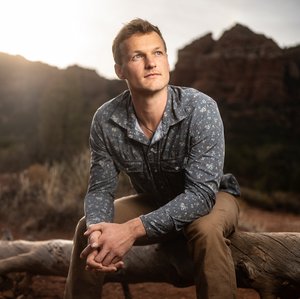
Dalton Johnson is sitting at six in the morning in his condo in South Lake Tahoe, watching a lake he has lived next to for years go from black to gray to the particular shade of blue that makes people drive twelve hours just to stand next to it. His camera gear is still unpacked on the floor behind him. His paddleboard is waiting downstairs. His college best friend Michael Whalen — known to everyone as Big Mike — is asleep in the other room, and in a few hours the two of them will carry everything they own for the next five days down to a public beach near Ski Run Marina and push off into water that is, depending on how the wind behaves, either going to carry them around the entire perimeter of this lake or remind them in uncomfortable detail that neither of them is much of a paddler.
Seventy-two miles. Five days. One lake.
Johnson has pointed a camera at all seven continents and directed commercial work for clients including Patagonia, Arc'teryx, GoPro, and Rivian. He spent eight years living out of a van, building a career on the premise that the best stories emerge from the hardest places, and that the gap between what a destination looks like in photographs and what it actually feels like to move through it is where all the interesting material lives. He has made documentaries that aired on PBS and on streaming platforms. He is not, by any conventional measure, someone who lacks for field experience.
He is also, by his own admission, not much of a paddler.
"Neither of us have really paddled all that much," he says, looking out at the water from his condo window. "So we'll see if we're even able to do this."
He says it with a laugh, but there's something real underneath it — a genuine question about whether the lake he has photographed and lived beside is going to cooperate with two men who have decided to circumnavigate it on stand-up paddleboards with limited training and a loosely organized gear situation. The uncertainty is not incidental to the project. It is, in Johnson's view, precisely the point.

The Idea
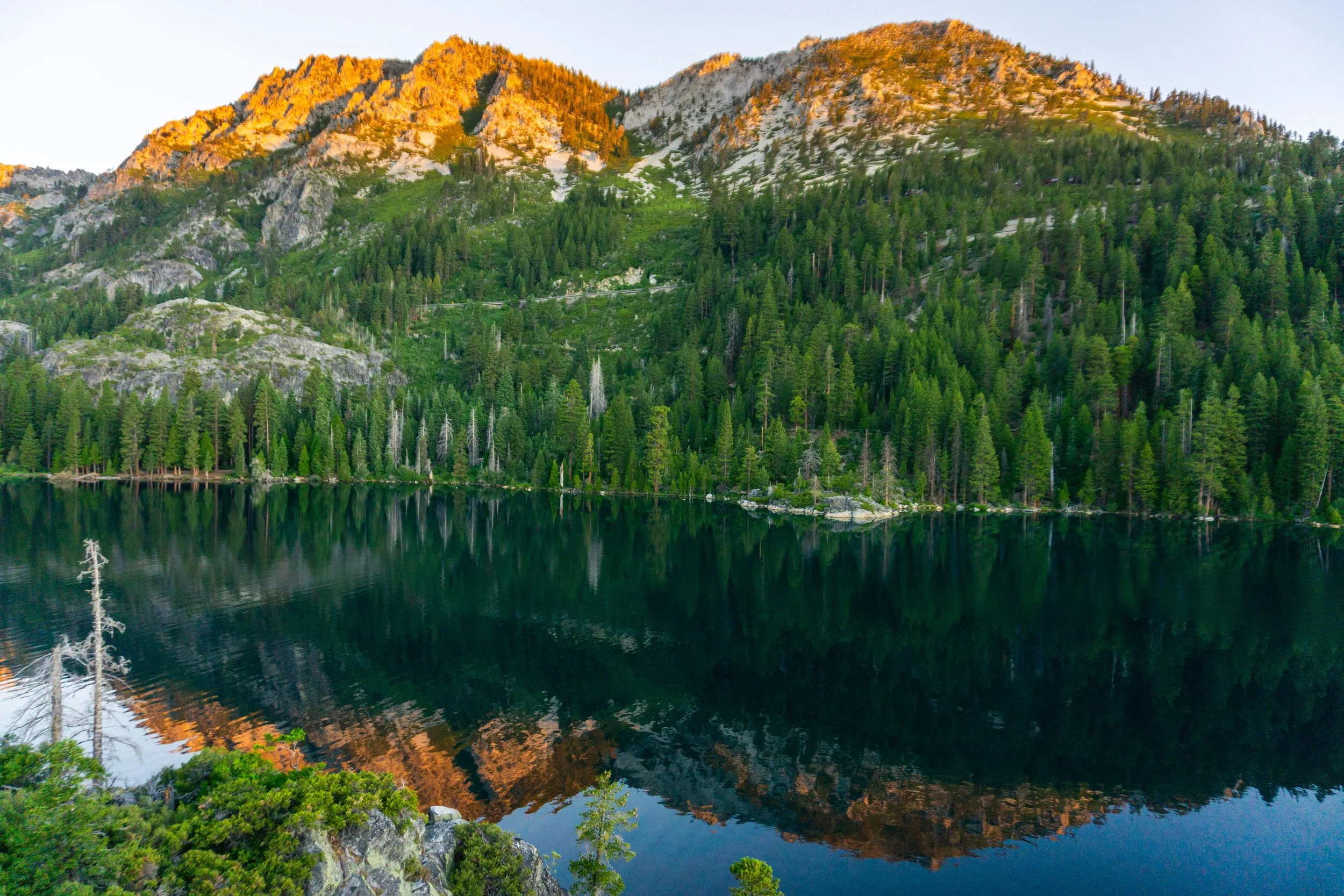
72 Miles of Blue is what he calls it, a name that came from the water itself, from the color Lake Tahoe turns on a still morning when the light hits it at the right angle and the blue goes so deep and saturated it reads as artificial, like someone pushed the saturation slider a few clicks past believable and simply left it there.
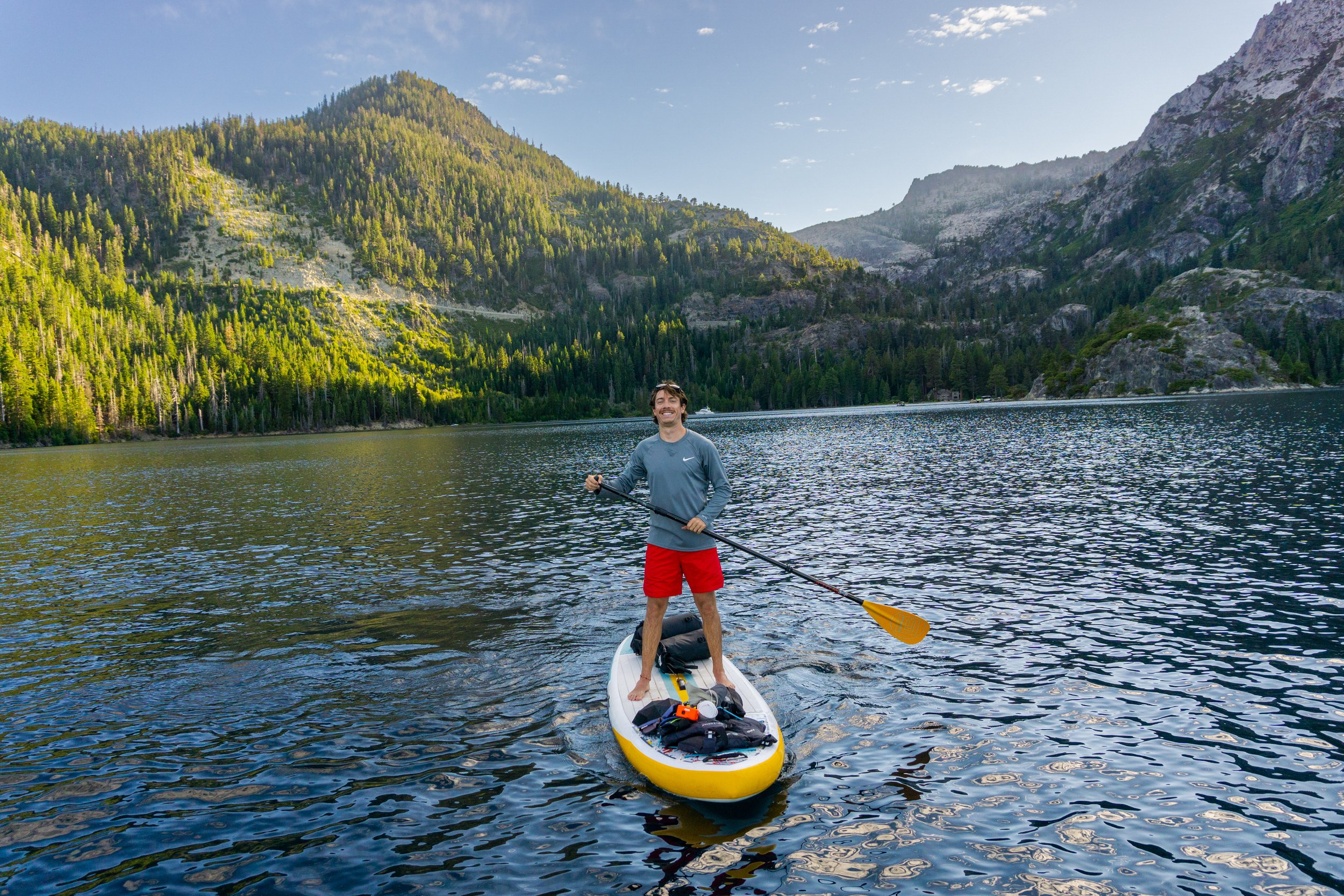
The idea is straightforward in the way that most genuinely difficult things are straightforward. Lake Tahoe measures roughly 72 miles around its perimeter. Johnson wanted to paddle every one of those miles on a stand-up paddleboard, camping on or near the shore each night, carrying everything he needed on the deck of his board, and moving at whatever pace the lake demanded rather than the pace that a production schedule or a brand brief would have preferred.
People have circumnavigated Tahoe before — it is not an untested route — but what distinguishes Johnson's version is the lens through which he approaches it, not as an athletic achievement to be optimized and converted into performance metrics, but as a travel story to be lived in real time. He is bringing a camera. He is bringing his college best friend. He is deliberately not over-planning, because over-planning, in his experience, tends to produce the kind of content that looks exactly like what you expected rather than what the place actually had to offer.
Johnson has been thinking about this distinction for most of his professional life. The work that endures, he will tell you, is almost never the work where everything went smoothly — it is the work where the tent collapsed or the subject changed their mind or the weather turned hostile and you had to invent something else on the spot, and what you invented turned out to be truer than anything you had written down in the prep document. The friction is not the obstacle to the story. The friction is the story.
"You don't know Lake Tahoe from a boat," he says. "You don't know it from the shore. You only know it when you're out on it, moving slowly enough that it can actually show you something."
Seventy-two miles, at paddleboard pace, is slow enough.
Day Zero: The Night Before
The night before departure does not go smoothly, and Johnson is the first person to say so, also the first to point out that this is not particularly surprising. Multi-day backcountry travel carries with it a specific variety of pre-departure chaos that no amount of professional experience fully inoculates you against — you always believe you have more time than you do, you always surface the thing you forgot at the worst possible moment, and the question is never whether something will go sideways in the prep phase but only how far sideways and whether it can be worked around.
In this case, the dry bags are running short, and one of the boards has no clean way to mount a power bank, which matters because the power bank is supposed to keep the camera charged throughout a five-day expedition. The camp stove fuel is distributed across a dozen half-empty canisters, which requires tracking down a connector to consolidate them into something actually functional. The camera gear itself, the most professionally significant component of the whole undertaking, sits in a pile on the condo floor, entirely unpacked, while Johnson makes the deliberate decision to deal with it in the morning rather than make tired gear choices at midnight.
The reasoning is sound even if it is not comfortable. He usually has equipment sorted days before a trip, but the water introduces variables he has not fully resolved — he genuinely does not know yet which pieces will survive the exposure, what will be accessible on a loaded paddleboard in moving conditions, or what is worth the weight given that everything he carries is going on a board that needs to stay manageable in rough water. Better to think clearly at dawn than to overpack out of anxiety at midnight.
Kristin, his partner, is there helping sort everything, which keeps the atmosphere from tipping into genuine stress. The World Cup is playing on television in the background — America loses to Belgium in a manner that does not reward close analysis — and Big Mike, Johnson's college best friend and the man who has agreed to paddle the first stretch of this circumnavigation alongside him, watches the match and maintains the kind of easy energy that has always made him good company in complicated situations.
Big Mike and Dalton met in college, bonded over surfing, and have stayed close across the years and the distance that adult life tends to insert between people who care about each other but live in different places and carry different schedules. This trip is, among other things, that kind of effort — a reason to actually do it rather than continue talking about doing it, a week on the water that will either strengthen the story they tell about their friendship or give them something new to add to it.
By the time they sleep, neither man is fully prepared. The dry bag situation remains unresolved. The camera is still in a pile on the floor. A significant amount remains uncertain. Nobody knew SPF 100 sunscreen existed until they found it at the store that afternoon, and that discovery, at minimum, is an unambiguous win.
Day One: Ski Run Marina to Fannette Island
They launch ahead of schedule, which surprises both of them and feels like a sign, even though signs of this kind are not reliable.
The beach near Ski Run Marina is quiet in the early morning, carrying the particular silence of a tourist town in the hour before the day's visitors arrive and the boats go out and the parking lots fill and Lake Tahoe becomes the version of itself that appears in the social media feeds of a few million people every summer. Johnson kisses Kristin goodbye on the beach. Text messages from family members begin arriving on his phone, small notes from people who know where he is going and want him to know they are paying attention. He tucks the phone away and gets on the board.
The first day is, by their later admission, almost suspiciously cooperative. The lake is calm and the sun comes up warm and holds there, and they find a paddling rhythm faster than either of them reasonably expected given their limited time on boards. There is something about a flat-water morning on Tahoe that is difficult to characterize without veering into promotional language, so it is worth noting simply that the quality is real and not exaggerated — the water at that hour and in those conditions produces a specific kind of stillness that feels less like weather and more like the lake deciding to be generous, and Dalton and Big Mike spend the first few miles paddling through it in something approaching disbelief.
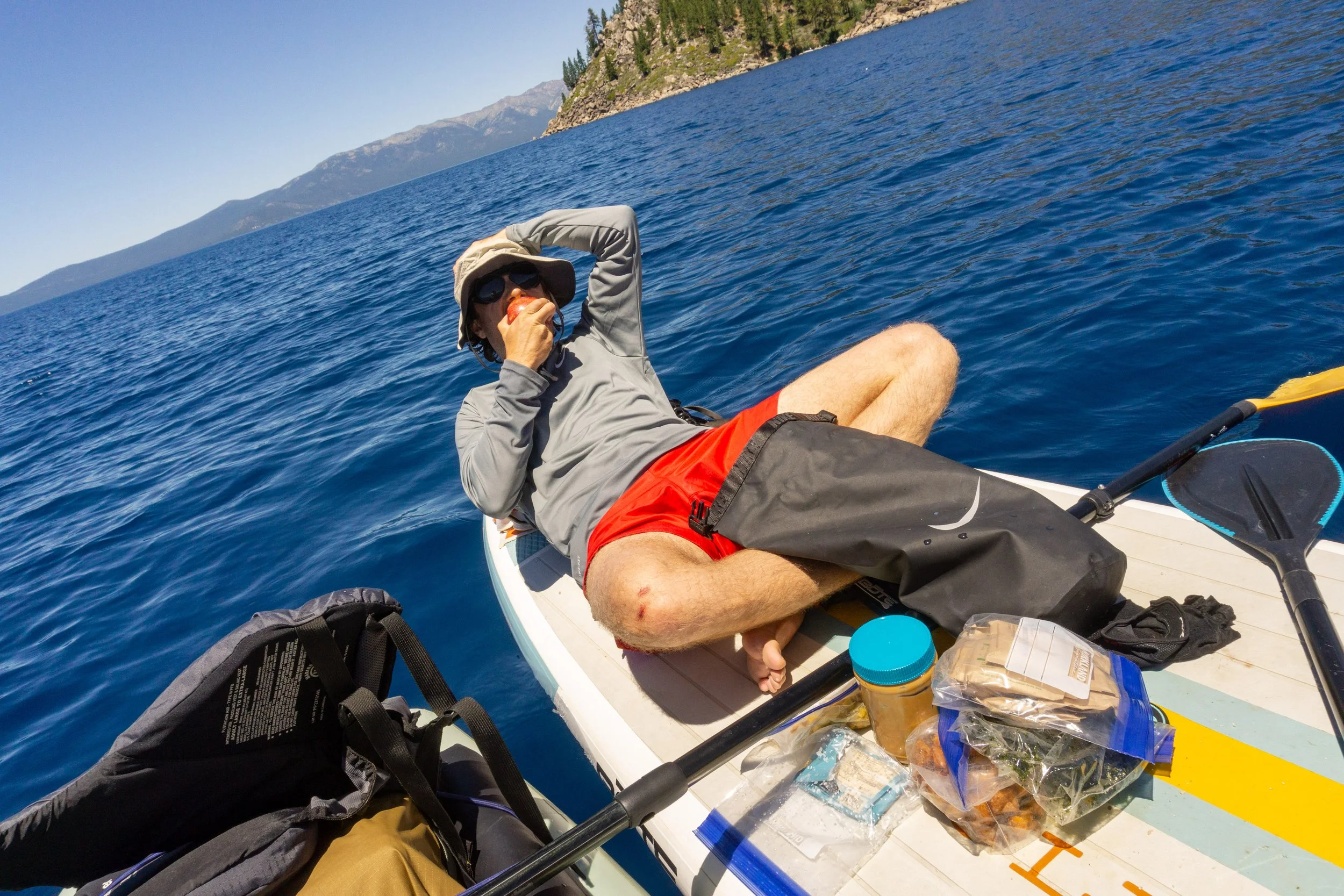
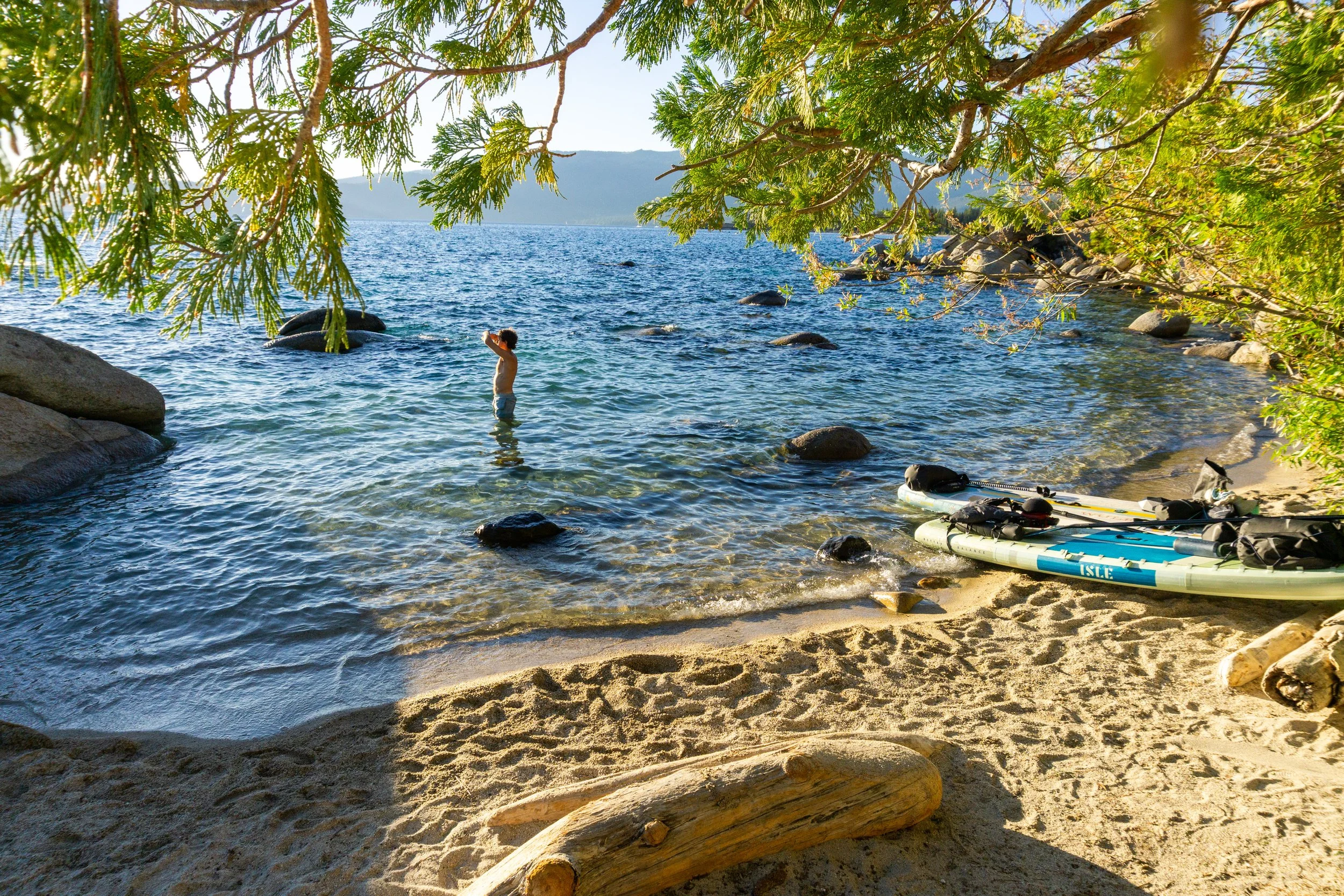
They stop where things interest them, at a hawk perched on a rocky point, at a pole jutting from the shore that neither man can resist jumping from, and at a wide sandy beach on the western shore where they take lunch and sit with their feet in the water and feel entirely settled in what they are doing. The miles pass in a way that feels earned but not punishing.
Then Emerald Bay arrives.
If you have driven Highway 89 along the western shore of Lake Tahoe, you have seen Emerald Bay from the overlooks that pull tour buses over in both directions, and it is genuinely stunning from that vantage — the granite walls coming down steep on both sides, the island in the middle, the color of the water shifting as the depth changes. From the water, coming at it by paddleboard, it is a different experience entirely, more enclosed and more personal, the scale presenting itself differently when you are inside it rather than above it.
The headwind arrives at the mouth of the bay without warning, the way Tahoe weather tends to announce itself, and it is stiff enough that paddling into it feels like paddling in place. Dalton and Big Mike pull to the rocks on the side and wait it out — twenty minutes — until it drops to something manageable and they can continue into the bay.
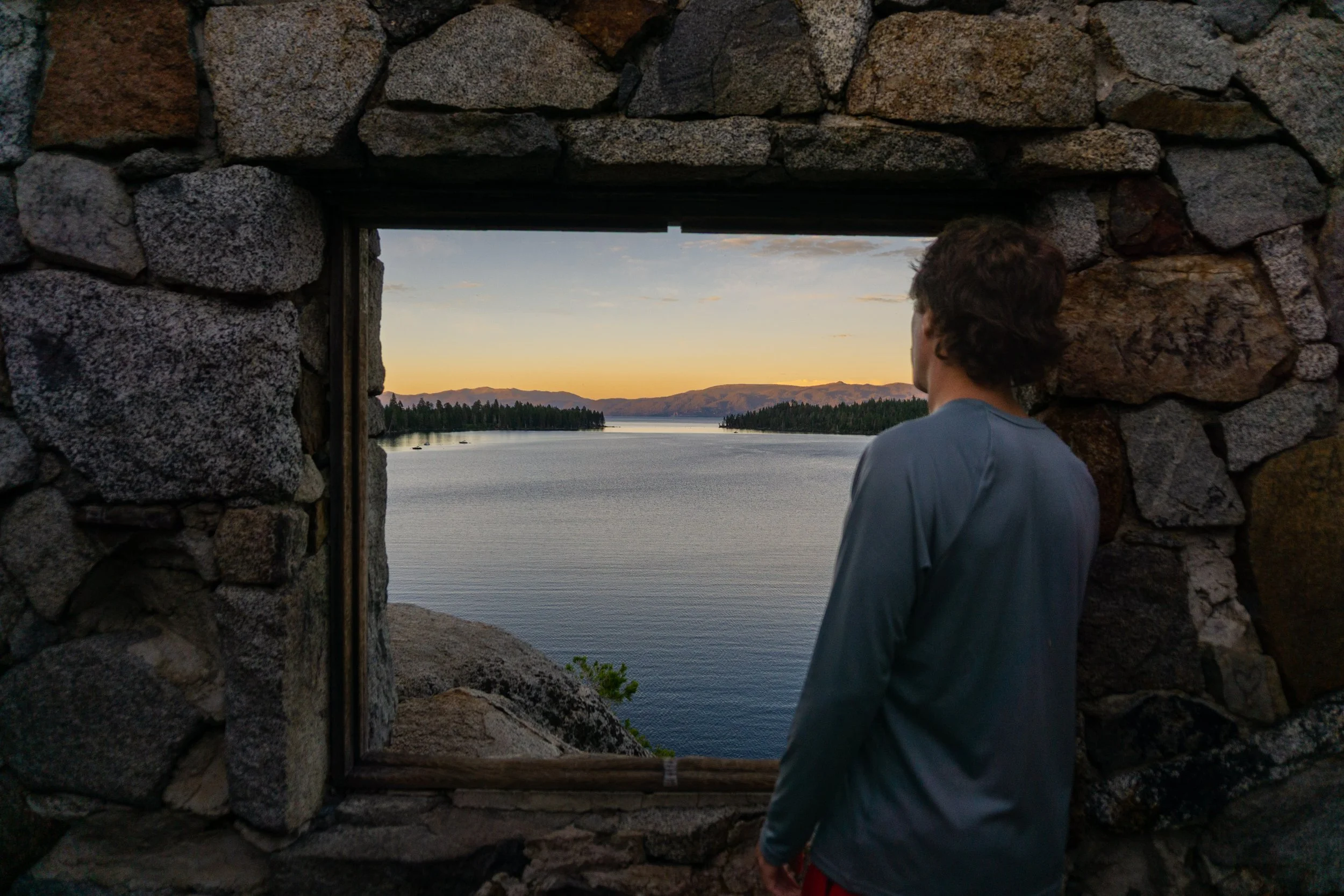
A mile and a half in, Fannette Island rises from the water. It is the only island in Lake Tahoe, a small granite outcrop with a stone tea house at its peak, built in the 1920s by a woman named Lora Knight who wanted somewhere to serve tea to guests who rowed across from the shore. The structure has been unoccupied for decades but remains open to anyone willing to carry themselves and their gear up to the top.
Dalton and Big Mike haul their camp up and make dinner as the light leaves the sky. The lake below them goes dark, and then a spotlight appears on the water, sweeping in wide arcs, moving toward the island in a way that produces a specific kind of alertness in two men who may or may not be sleeping somewhere they are permitted to sleep. Johnson is already mentally rehearsing the explanation when the spotlight circles away without incident, belonging to a boat full of young people doing laps around the bay for no apparent reason.
Then quiet. Then stars.
The tea house has no roof, and lying in sleeping bags on that stone floor, looking straight up through the open frame of the walls, Dalton and Big Mike watch the Milky Way move across the sky in its slow arc. Johnson will later reach for words to describe it and find them inadequate — one of the most beautiful nights of his life is where he lands, which is accurate and also insufficient for what it actually looked like. The sleep that follows is genuinely terrible, cold stone and thin insulation and not enough distance from the ground, but neither man mentions this prominently when they tell the story later.
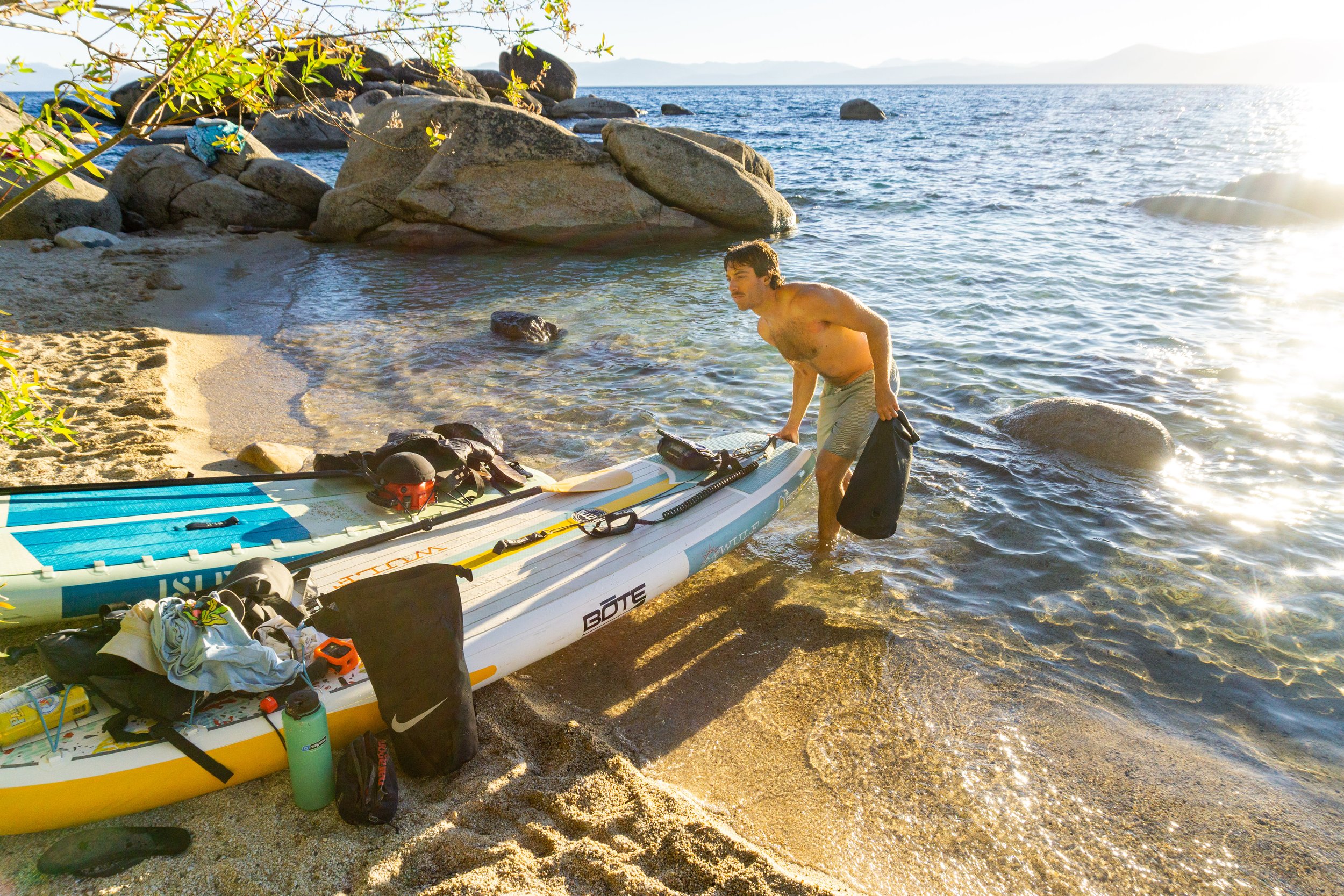
They are up at five. Coffee as the sun comes over the eastern ridge. Interviews recorded on camera. Boards repacked and back on the water by ten.

Day Two: Out of Emerald Bay and Into the Heart of the Lake
Coming north out of Emerald Bay, they find a beach that stops them.
It is not on any list Johnson is aware of, not marked in any way that would draw attention to it, just a small crescent of sand tucked against granite and pine on the north side of the bay, sheltered from the chop, with water in front of it that runs blue-green in a way that does not quite match the rest of what they have seen on the lake. Johnson will later describe it as feeling tropical, which is geographically absurd at six thousand feet in the Sierra Nevada and also completely accurate in terms of what it actually produces in the people who encounter it. They pull up their boards and lie flat on the sand and stare at the sky above them.
Big Mike calls it a Captain Cook moment — the feeling of having found something, of being the first ones here, even though they are not and have never been, even though people have been arriving at this exact stretch of shore for generations before them. The feeling doesn't care about the facts. It feels discovered, and that is what slow travel does to a place: it makes the experience of it feel personal in a way that faster movement does not allow, because you have earned the specific view rather than simply arriving at it through speed and convenience.
The rest of day two is the kind of day that accumulates detail at a pace that only makes sense when you are moving slowly enough to receive it. They spot river otters working the rocky shoreline with the total confidence of animals who have never had reason to defer to anyone. They hear ospreys calling overhead, a sound that cuts through whatever Johnson is thinking about and pulls his attention back to the water every time. Baby ducklings scatter at their approach on one beach, and from there the ducks are a constant presence — bobbing in the coves, drifting along the shoreline, entirely unbothered by two men on paddleboards moving slowly through their lake.
The pollen is something else entirely. At some point in early summer the conifers around Lake Tahoe release their pollen in quantities substantial enough to settle visibly on the surface of the water, and from a paddleboard a foot above that surface it presents as a thin, continuous carpet stretching across miles of the lake, moving gently with the small ripples that cross it. Every paddle stroke leaves a mark — a small crater where the blade enters, a wake that fans out behind for thirty seconds before the surface closes over it, erasing the evidence of passage as completely as if it never happened. Moving across Tahoe with pollen on the water is like writing something temporary on a surface that is designed to forget, and Johnson finds himself watching his wake disappear behind him with an attention he did not anticipate.
His allergies, by midafternoon, are providing all the empirical confirmation anyone needs.
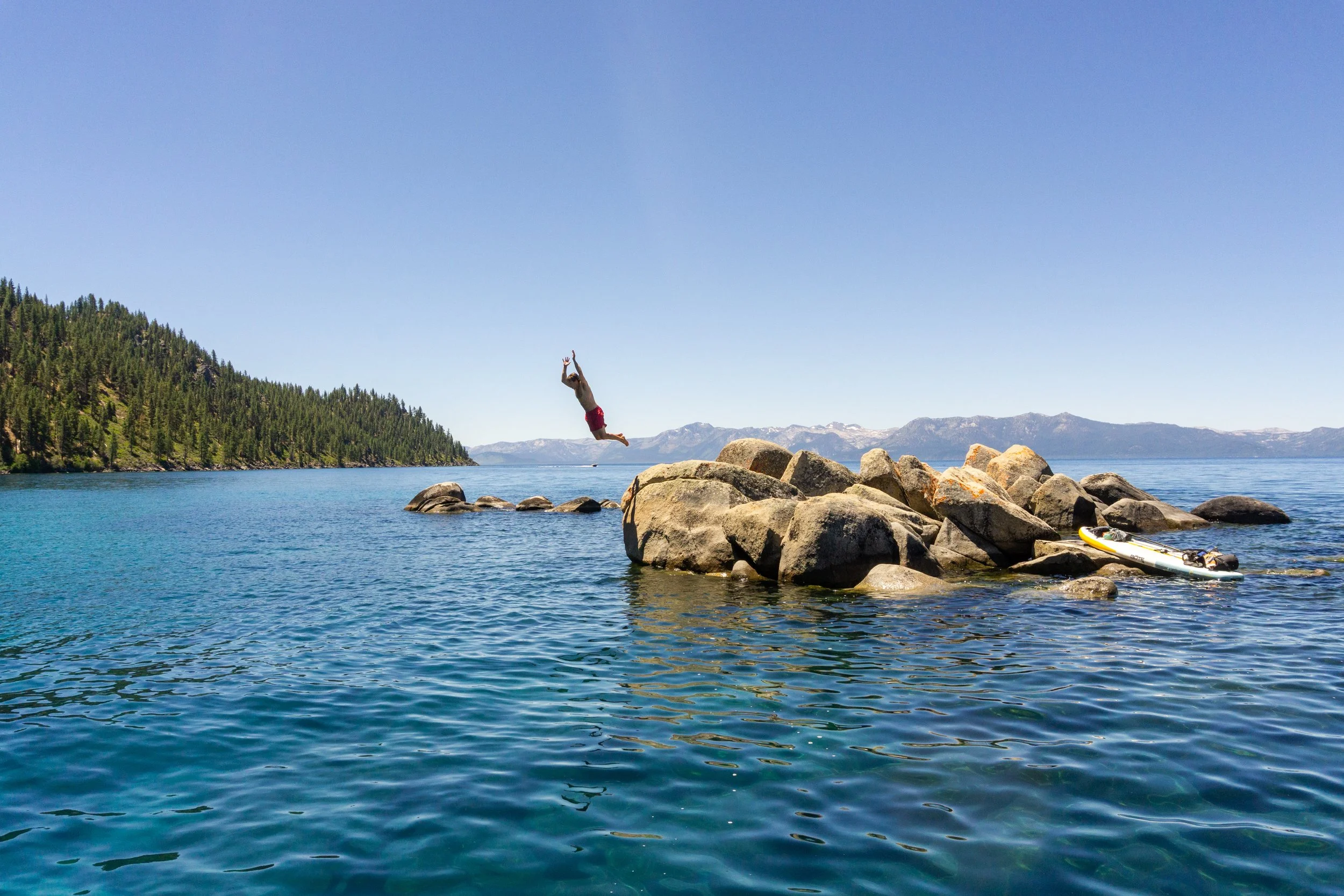
Rooster Rock appears on the western shore, a granite ledge above deep water that locals have used as a jump spot for years, the kind of place that carries no sign and needs none because everyone who knows it simply knows it. Johnson has not grown up on this lake and has never been here, and he climbs it anyway, which is where things get interesting, because the climbing is where the fear actually lives — sloped granite with minimal holds, warm from the sun, a long fall in the wrong direction if anything slips. The jump itself, when he finally takes it, is easy: one step off the edge, a second of air, cold water. He does it twice, because the second time he is not surprised by any of it and can simply enjoy it.
They push through Rubicon Beach, stop for afternoon coffee just past Meeks Bay, and catch a tailwind through Tahoma that carries them all the way into Homewood. Along the way they stop at Tahoma Market to pick up dinner for camp that night — Big Mike takes a chicken burrito of a size that warranted specific mention, and Johnson eats an entire chicken pizza by himself and is not remotely embarrassed about the state his stomach is in afterward. It is at West Shore Market in Homewood — inside, over food, with the lake visible through the window — that the arithmetic of the trip presents itself plainly for the first time.
They are not putting in enough daily hours on the water. The full circumnavigation, at the pace they are keeping, will outlast the time Big Mike has available before he needs to catch a bus home. There are people waiting on the other end, commitments that don't move. He cannot stay until the finish.
They work through the options and arrive at the only one that makes sense. Big Mike will paddle through day three, and on the morning of day four, Kristin will arrive with a resupply and take him home. Johnson will continue alone for whatever remains of the route.
Johnson does not editorialize about this at length. He describes thinking about it as already a little sad, and that is enough.
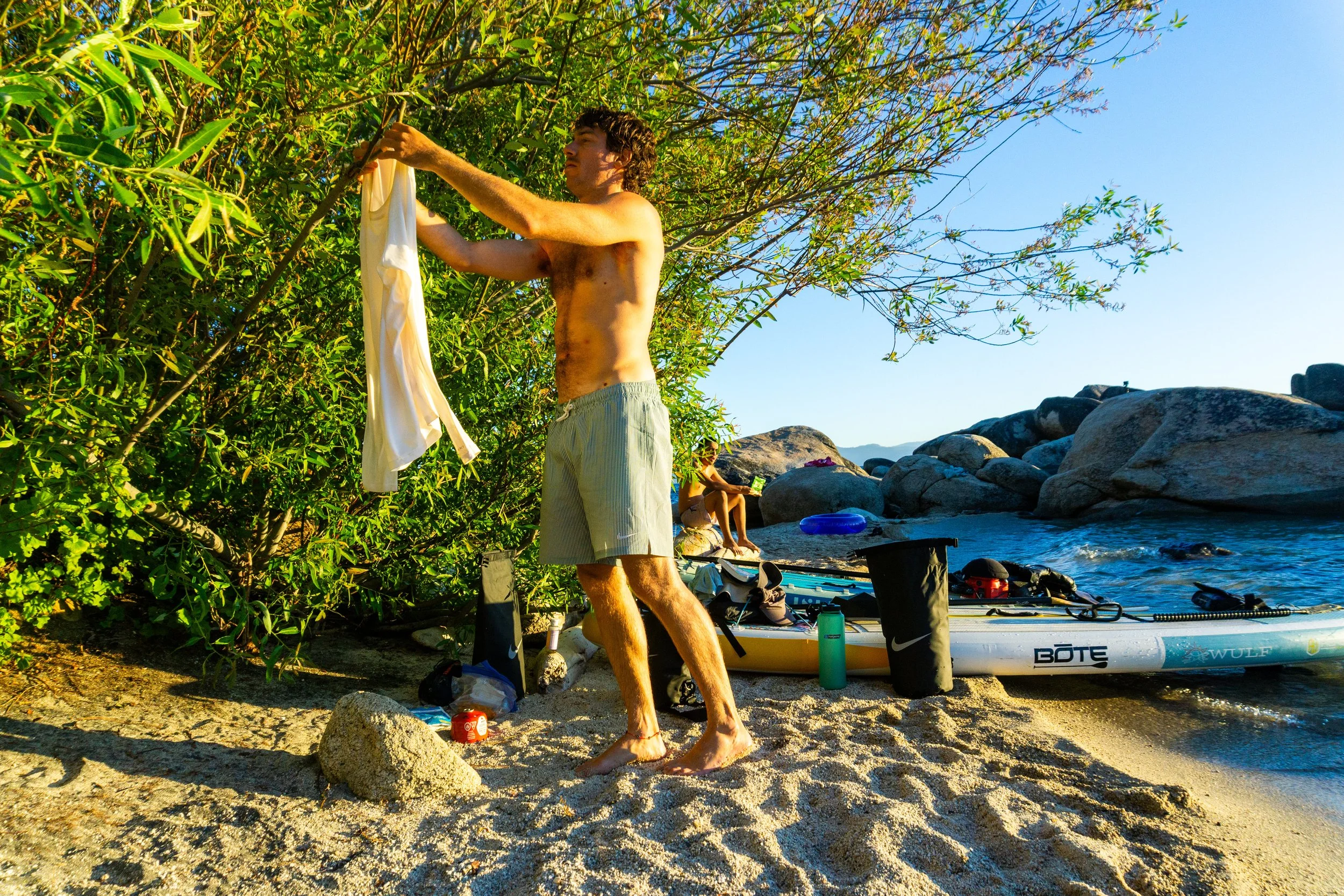
Two miles further north brings them to a spot near Eagle Rock that turns out to be private property, a river access belonging to a house sitting quiet in the trees above the shore. They pull ashore in the late evening and explain themselves to the owners on the porch — two men on paddleboards with camping gear, asking to sleep by the river. The owners look at them for a moment and say yes, on the condition that they stay off the property and leave no mess.
Then the owners start talking, the way people sometimes do when something unexpected arrives at their door at dusk, and it emerges that the house has been in the same family since 1940 and has never been renovated — not once, everything inside still original, the floors and fixtures and accumulated quality of a place that has been well used across eight decades without being altered. The owners say it the way you say something you are quietly proud of, which is the right way to say it.
Dalton and Big Mike set up camp by the river and stay up until eleven, talking about the trip and what it keeps making them think about and what these kinds of projects are really for underneath all the practical justifications. The conversation goes wherever it goes, the way conversations do late at night in the field when the regular world has gone quiet and there is nothing to do but think and talk. Then they sleep.
Five AM. Coffee in the sun. Mount Freel and Mount Rose visible across the water, and most of the lake spread out in front of them from an angle neither of them has seen it from before. Johnson sits with it for a while without saying much.
Here’s What We Packed:

Day Three: Seventeen Miles and Perfect Flat Water
Day three is the biggest day on the water, and the lake, for most of it, decides to be generous.
They launch with breakfast burritos from West Shore Market already in their systems and Dollar Point as the morning's target, and it arrives ahead of schedule in a way that has started to feel characteristic of what flat water does to perceived distance on a paddleboard. They eat snacks at the point, assess the remaining light, and decide without much deliberation to keep going.
By the time they have put thirteen miles behind them, they are sitting under some rocks with their feet in the water and the question of Banzai Rock hanging in the air between them. It is further than the original day's plan called for, and the tailwind that has been pushing them north is still there, and the light is still good, and neither man is interested in doing the math that would require them to make up the miles tomorrow. They decide to push.
The tailwind carries them northeast with real generosity at first, then shifts in the way that Tahoe wind tends to shift in the afternoon, a few degrees off course, building chop on the surface as it goes. By the time Sand Harbor appears on the Nevada shore, the conditions have changed the character of the crossing from an enjoyable run into something that demands full attention — standing upright on the boards means absorbing lateral force through the legs, catching the board as it goes sideways, resetting, absorbing again. Both men come close to going in over the final stretch, multiple times, three days into a trip on which neither of them has fallen, a streak that has at this point become less a statistic and more a quiet point of competitive pride. They fight to maintain it through chop that is entirely indifferent to their preferences.
They make Banzai Rock. Seventeen miles for the day. The streak holds.
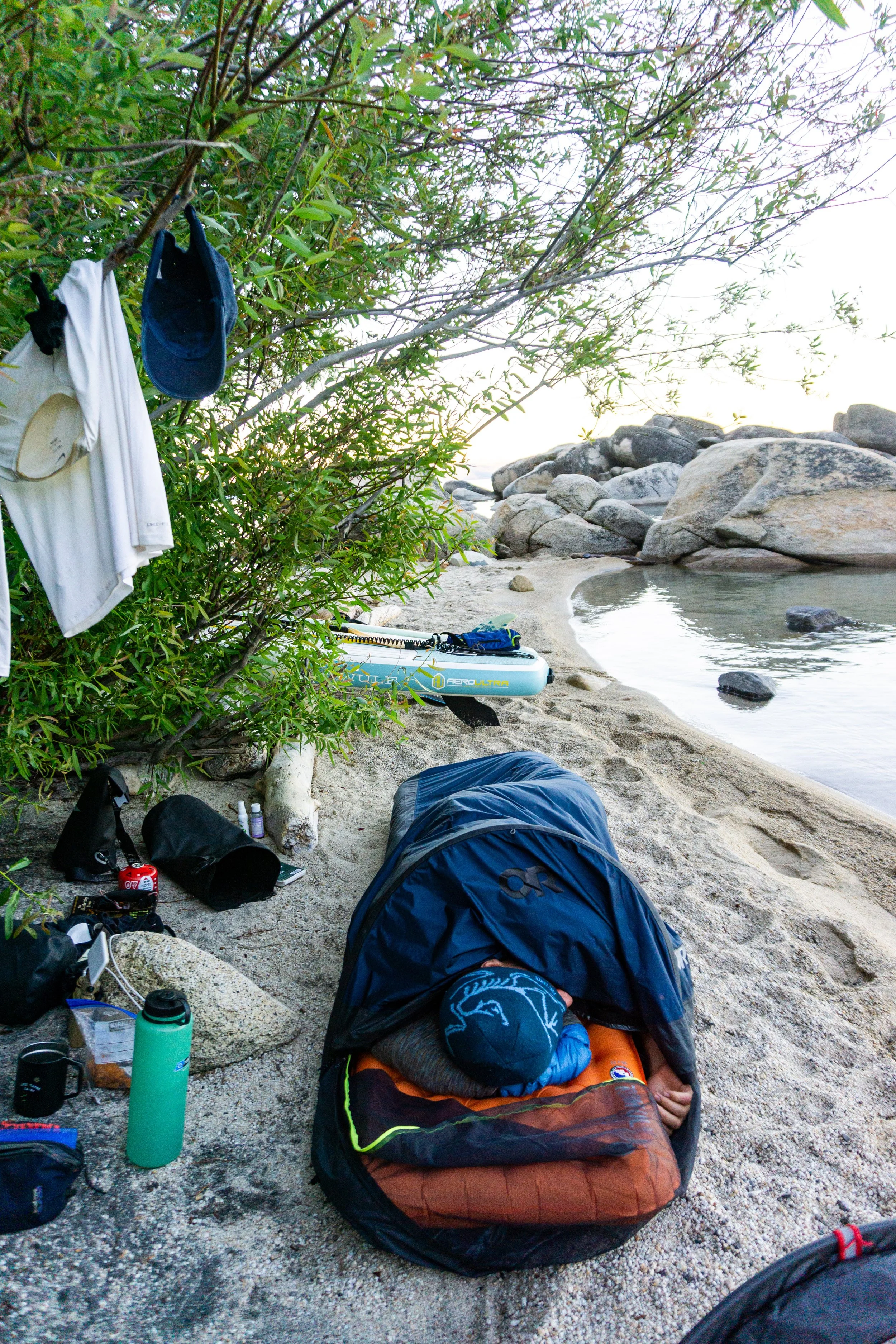
They set up camp exhausted and in excellent spirits, and the night is a quiet one — just the two of them, the lake settling into stillness, Dalton and Big Mike ending up in their sleeping bags listening to jazz from a phone and talking in low voices about the things that surface when you have been moving slowly through the outdoors for three days and the noise of ordinary life has dropped far enough away that you can actually hear yourself think. It is the kind of conversation that does not reproduce well in summary. The fact of it is the point.

Day Four: The Plan Changes Again
The morning at Banzai Rock arrives unhurried, which is appropriate given that the day's plan is about to change without anyone making a dramatic announcement about it.
The original intention was for this to be the day Big Mike leaves — Kristin arrives with a resupply, takes him home, and Johnson heads back out alone into the second half of the route, carrying the miles and the solitude by himself for however many days remain. He has been sitting with this prospect since the conversation at West Shore Market two days prior, and it has not grown more appealing in the intervening time.
The plan dissolves quietly over morning coffee, without drama, because the logistics turn out to have more flexibility than the initial read suggested. Big Mike's schedule, examined from a slightly different angle, has room that wasn't visible before. He is not leaving. He will paddle all the way to the finish.
Johnson receives this news the way you receive something good when you have already done the work of accepting the alternative — a pause, a recalibration, something that is not quite relief but functions like it.
They paddle south from Banzai Rock, and the Nevada shore opens into a stretch of coastline that Johnson keeps wanting to tell people about, a series of wide sandy coves past Deadman's Point where the water is clear enough to see the bottom in detail and the beaches are wide and warm and sheltered in a way that makes the word tropical keep presenting itself despite being technically incorrect for a lake at six thousand feet. Nobody arrives here by car. Nobody parks nearby. The only way in is by water, and most people who come by water are moving fast enough that they pass through it without really seeing it. Dalton and Big Mike are not moving fast.
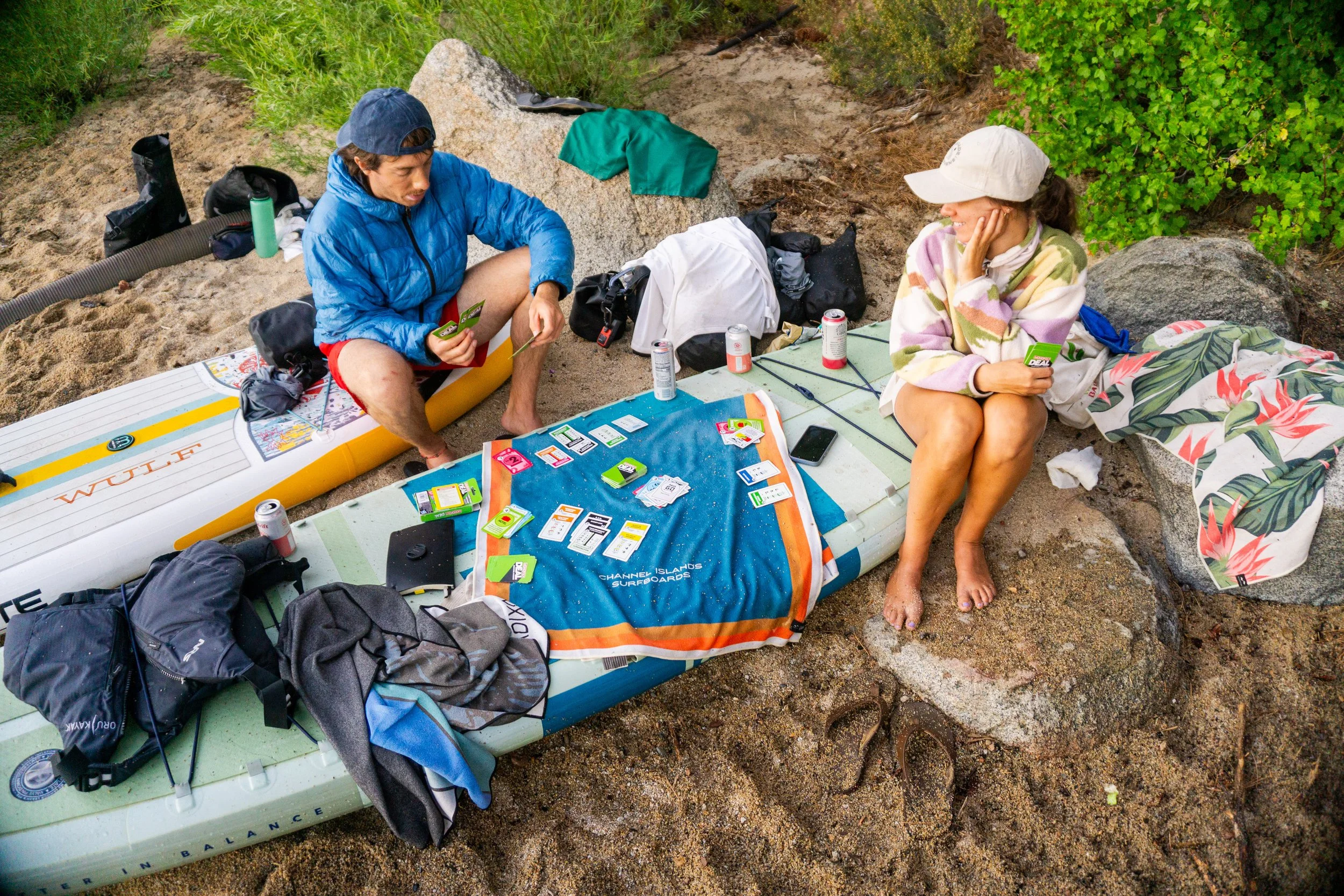
The wind returns at Cave Rock, hard enough to turn the surface of the lake into something that looks inhospitable, and they pull into Cave Rock Marina to wait it out. An hour passes. The wind drops but the swell keeps going, the chop continuing to run without the wind to sustain it, and they have the conversation that has become a recurring feature of this trip: push or don't push. They push, paddling the mile and a half to Zephyr Cove seated the entire way, working through conditions that are uncomfortable but not dangerous, and arriving at the cove around seven thirty in the evening to find Kristin waiting with pizza, sparkling water, and Chestnut, their Bernadoodle, who comes down the beach at full speed with the energy of a dog who has spent four days being unable to account for where everyone went. Monopoly Deal is played. Stories are told. The evening takes on the quality of a genuine celebration, unhurried and easy, the stars coming out over the Nevada mountains and the lake finally settling into stillness as the night comes on around them.
Day Five: All the Way Home
The last morning at Zephyr Cove begins with something that is not, in fact, a metaphor: two grown men dancing on a beach at six in the morning because someone's phone has just enough battery left to play music and the last day of a hard thing you were not certain you could do deserves more than a quiet, efficient launch.
They drink coffee and eat breakfast and watch a short film on YouTube — Strange Rumblings in Shangri-La — a piece they first encountered together in college when surfing was the organizing principle of their friendship and the future was still entirely open. Watching it on the beach at the beginning of their final day on the water, they talk about what it means to still be doing things like this, still choosing the inconvenient and physical and genuinely uncertain, still showing up for the version of life that requires something from you before it gives anything back.
Then they get on their boards and paddle north along the Nevada shore, where the American Century Championship celebrity golf tournament is in full operation — boats lined three rows deep in the water, an assembled fleet that Johnson estimates at something in the range of three hundred million dollars, anchored in the blue while spectators onshore watch famous people take swings at a small white ball. He and Big Mike pull ashore and walk the beach for twenty minutes and observe the spectacle with the detached amusement of two people who have spent five days in a fundamentally different relationship with this lake than anything currently represented by the boats.
Then they turn south, back toward Ski Run Marina, back toward the beach they pushed off from five mornings ago in the early quiet before the town woke up. From the water, approaching from the north, everything looks different — the shoreline more familiar and somehow more significant at the same time, the way places look when you have been away from them in a meaningful way and are returning with something you did not have when you left.
The excitement begins building well offshore, Johnson making noise about it out on the open water because five days of accumulated uncertainty and distance and headwinds and chicken pizza and pollen allergies and cold stone and the Milky Way through an open roofless frame are all arriving at their conclusion simultaneously, and the conclusion is right there in front of them.
Then the dock appears, sitting directly across the cleanest line to the beach, and the decision about what to do with it is made in approximately one second. They drop to their knees and shoot the gap underneath it, coming out the other side into the final hundred yards with the finish line fully visible in front of them.
Big Mike is ahead. He comes in with speed, board catches the sand, and what happens next is not a graceful landing — it is a spectacular trip, feet catching as he hit the shallower water, body going forward with full commitment, arms out, momentum carrying him face-first into the shallows in a way that is so perfectly timed and so completely unnecessary and so entirely funny that it lands not as the tragedy of a fall but as the punchline the whole trip had apparently been building toward. Five days on the water. Seventy-two miles. Not a single fall until the last twenty feet, when it didn't matter at all and mattered more than anything.
They get up. They stand in the shallows and look at each other and start laughing, the kind of laughing that has a lot in it — the absurdity of the ending, the relief of completion, the disbelief that the thing they were not entirely sure they could do is, in fact, done, and the last image of it is Big Mike going face-first into the water at the finish line in front of exactly nobody.
Later there is Mexican food, loud and celebratory, and a market stop where a cornbread bar becomes the subject of an extended philosophical inquiry into what a person would or would not do for one. There is a bus stop, and Dalton watches his best friend board a bus home to his family and stands there for a moment after it pulls away. There is a barbecue at home with Kristin and Chestnut and the particular silence of a trip that has fully completed itself.

The Part That Stays
A few days after the trip ends, Dalton is back in South Lake Tahoe, back to the routines of someone who lives next to a lake rather than moving across it. He drives past the marina where they launched. He can see Fannette Island from the road on the way into town, that small granite shape sitting in the middle of Emerald Bay, the tea house at its peak invisible from this distance but there, the way things are always there once you have been inside them.
He thinks about the pollen on the water and the way his paddle strokes disappeared behind him. He thinks about the owners of the 1940 house who said yes to two strangers asking to sleep by their river. He thinks about Big Mike going face-first into the shallows at the finish line, seventy-two miles of paddling ending in a trip over his own feet at the very last moment, and how it was the funniest thing either of them had seen in years, and how there was no one else there to see it, and how that somehow made it better.
The lake looks the same from the road as it always has. Blue and large and indifferent to what anyone thinks about it. Dalton knows now that this is not the whole picture, that the version of the lake available from the road and the version available from five days on a paddleboard are not the same place, that the second one takes longer to get to and is worth considerably more when you arrive.
While Dlaton has lived here for years, he is still finding out what his home has to offer.
The Day’s Gallery










Discover More Adventures Arounds Lake Tahoe

About the Author:
Dalton Johnson is an adventure and editorial photographer and director based in South Lake Tahoe, California. He has shot on all seven continents for brands including Patagonia, GoPro, Arc’teryx, Four Seasons, Nike, Rivian, Big Agnes, and Ford Bronco, directed more than fifty commercial spots, and spent eight years living out of a van and a car while building his business from nothing.
His documentary work includes a PBS aired film, several travel series, and a few personal adventures, like 72 Miles of Blue.
He writes about adventure travel, outdoor gear, and adventure photography for other photographers building their own careers.