What The Heck Is The Difference Between Freelance Photographer VS Solo-Agency
When you’re building a career in photography, one of the first things you need to understand is whether you are operating as a freelance photographer or as a solo-agency. This distinction affects how you price projects, manage clients, and structure your business.
When you’re building a career in photography, one of the first things you need to understand is whether you are operating as a freelance photographer or as a solo-agency. This distinction affects how you price projects, manage clients, and structure your business.
Freelance Photographer
A freelance photographer typically works independently. You handle the creative work, meet with clients, and deliver images, but your role is primarily focused on shooting and editing. Freelancers usually hire assistants or contractors on a project-by-project basis, rather than maintaining a full team.
The main advantages of freelancing are flexibility and simplicity. You can focus entirely on the creative side, keep overhead low, and manage your own schedule. Freelance photographers also tend to have lower base rates because they are not responsible for covering a team’s salaries or extensive production costs.
Solo-Agency
Operating as a solo-agency is different. Even though it might still be just one person officially running the business, you are managing both creative and production responsibilities. This can include coordinating assistants, stylists, equipment rentals, logistics, and more. You are essentially acting as a one-person company that handles the full scope of a project.
The benefits of being a solo-agency include higher earning potential and greater control over large or complex projects. You can quote higher rates because you are offering a full-service solution. However, it also comes with more responsibility. You need to manage budgets, timelines, client communication, and any collaborators involved in the project.
How This Impacts Pricing
Understanding whether you are a freelancer or a solo-agency directly impacts how you quote projects. Freelancers might focus on a creative fee for their photography and basic production costs. Solo-agencies must account for full production fees, including all resources required to deliver the project from start to finish.
Which Path Should You Choose?
There is no right or wrong answer. Freelancing is great for photographers who want to stay nimble, keep costs low, and focus on their art. Running a solo-agency works well for those who want to scale projects, take on larger clients, and manage more complex productions. Many photographers evolve from freelance to solo-agency as their experience and client base grow.
This lesson comes from The Adventure Photographer’s Playbook, where I cover practical strategies for structuring your business, quoting projects, and knowing your worth in the photography world.
This lesson comes from my ebook "The Adventure Photographer's Playbook" and it costs $10. Why so cheap? The goal is to help as many new to mid level photographers as possible go from nothing to getting booked in 18 months:

Read More From The Photographer’s Playbook
Here's What Goes Into A Production Fee For Adventure Photographers
When clients receive a photography estimate, one line item that often raises questions is the production fee. Unlike the creative fee, which compensates the photographer for their vision, skill, and licensing of images, the production fee accounts for the tangible costs of bringing a project to life. It’s the backbone of any shoot — the logistical and financial structure that ensures everything runs smoothly.
When clients receive a photography estimate, one line item that often raises questions is the production fee. Unlike the creative fee, which compensates the photographer for their vision, skill, and licensing of images, the production fee accounts for the tangible costs of bringing a project to life. It’s the backbone of any shoot — the logistical and financial structure that ensures everything runs smoothly.
What Is a Production Fee?
The production fee covers the actual costs of executing a project. Think of it as the behind-the-scenes support system that makes your creative work possible. These aren’t add-ons or “extras,” but essential elements that transform an idea into reality. Without these resources, a photographer wouldn’t be able to deliver the quality and consistency a client expects.
Common Expenses Within a Production Fee
While the specific needs of each shoot vary, a production fee often includes:
Equipment Rentals – Cameras, lenses, lighting, drones, or specialty gear that may not be part of the photographer’s standard kit.
Assistants & Crew – Additional hands to manage lighting setups, handle equipment, or capture behind-the-scenes work.
Permits & Insurance – Legal permissions to shoot in certain locations, plus liability insurance for protection.
Travel Costs – Transportation, lodging, and meals when a project requires moving outside the studio or local area.
Location Fees – Renting a studio, securing a private property, or paying access fees for unique locations.
Props & Wardrobe – Items that help set the scene or align with the client’s vision.
Stylists & Makeup Artists – Professionals who ensure talent looks their best and the scene is styled appropriately.
Why the Production Fee Matters
A production fee isn’t just about covering expenses; it ensures the client receives the best possible outcome. By budgeting for the right gear, support staff, and locations, a photographer can focus on their creative contribution without being limited by logistics. It also gives clients transparency into where their money goes, building trust and professionalism into the process.
The Balance Between Creative and Production Fees
Together, the creative fee and production fee form the foundation of a fair photography estimate. The creative fee values the photographer’s vision and expertise, while the production fee funds the resources needed to bring that vision to life. Both are essential for delivering high-quality, professional results.
This lesson comes from my ebook "The Adventure Photographer's Playbook" and it costs $10. Why so cheap? The goal is to help as many new to mid level photographers as possible go from nothing to getting booked in 18 months:
Read More From The Photographer’s Playbook
What Goes Into a Creative Fee as an Adventure Photographer
When you’re building a quote for a client, one of the most important pieces to define is your creative fee. This number represents far more than just the time you spend taking photos—it’s the heart of your value as a professional. Understanding what goes into a creative fee not only helps you communicate with clients but also ensures you’re compensated fairly for the work you bring to the table.
When you’re building a quote for a client, one of the most important pieces to define is your creative fee. This number represents far more than just the time you spend taking photos—it’s the heart of your value as a professional. Understanding what goes into a creative fee not only helps you communicate with clients but also ensures you’re compensated fairly for the work you bring to the table.
Time Behind the Camera
At its simplest, the creative fee covers the hours you spend actively shooting. Whether it’s a half-day portrait session, a multi-day commercial campaign, or a fast-paced event, the time you dedicate on set is a clear part of your fee. But this is just the surface layer.
Experience and Skill
Your fee also reflects the years you’ve invested in building your craft. From mastering lighting techniques and composition to developing your personal style, the skills you bring didn’t appear overnight. Clients are paying for your ability to consistently deliver strong images, solve problems quickly, and make creative decisions under pressure.
Creative Direction and Vision
A huge part of your value lies in the ideas you contribute. Clients don’t just hire a photographer to press a shutter button; they rely on you for your creative input, perspective, and direction. Whether it’s conceptualizing how a brand story should be told visually or finding the perfect location to bring a mood to life, your artistry is built into the creative fee.
Licensing and Usage Rights
One of the most important—yet often overlooked—components of the creative fee is licensing. This is where you grant the client rights to use your images, and the scope of that use directly affects your fee. A photo used for a small local flyer carries a different value than one used in a nationwide ad campaign. By including licensing in your creative fee, you ensure you’re compensated fairly based on how your work will be distributed and for how long.
Professionalism and Reliability
Finally, the creative fee acknowledges your role as a professional. Clients pay not just for images, but for peace of mind. This includes your ability to communicate clearly, meet deadlines, coordinate with teams, and deliver consistent results. Your reputation and reliability are part of the package, and that has real value.
Why the Creative Fee Matters
Breaking down what goes into a creative fee helps clients understand that it’s not just an arbitrary number—it’s a reflection of the expertise, vision, and rights you bring to a project. For photographers, setting a thoughtful creative fee is essential for building a sustainable career and ensuring your work is valued appropriately.
This lesson comes from my ebook "The Adventure Photographer's Playbook" and it costs $10. Why so cheap? The goal is to help as many new to mid level photographers as possible go from nothing to getting booked in 18 months:
Read More From The Photographer’s Playbook

"Diverse Similarities" a Poem by Dalton Johnson
"Diverse Similarities" is a poem by Dalton Johnson published in his first book 51 Poems For Humankind To Think About. This article also has a video of Dalton reading aloud his poem. You can purchase this book on Dalton Johnson's website or on Amazon.
DIVERSE SIMILARITIES
He is black, I’m white.
We are sitting, across from each other Observing, one another.
But we are both, on the train,
Nothing is different Between us. Except, where we hail.
He is a father, I am a son.
He teaches his daughter, The same teachings, My father Taught me.
So why do people say, That we are different?
The teachings of both fathers, are the same, My dad just made more money.
Does money, really make a difference? Does money, affect ones success?
My father’s hard work, Has privileged me.
Does this mean his daughter, Won’t be more successful than me?
Order Your Copy Today: Buy on Amazon
Order Your Signed Copy Today:
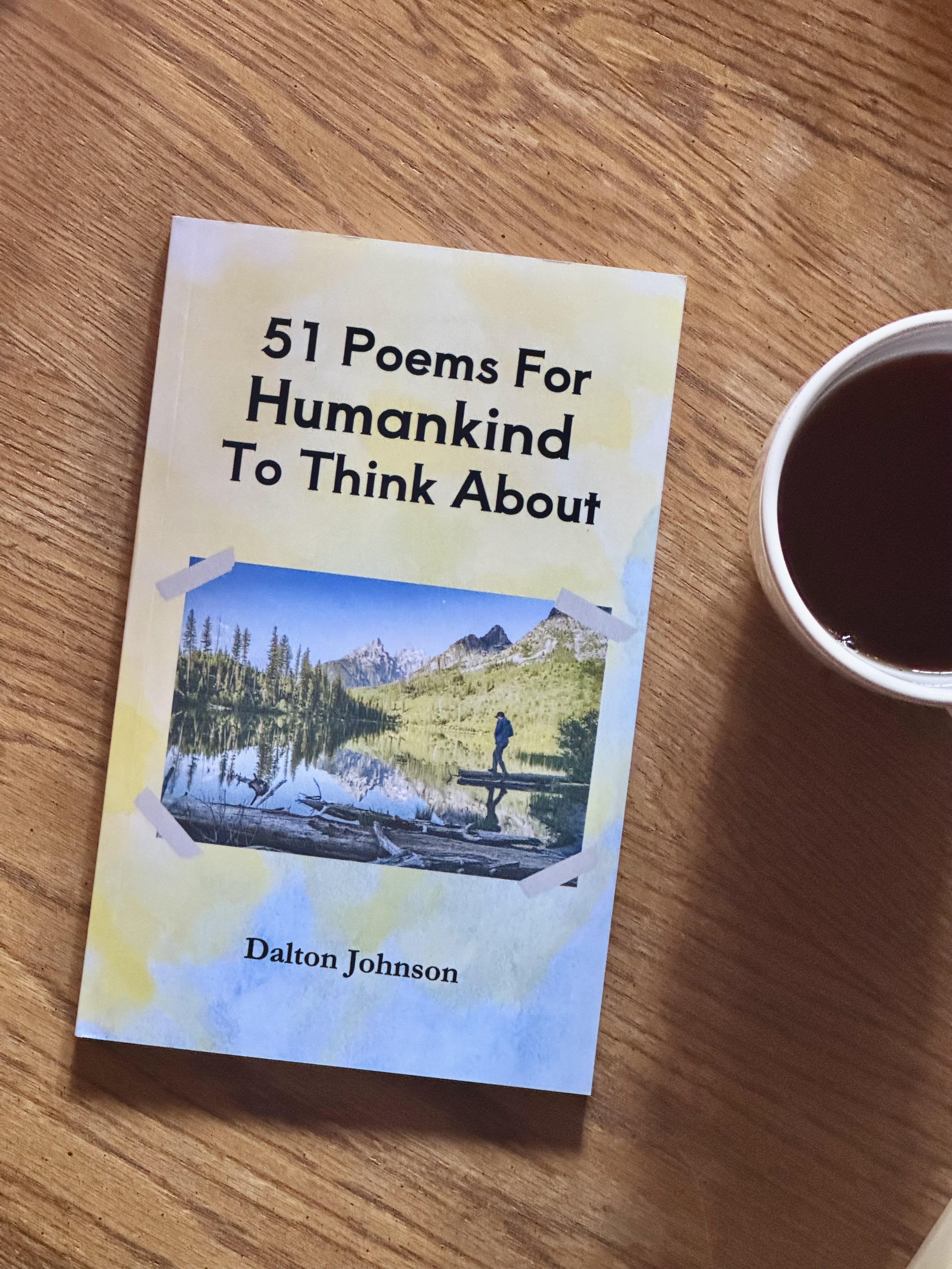
Get your signed copy of 51 Poems For Humankind To Think About. Dalton Johnson's first book of poetry. These 51 poems are his critique of American hustle culture told from the perspective of a young man returning to the world after years of living off the grid on less than $500 a month.
These poems capture the internal battle of consumerism, American greed, humans loss of connection with the natural world, and pokes fun at some of the absurd cultural norms of adulting. Each poem touches on different parts of American's superficial society in hopes of promoting the change from group thought to individuality. For it is at the individual level Johnson belives you unlock your true self.
As you read these poems take some time to think about what stirs inside of yourself to find where you can change and grow into the human you want to be today and tomorrow.
Please Note: Signed paperback will be shipping the middle of April, 2025 and should arrive by the end of April

The Difference Between Creative Fees and Production Fees in Photography
When you’re starting out as a professional photographer, one of the biggest challenges is figuring out how to price your work. You know you should be paid for your time, talent, and vision — but there are also hard costs that make a project happen. To simplify this, I’ve found one tool that makes pricing far more straightforward: breaking a quote into two clear parts.
When you’re starting out as a professional photographer, one of the biggest challenges is figuring out how to price your work. You know you should be paid for your time, talent, and vision — but there are also hard costs that make a project happen. To simplify this, I’ve found one tool that makes pricing far more straightforward: breaking a quote into two clear parts.
Creative Fee
The creative fee is what you make as a photographer. This includes not just the hours you’re behind the camera, but also your experience, skill, and creative input. Importantly, it also includes licensing — the rights the client has to use your images. Think of the creative fee as your paycheck for bringing the project to life with your perspective and artistry.
Production Fee
The production fee is different. This is the actual cost of producing the project. It covers everything beyond your creative pay: equipment rentals, assistants, permits, travel, location fees, props, stylists, and any other expenses required to make the shoot happen. In short, it’s the logistical and financial backbone that allows your creative work to exist.
Why the Distinction Matters
Breaking your quote into these two parts does more than organize your own thinking — it creates transparency with clients. They’ll understand that one part of your fee is about your craft and licensing, and the other is about tangible costs that bring the project together. It also makes negotiations easier: if a client asks to lower the budget, you can adjust production costs without undervaluing your creative worth.
This lesson comes from The Adventure Photographer’s Playbook, and it’s one that completely changed how I approached client conversations. Once you make this separation, you’ll notice your confidence grow, your pricing feel clearer, and your clients understand exactly what they’re paying for.
This lesson comes from my ebook "The Adventure Photographer's Playbook" and it costs $10. Why so cheap? The goal is to help as many new to mid level photographers as possible go from nothing to getting booked in 18 months:
Read More From The Photographer’s Playbook

As a Photographer, You Need To Know The Client's Budget
When you start the conversation with a potential client, your first goal is to get a feel for their budget. This helps you understand how big of a production you can realistically create. Just as important, you need to know whether you are acting as a photographer or as a solo-agency. That distinction has a major impact on pricing.
When you start the conversation with a potential client, your first goal is to get a feel for their budget. This helps you understand how big of a production you can realistically create. Just as important, you need to know whether you are acting as a photographer or as a solo-agency. That distinction has a major impact on pricing.
If you are asked to take on the production side, remember to pay yourself for those extra days. Your time is valuable, and production work is just as much a part of the job as taking the photos.
Assistants are another factor to consider. A part-time assistant should be compensated for every hour of their involvement. If you work with a full-time assistant, you already know the ongoing costs of having them on projects, but it is worth factoring them into every budget conversation.
Budget flexibility is a big part of this business. If a client’s budget is lower than your usual rate, it is okay to accept the project if the number works for you. There is nothing wrong with adjusting your price as long as you are comfortable with the wage.
Sometimes clients will not fully understand why certain costs exist. In those cases, take the time to explain. Education builds trust and helps them see the value of your work.
One tool I have found helpful is breaking a quote into two clear parts:
Creative fee: what you make as a photographer, including the licensing.
Production fee: the actual cost of the project, which covers everything beyond your creative pay.
This approach simplifies conversations, avoids confusion, and gives clients clarity on where their money is going.
This lesson comes from my ebook "The Adventure Photographer's Playbook" and it costs $10. Why so cheap? The goal is to help as many new to mid level photographers as possible go from nothing to getting booked in 18 months:
Read More From The Photographer’s Playbook
"When All You Crave Is Success" a Poem by Dalton Johnson
"When All You Crave Is Success" is a poem by Dalton Johnson published in his first book 51 Poems For Humankind To Think About. This article also has a video of Dalton reading aloud his poem. You can purchase this book on Dalton Johnson's website or on Amazon.
WHEN ALL YOU CRAVE IS SUCCESS
It burns deep,
deep inside of my gut. There is a desire,
a desire to succeed.
But succeed in what? I desire to succeed, at what I love.
And what is it, which I love?
I love the taste of success,
I love to sweat,
I love the tears I shed in pain,
I love the sensation, my body feels, after I succeed.
I LOVE THE FIRE IN MY GUT!
This fire is never ending, only revitalizing!
So then,
Am I ever in love?
Or, am I always succeeding? Or, am I never succeeding?
Order Your Copy Today: Buy on Amazon
Order Your Signed Copy Today:
Get your signed copy of 51 Poems For Humankind To Think About. Dalton Johnson's first book of poetry. These 51 poems are his critique of American hustle culture told from the perspective of a young man returning to the world after years of living off the grid on less than $500 a month.
These poems capture the internal battle of consumerism, American greed, humans loss of connection with the natural world, and pokes fun at some of the absurd cultural norms of adulting. Each poem touches on different parts of American's superficial society in hopes of promoting the change from group thought to individuality. For it is at the individual level Johnson belives you unlock your true self.
As you read these poems take some time to think about what stirs inside of yourself to find where you can change and grow into the human you want to be today and tomorrow.
Please Note: Signed paperback will be shipping the middle of April, 2025 and should arrive by the end of April
"Emptiness" a Poem by Dalton Johnson
"Emptiness" is a poem by Dalton Johnson published in his first book 51 Poems For Humankind To Think About. This article also has a video of Dalton reading aloud his poem. You can purchase this book on Dalton Johnson's website or on Amazon.
EMPTINESS
My body wanders streets and converses with others but only my body.
I’m an empty sack of skin and bones wandering the streets like a zombie. Moving without a purpose throughout society.
There is nothing to me besides my body sack,
I have no soul, no beating heart, I am connected to nothing.
I go through the motions,
proceeding day in and day out without a purpose.
Only to live an empty pointless life.
Order Your Copy Today: Buy on Amazon
Order Your Signed Copy Today:
Get your signed copy of 51 Poems For Humankind To Think About. Dalton Johnson's first book of poetry. These 51 poems are his critique of American hustle culture told from the perspective of a young man returning to the world after years of living off the grid on less than $500 a month.
These poems capture the internal battle of consumerism, American greed, humans loss of connection with the natural world, and pokes fun at some of the absurd cultural norms of adulting. Each poem touches on different parts of American's superficial society in hopes of promoting the change from group thought to individuality. For it is at the individual level Johnson belives you unlock your true self.
As you read these poems take some time to think about what stirs inside of yourself to find where you can change and grow into the human you want to be today and tomorrow.
Please Note: Signed paperback will be shipping the middle of April, 2025 and should arrive by the end of April
"Sermons of Peace" a Poem by Dalton Johnson
"Sermons of Peace" is a poem by Dalton Johnson published in his first book 51 Poems For Humankind To Think About. This article also has a video of Dalton reading aloud his poem. You can purchase this book on Dalton Johnson's website or on Amazon.
SERMONS OF PEACE
I
Off the cliff it falls, tumbling Down the mountainside, on course To the ocean residing below.
Plunging in to take a swim, it sinks
To the bottom like a rock. No struggles, No resistance, it sinks to the depths.
For the oceans density does Not support and its buoyancy is Not enough to float on.
II
Made from Mother Earth
Its lost old soul belongs to this World. Destined to search
The lands and speak out against Inequality, in the name of love.
The soul has hardened
Over the years, but its ready to take
The plunge into the unsupportive waters Without resistance.
The soul is ready to tread among the water, Struggle through thick and thin.
The soul is ready to preach peace at sermons of unconditional love.
For a destiny is a destiny, one Cannot deny their calling.
Order Your Copy Today: Buy on Amazon
Order Your Signed Copy Today:
Get your signed copy of 51 Poems For Humankind To Think About. Dalton Johnson's first book of poetry. These 51 poems are his critique of American hustle culture told from the perspective of a young man returning to the world after years of living off the grid on less than $500 a month.
These poems capture the internal battle of consumerism, American greed, humans loss of connection with the natural world, and pokes fun at some of the absurd cultural norms of adulting. Each poem touches on different parts of American's superficial society in hopes of promoting the change from group thought to individuality. For it is at the individual level Johnson belives you unlock your true self.
As you read these poems take some time to think about what stirs inside of yourself to find where you can change and grow into the human you want to be today and tomorrow.
Please Note: Signed paperback will be shipping the middle of April, 2025 and should arrive by the end of April
"Lost" a Poem by Dalton Johnson
"Lost" is a poem by Dalton Johnson published in his first book 51 Poems For Humankind To Think About. This article also has a video of Dalton reading aloud his poem. You can purchase this book on Dalton Johnson's website or on Amazon.
LOST
I sit around all day, watching people pass me by.
They are all busy, forcing me to sit alone, unnoticed.
Work consumes those who pass me, while I consume myself, with thoughts of disgust and heartache.
I sit on the cold, hard earth while my emotions keep me warm. Disgust fills my body, as I watch these heartless zombies trudge the crowded streets. Only capable of seeing where their GPS leads and interact with those who carry the latest iPhone.
The men and women who pass me by, disgust me.
I am disgusted they don’t take the time to look at the beauty which surrounds them. I agree beauty is in the eyes of the beholder, but when your 3 inch screen displays the world around you, I don’t understand why you can’t simply look up.
Also, I am offended by the ones who purposefully look away as they pass; only because I am not a clone, like them.
I have a mind, which thinks independently!
Although my emotions keep me warm, without a companion I grow cold. My heart slows beat by beat as it freezes.
Without a companion my words go unheard and my ears grow quiet. My shoulders were created to bear the weight of another, if only they dare to stop walking, sit down, and start talking.
My heart is open to all, but few are willing to stop moving with the crowd. For they fear they will be left behind.
My heart aches for those who fear to slow down and look around. For they live a life without color, without appreciation, without love. While several would disagree, yet day in and day out, as my ears grow quite I observe tired eyes, frowns, and saddened expressions.
Yet the most disheartening part of my life is when most decided to join me on the ground. For I am here by choice, I can get up and go with the flow till I tire then I’ll sit back down. But, for most who seek my shoulders, it is too late. They have already lost everything by the time they decide to sit with me. I am everyones last resort, although I am always willing to boost those who are in need and those who are already at the top. It just behooves me that those at the top never sit down until everything is lost.
Once everything is lost, their tears of sorrow will drip one by one on my shoulder until they realize what they have been missing. Then and only then will they let the flood gates open, until a puddle forms beneath us. With the formation of that puddle, we sit in mud. With this mud I will teach those to build bricks. These bricks alone are not strong, but make enough bricks and you can build a foundation. A foundation which allows you to stand again and walk with the crowd.
Once you regain your footsteps you will wander away without glancing back, as if you have forgotten instantly who I am. My life may seem sad but you know where I sit. Here is my domain, where I will reside day in and day out, until another comes crashing upon my shoulders. And I will aid them to stand and walk again, just as I did you.
My only wish is that you would stop walking, sit down, and start talking before everything is lost,
again.
Order Your Copy Today: Buy on Amazon
Order Your Signed Copy Today:
Get your signed copy of 51 Poems For Humankind To Think About. Dalton Johnson's first book of poetry. These 51 poems are his critique of American hustle culture told from the perspective of a young man returning to the world after years of living off the grid on less than $500 a month.
These poems capture the internal battle of consumerism, American greed, humans loss of connection with the natural world, and pokes fun at some of the absurd cultural norms of adulting. Each poem touches on different parts of American's superficial society in hopes of promoting the change from group thought to individuality. For it is at the individual level Johnson belives you unlock your true self.
As you read these poems take some time to think about what stirs inside of yourself to find where you can change and grow into the human you want to be today and tomorrow.
Please Note: Signed paperback will be shipping the middle of April, 2025 and should arrive by the end of April
"Unlearning To Instruct Myself" a Poem by Dalton Johnson
"Unlearning To Instruct Myself" is a poem by Dalton Johnson published in his first book 51 Poems For Humankind To Think About. This article also has a video of Dalton reading aloud his poem. You can purchase this book on Dalton Johnson's website or on Amazon.
UNLEARNING TO INSTRUCT MYSELF
All my life,
I have been pulled,
this way and that,
now my arms are stretched and ache.
It is time,
to heal my arms, back to their normal length, and do as I please.
This way,
I take pride, responsibility, ownership,
in the mistakes I make, because it was only me, who made the mistake.
Nobody else has ownership, it was my decision,
and if I fail,
I pick myself up,
and fix what went wrong.
It is time,
to live my own life, make my own decisions, to fail alone.
It is time, to instruct myself!
Order Your Copy Today: Buy on Amazon
Order Your Signed Copy Today:
Get your signed copy of 51 Poems For Humankind To Think About. Dalton Johnson's first book of poetry. These 51 poems are his critique of American hustle culture told from the perspective of a young man returning to the world after years of living off the grid on less than $500 a month.
These poems capture the internal battle of consumerism, American greed, humans loss of connection with the natural world, and pokes fun at some of the absurd cultural norms of adulting. Each poem touches on different parts of American's superficial society in hopes of promoting the change from group thought to individuality. For it is at the individual level Johnson belives you unlock your true self.
As you read these poems take some time to think about what stirs inside of yourself to find where you can change and grow into the human you want to be today and tomorrow.
Please Note: Signed paperback will be shipping the middle of April, 2025 and should arrive by the end of April
"All I Ask In Return" a Poem by Dalton Johnson
"All I Ask In Return" is a poem by Dalton Johnson published in his first book 51 Poems For Humankind To Think About. This article also has a video of Dalton reading aloud his poem. You can purchase this book on Dalton Johnson's website or on Amazon.
ALL I ASK IN RETURN
Like the Leaning Tower of Pisa,
I feel off -- something isn’t right -- my heart aches and my soul is deprived.
People keep looking at me with their heads crooked, as if I am leaning and about to fall.
At times I am king of the world.
Yet, when I ask myself, how are you, a negative response arrives.
But, why?
People like me, people say I’m attractive, I have friends,
but I don’t have a lover. Not a sexual lover but one who loves me.
For they love to talk with me. To discuss life. To hear my issues and my complaints.
I want somebody who’s willing to bare the weight of my head upon their shoulder. For I am unhappy.
I’ve realized I’m searching for this person, in the wrong place.
I’ve tried at parties, but that isn’t me. That is me fitting in. That isn’t me being me. That is me being socially accepted by those around me who don’t even know, my name.
Why do I care about them? What attaches me, my soul, and my desires to them?
Who are these people?
I feel as if my heart has been ripped out, yet nothing specific did this! My soul desires to listen to you, your complaints, your achievements.
All I ask in return,
is for you
to do the same for me.
Order Your Copy Today: Buy on Amazon
Order Your Signed Copy Today:
Get your signed copy of 51 Poems For Humankind To Think About. Dalton Johnson's first book of poetry. These 51 poems are his critique of American hustle culture told from the perspective of a young man returning to the world after years of living off the grid on less than $500 a month.
These poems capture the internal battle of consumerism, American greed, humans loss of connection with the natural world, and pokes fun at some of the absurd cultural norms of adulting. Each poem touches on different parts of American's superficial society in hopes of promoting the change from group thought to individuality. For it is at the individual level Johnson belives you unlock your true self.
As you read these poems take some time to think about what stirs inside of yourself to find where you can change and grow into the human you want to be today and tomorrow.
Please Note: Signed paperback will be shipping the middle of April, 2025 and should arrive by the end of April
"Try Not To Conform" a Poem by Dalton Johnson
"Try Not To Conform" is a poem by Dalton Johnson published in his first book 51 Poems For Humankind To Think About. This article also has a video of Dalton reading aloud his poem. You can purchase this book on Dalton Johnson's website or on Amazon.
TRY NOT TO CONFORM
Our actions don’t define us. They justify our claims, like a quote within a paper.
Our actions prove, or disprove,
our words. But unfortunately,
our words are taken like a grain of sand in the Sahara Desert.
Ironically words are useless, within our society of reputations.
For a reputation constructed from words and actions, define our worth in a worthless society of judgmental people.
Judgements are everything,
although the people who judge you,
are no different from yourself,
their unworthy words,
attempt to tear into your soul and dishearten who you are.
Only to conform you into them.
Order Your Copy Today: Buy on Amazon
Order Your Signed Copy Today:
Get your signed copy of 51 Poems For Humankind To Think About. Dalton Johnson's first book of poetry. These 51 poems are his critique of American hustle culture told from the perspective of a young man returning to the world after years of living off the grid on less than $500 a month.
These poems capture the internal battle of consumerism, American greed, humans loss of connection with the natural world, and pokes fun at some of the absurd cultural norms of adulting. Each poem touches on different parts of American's superficial society in hopes of promoting the change from group thought to individuality. For it is at the individual level Johnson belives you unlock your true self.
As you read these poems take some time to think about what stirs inside of yourself to find where you can change and grow into the human you want to be today and tomorrow.
Please Note: Signed paperback will be shipping the middle of April, 2025 and should arrive by the end of April
When To Start Pitching Sponsored Projects As A Photographer
If you’re waiting for someone to give you permission to pitch sponsored projects, here it is: you can start today. You don’t need to be a world-famous photographer or have a massive following. What you do need is a strong idea, the ability to communicate that idea, and the willingness to do the work of putting yourself out there.
If you’re waiting for someone to give you permission to pitch sponsored projects, here it is: you can start today.
You don’t need to be a world-famous photographer or have a massive following. What you do need is a strong idea, the ability to communicate that idea, and the willingness to do the work of putting yourself out there.
For me, sponsored projects started as a way to fund personal ideas that I already wanted to create. I’d have a concept I was excited about—maybe a road trip, an expedition, or even just a photo essay about a story unfolding in my own backyard. From there, I’d build a pitch deck that explained what I wanted to make, why it mattered, and how a sponsor could be involved.
Once I have that in place, I start sending it out. On average, my sponsorship success rate is about three percent. That means I’ll get three yeses for every 100 cold emails or messages I send. It’s a low number, but it’s enough. All it takes is one good sponsor to get a project off the ground.
This is a numbers game. But it’s also a timing game. Sometimes, the idea is great, but it just doesn’t land at the right time for a brand. That’s okay. I’ve had projects get picked up months after the initial pitch simply because someone came back around when the time was right.
You don’t need permission, a huge budget, or even previous sponsorships to begin. You just need to believe in the story you want to tell and be willing to pitch it. I break this process down step-by-step in The Adventure Photographer’s Playbook, including tips for cold outreach, deck design, and structuring deliverables.
Offering sponsored projects isn’t reserved for top-tier professionals. It’s a tool anyone can use to build their body of work, tell meaningful stories, and make a living doing what they love. So if you’re asking when you can start, the answer is simple.
Right now.
This lesson comes from my ebook "The Adventure Photographer's Playbook" and it costs $10. Why so cheap? The goal is to help as many new to mid level photographers as possible go from nothing to getting booked in 18 months:
Read More From The Photographer’s Playbook
"The Lack of Greatness" a Poem by Dalton Johnson
"The Lack of Greatness" is a poem by Dalton Johnson published in his first book 51 Poems For Humankind To Think About. This article also has a video of Dalton reading aloud his poem. You can purchase this book on Dalton Johnson's website or on Amazon.
THE LACK OF GREATNESS
The mind continually conjures thought after thought,
memory after memory,
idea after idea.
Relishing within the mind, dreaming, hoping, expressing life without censorship within a politically correct life.
Impossible, because
The individual is sacrificed for the
greater good, diluting and polluting greatness for the incapable.
Forced to pick up after those physically and mentally
Weaker. Political correctness promotes leaches
Feeding off the strong, never forcing the weak to become great themselves.
Now, whose fault is this? Sure, we should all build each other up by Dedicating oneself to their calling. For that is how you become strong, But how does society accept
Leaving political correctness in the rearview mirror so
Individuals can find greatness in themselves, own their mistakes, and Future by reducing the lack of greatness one individual at a time.
Order Your Copy Today: Buy on Amazon
Order Your Signed Copy Today:
Get your signed copy of 51 Poems For Humankind To Think About. Dalton Johnson's first book of poetry. These 51 poems are his critique of American hustle culture told from the perspective of a young man returning to the world after years of living off the grid on less than $500 a month.
These poems capture the internal battle of consumerism, American greed, humans loss of connection with the natural world, and pokes fun at some of the absurd cultural norms of adulting. Each poem touches on different parts of American's superficial society in hopes of promoting the change from group thought to individuality. For it is at the individual level Johnson belives you unlock your true self.
As you read these poems take some time to think about what stirs inside of yourself to find where you can change and grow into the human you want to be today and tomorrow.
Please Note: Signed paperback will be shipping the middle of April, 2025 and should arrive by the end of April

A BTS Look At Creating Sponsored Photography Projects
Sponsored projects have become one of the most rewarding and challenging parts of my career as an adventure photographer. They are a way to fund personal stories I care deeply about while also building my body of work and, in many cases, earning real money.
Sponsored projects have become one of the most rewarding and challenging parts of my career as an adventure photographer. They are a way to fund personal stories I care deeply about while also building my body of work and, in many cases, earning real money.
The process usually starts with an idea. That idea could be anything from a road trip or expedition to a local story about a friend. Once I know what I want to create, I put together a pitch deck to help communicate the concept clearly to potential sponsors.
Then I start sending it out. My average sponsorship rate is around three percent. That means for every 100 potential clients I contact, about three sign on. It’s a numbers and timing game, and you have to be okay hearing “no” a lot. But if you believe in the project, you keep going.
Sponsored projects can range from massive to modest. I’ve worked on everything from ten-part TV shows and short documentaries to simple photo essays. The key is matching the scope of the project to the story and budget.
Here are the basic steps I follow for each one:
Come up with an idea you are excited to create
Build a pitch deck that tells the story and outlines the vision
Send it to at least 50 potential sponsors
Land one or more sponsors (enough to fund the project fully, ideally)
Go out and create the work
Deliver it to your sponsors
Market the final project
Repeat
It might sound simple, but sponsored projects take a lot of time and effort. They also take a thick skin, solid communication, and the patience to manage moving parts and expectations.
I talk about this entire process in The Adventure Photographer’s Playbook, including how to pitch, structure your deliverables, and turn these kinds of projects into career-defining opportunities.
The truth is, these projects have brought me the most joy, the most frustration, the most growth, and the most income. If you want to take your work to the next level, this is where things get real.
This lesson comes from my ebook "The Adventure Photographer's Playbook" and it costs $10. Why so cheap? The goal is to help as many new to mid level photographers as possible go from nothing to getting booked in 18 months:
Read More From The Photographer’s Playbook

How To Fund and Profit From Personal Projects In Photography
The short answer is yes and no. As an adventure photographer, I’ve landed over $20,000 for a single project from one sponsor, which was a fantastic win. But more often than not, sponsorships mostly help offset the cost of producing the project rather than making a big profit upfront.
The short answer is yes and no. As an adventure photographer, I’ve landed over $20,000 for a single project from one sponsor, which was a fantastic win. But more often than not, sponsorships mostly help offset the cost of producing the project rather than making a big profit upfront.
Sponsored projects often function like fundraising campaigns for your creative work. You’re using sponsors to cover expenses like travel, gear, and production costs. This means that instead of paying yourself a full fee, you’re leveraging partnerships to make the project possible in the first place.
But that doesn’t mean you can’t make money from personal projects. Here’s how I’ve found success in turning sponsored projects into income:
Use sponsorships to fund the cost of the project. This is the baseline. Without sponsorships, many projects would never get off the ground.
Sell a final product. This could be a photo book, limited edition prints, a short film, or even digital downloads. Personal projects have stories that resonate with audiences, so packaging your work for sale is a powerful way to generate revenue.
Host in-person events. Think gallery shows, talks, or workshops that showcase your project. These events can create additional income streams and deepen connections with your audience and potential clients.
Photo licensing. Once the project is complete, licensing your images for editorial, commercial, or stock use can bring in ongoing revenue.
I dive deeper into this in The Adventure Photographer’s Playbook, where I break down how to fund personal work, pitch sponsors, and create opportunities beyond the shoot itself. The key is to think beyond just the sponsorship check. Your project is a platform that can generate multiple income sources if you plan ahead.
This lesson comes from my ebook "The Adventure Photographer's Playbook" and it costs $10. Why so cheap? The goal is to help as many new to mid level photographers as possible go from nothing to getting booked in 18 months:
Read More From The Photographer’s Playbook

How to Climb Mount of the Holy Cross in Colorado
Mount of the Holy Cross is one of Colorado’s most striking 14ers. Named after the snow-filled cross that forms in a northeast-facing couloir, this 14,005-foot peak stands alone in the northern Sawatch Range and draws climbers looking for a more remote experience. The standard route is long, rugged, and includes a frustrating re-climb on the return—so be prepared.
How to Climb Mount of the Holy Cross in Colorado
Mount of the Holy Cross is one of Colorado’s most striking 14ers. Named after the snow-filled cross that forms in a northeast-facing couloir, this 14,005-foot peak stands alone in the northern Sawatch Range and draws climbers looking for a more remote experience. The standard route is long, rugged, and includes a frustrating re-climb on the return—so be prepared.
Trailhead Access
To reach the trailhead, drive Tigiwon Road (FR 707) from Minturn. It’s about 8 miles of maintained dirt road to the Half Moon Trailhead. The road is passable for most vehicles when dry but is closed seasonally—usually opening in late June or early July depending on snowpack.
Route Description
The North Ridge route begins at the Half Moon Trailhead and follows the Fall Creek Trail toward Half Moon Pass. You’ll immediately climb 1,000 feet to reach the pass, only to descend 1,000 feet into the East Cross Creek basin—a key detail that makes the return hike feel much harder.
From East Cross Creek, the trail becomes steeper and more rugged. You’ll exit the forest and climb onto open alpine slopes, where the route gets less defined. Use cairns to stay on track as you ascend talus and boulder fields toward the summit ridge.
The summit views are expansive. On a clear day, you may be able to spot the namesake cross snowfield, depending on the time of year and snow conditions.
Stats
Distance: ~12 miles round trip
Elevation gain: ~5,600 feet total
Trailhead: Half Moon Trailhead (Tigiwon Road)
Class: 2
Tips for Hiking Mount of the Holy Cross
The return climb back over Half Moon Pass is brutal after a long summit day. Keep that in mind when pacing.
If you're not acclimated, consider camping near East Cross Creek to split the effort over two days.
Water is available at East Cross Creek—bring a filter.
This hike takes most people 8–10 hours. Start early to avoid afternoon weather.
Snow can linger through mid-summer. Check conditions before you go.
Holy Cross is one of the more memorable 14ers thanks to its beauty, remoteness, and overall challenge. It's a solid objective for experienced hikers looking to get off the beaten path.