I Shuttled Two Loads Into Mount Shasta Horse Camp and Here’s Why
as always, the full gallery is at the bottom, so skip there if you don’t care about the words
Nobody plans to make two trips. When you are standing at the bottom of a mountain with all your gear spread out in front of you, the goal is always to pack smart, load up once, and move. But somewhere between the parking lot and horse camp on Mount Shasta, I learned that being a solo adventure photographer has a way of humbling your best intentions.

Here is the thing about this trip that most people would not think about. I was not just climbing Mount Shasta for fun. I was up there creating content for real outdoor brands. That means I needed everything a mountaineer needs, tent, sleeping gear, food, climbing equipment, layers for two nights out, plus everything a photographer needs. Tripod. Full camera kit. And the actual brand products that needed to be photographed on the mountain. When you add all of that together, one load is simply not realistic for a solo person covering that much vertical gain.
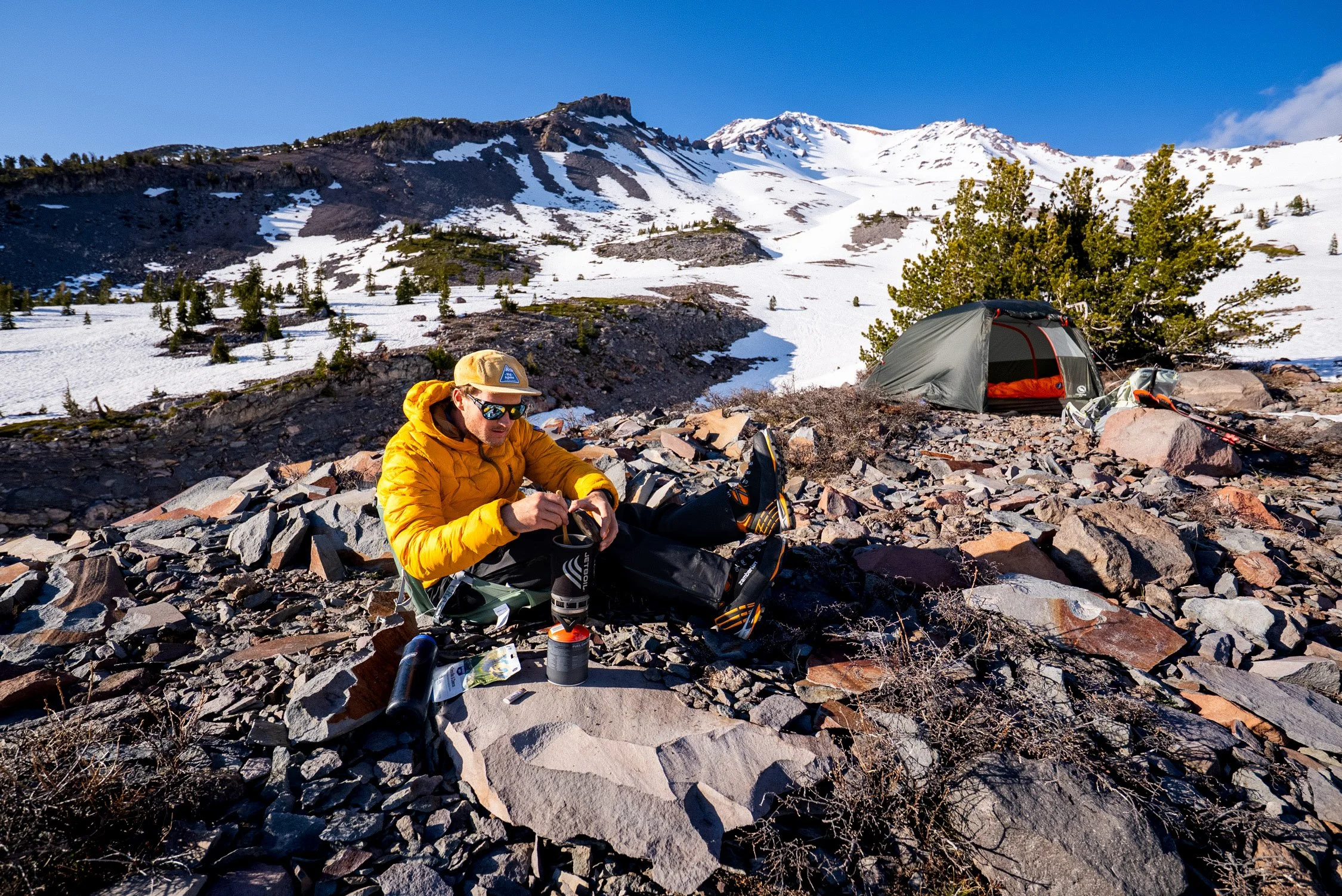
My plan going in was reasonable enough. Bring my skis to speed up the approach since someone told me the ski route cuts a more direct line than the hiking trail. What I did not do was actually follow the ski route. Instead I stayed on the hiking trail for over three miles with my skis strapped to my back, grinding uphill on foot when I should have been gliding. By the time I reached horse camp my legs were already spent and I had not even started the real climbing yet. I set up my tent, looked out at the stunning view of Mount Shasta rising above me, and then the reality hit. I still had a full load of gear sitting in the van.
My Favorite Items I Brought On This Trip:
2p Tent Copper Spur by Big Agnes; I’ve had this tent going on 5 years and still love it
Crazy Creek Camp Chair; easy and simple to use
Jetboil Flash; I’ve had mine for almost a decade and still works great
Sony a7r4; my work horse of a camera
Tamron 16-30; probably my favorite lens right now
Peak Design Tripod; a requirement for solo creatives
So I put my skis on and went back down. There was no other option. The tripod was down there. The camera kit was down there. The brand products I had come all this way to photograph were down there. All the things that actually made this a professional project instead of just a personal hike were sitting in the parking lot waiting for me. I skied back to the van, loaded everything up, and headed back up for round two. This time I knew exactly which route to take. The ski route was dramatically faster. Of course it was. If I had used it the first time I would have saved myself an enormous amount of suffering.
That second load was the hardest physical effort of the entire seven day trip. My legs had already put in a full day of work and now they were being asked to do it all over again with more weight. But somewhere in the middle of that second climb, something clicked. I stopped being frustrated about the situation and started being grateful for it. The double load, the wrong route, the extra miles, all of it was becoming content. It was becoming the honest behind the scenes story of what solo brand photography actually looks like when nobody is watching.
That is the lesson I took off that mountain. When you are a solo creator working on a professional project, logistics are not separate from the work. They are part of the work. The double load taught me to plan gear distribution more carefully on future projects. It taught me to scout the approach route before committing to it. And it reminded me that the unglamorous moments, the ones where you are sweating and frustrated and hauling gear up a mountain for the second time in one afternoon, are often the most valuable parts of the story you are trying to tell.
Plan better. Scout your route. And when you inevitably have to make two loads anyway, find a way to make that part of the story too.
Read More From My Lassen & Shasta Road Trip:
The Day’s Gallery






About the Author:
Dalton Johnson is a photographer, direcor, and writer (award-winning at all three) based in South Lake Tahoe, CA.
Over the last 10 years, Dalton’s creative work has taken him to every continent, above the arctic circle, and below the antarctic circle.